


By Robert Bruce
(Editor’s note: Small Arms Review takes special pride in telling the “story behind the story,” bringing our readers background information that won’t be found in ordinary gun magazines. In this case it’s the fascinating saga of the Kriss Super V Vector submachine gun and semiautomatic carbine, a pair of radically new weapons. These are genuinely innovative weapons created by a pair of European visionaries who have been indispensably aided by Americans skilled in business, engineering, manufacturing, and more. In next month’s issue of SAR we will have a report on the weapons themselves.)
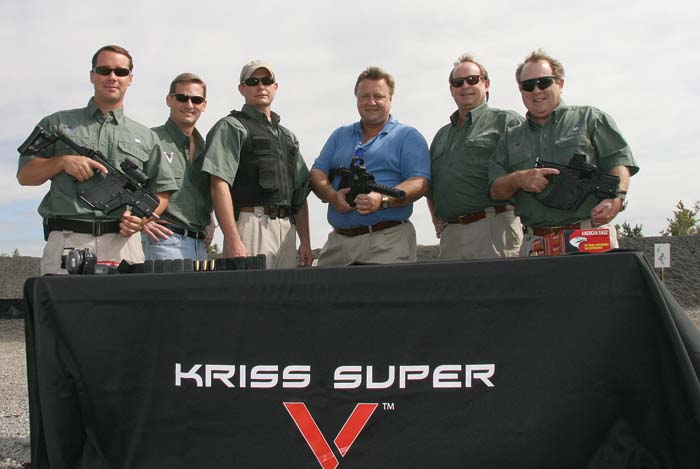
“Doing design development on this project while putting the infrastructure in place and building the company has sort of been like laying railroad track while the train is barreling down on you at 60 miles an hour.” Tim Lindsay, TDI VP for Programs and Engineering.
It is useful to note that America’s Army has recently begun fielding its new M26 shotgun. Despite being a decidedly simple single shot 12 gauge with manually operated straight pull operation, it still took ten years to get from concept to combat. Mostly because the “Big Green Machine” is serviced by a big gray bureaucracy.
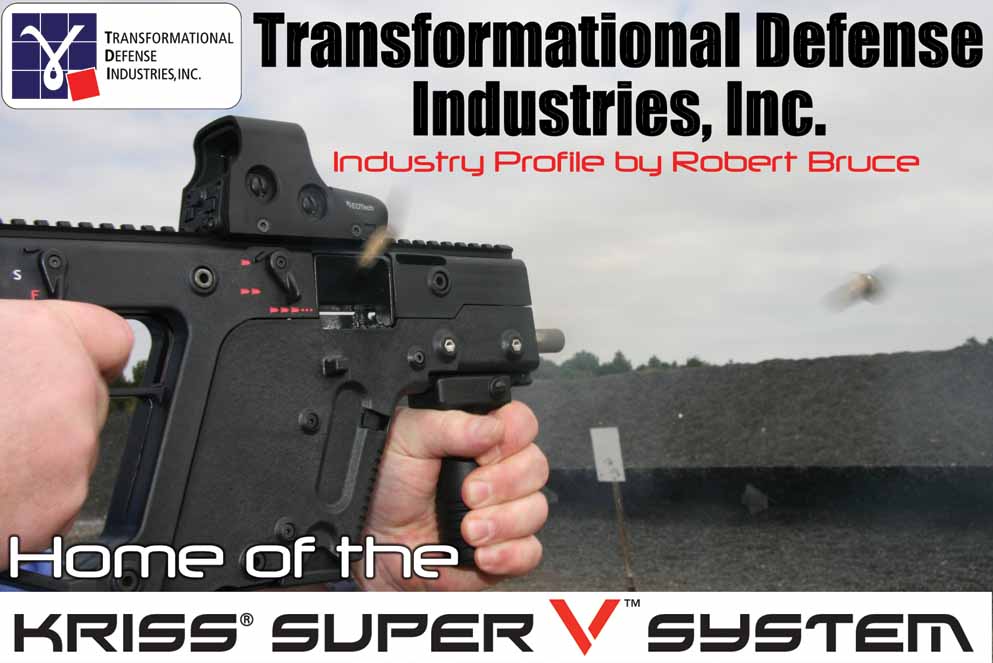
By way of contrast, TDI’s radically unusual KRISS submachine gun has made the trip from first patent application by inventor Renaud Kerbrat to mass production in six years.
Unimpressed? Same for us, until we considered the very necessary and practical steps that had to be taken behind the scenes in that six year lag. When you have something really, really new that shakes up the status quo, it is far more likely to achieve success when vested interests are players in the process.
The right ones can make or break public perception. Thus, the seal of approval from established and respected authorities is essential.
Kerbrat and his very savvy business partners apparently know this quite well. Gamma Group has fully sufficient resources to bankroll the project, so Transformational Defense Industries could have fast-tracked it to completion.
But the resulting weapon, like many before, was likely to be handicapped by the opinion that it was just another interesting novelty.
So it was necessary to get the Army involved.
(Editor’s Note: TDI points out that actual design to production time of the KRISS Super V Vector SMG and CRB/SO was a little over two years; starting from a “clean sheet” after engineering baseline studies in December 2005, to first sales in January 2008. The circumstances between patent and production are detailed in the following Developmental Timeline)
Developmental Timeline
What follows here is based primarily on an extensive interview and subsequent email exchanges with retired Army Colonel Timothy C. Lindsay, TDI’s Vice President for Programs and Engineering. Lindsay has been there nearly from the start and has been intimately involved in all aspects of the KRISS Super V system’s journey from patent drawings to production. SAR is grateful for his unique perspective and his help in getting the facts straight.
- September 11, 2001. In a well planned and carefully coordinated suicide mission, nineteen radical Islamic terrorists hijack four US commercial airliners. Two are crashed into the World Trade Center and a third hits the Pentagon. A handful of courageous passengers overcome their captors on the fourth plane but all aboard are killed when it plummets into a field in rural Pennsylvania. 3,000 die in the space of a few hours. Soon afterward, President George W. Bush declares a Global War on Terror (GWOT).
- Early 2002. International entrepreneur Jan Henrik Jebsen, deeply affected by the horrific terrorist attacks and determined to provide essential support to the GWOT, founds Gamma Applied Visions Group in Switzerland. Gamma AVG brings together several companies specializing in defense and security, anti-terrorism, communications, civil protection, and other disciplines. One of these is Gamma KDG, formed to develop innovative weaponry including designs envisioned by Renaud Kerbrat, formerly an armaments engineer for FN Herstal and reportedly an ex-field operative for France’s intelligence apparatus.
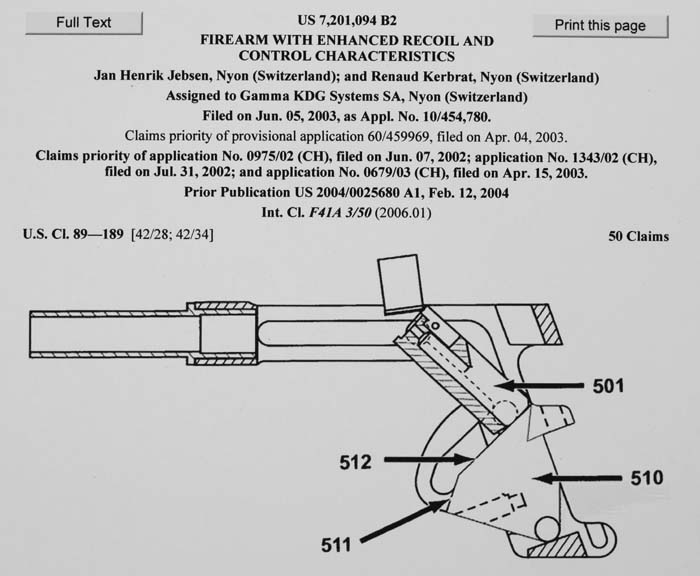
- June 2002. Jebsen begins a series of patent filings for Kerbrat’s radically new “Recoil Control Device,” applicable in various configurations to a wide variety of firearms from handguns to cannon. Kerbrat, perhaps invoking the mystical powers attributed to the fearsome, wavy bladed kris swords that originated in 13th century Indonesia, bestows the exotic name KRISS to his unique system. It will eventually receive international and US patents, clearing the way for commercial development.
- November 2002. Jebsen travels to the US to promote Gamma’s diverse offerings – notably including Kerbrat’s KRISS weapons – to industry, government, military and law enforcement. In a chance meeting in Washington, DC, Jebsen encounters Timothy C. Lindsay of the consulting firm Whitney, Bradley and Brown (WBB). It’s Jebsen’s good luck that Lindsay is a retired Army Colonel with years of experience at the US Army’s Armaments Research, Development and Engineering Center (ARDEC).
- January 2003. Jebsen hires WBB for its expertise in the US Department of Defense’s notoriously complex acquisition structure. Lindsay proves central to this effort.
- March 2003. Gamma AVG forms the US firm Transformational Defense Industries (TDI), headquartered in Washington, DC. Its name is based on Jebsen’s determination to “transform” traditionally slow bureaucratic processes so that the newest and most effective weaponry can be put into the hands of troops much more quickly. TDI’s first employee is Andrew Finn, a former Marine Corps officer who went on to distinguish himself in the financial world. Finn, Senior Vice President for Business Development, collaborates with Lindsay in a successful effort to obtain government funding for further development of one of Kerbrat’s weapon designs.
- September 2004. Francis J. Dougherty, a 28 year veteran US Navy officer and defense industry executive, takes the helm as TDI’s President and Chief Executive Officer.
- July to August 2004. TDI is awarded $250,000 under a sole-source contract from ARDEC’s Joint Service Small Arms Program (JSSAP) for a Technology Feasibility Study of the Super V recoil technology at Picatinny Arsenal, New Jersey. Lindsay heads up this effort, as Project Manager for TDI, hiring former ARDEC engineers Curtis Johnson and Michael Clune to support the effort. Through a Cooperative Research and Development Agreement (CRADA) at the Small Arms Division of the Weapons Technology Branch at Picatinny, they collaborate with ARDEC’s Mike Daniti, Team Leader, and Steve Liss. ARDEC engineers, notably Adam Jacob and Eric Binter, are also key to the project that soon includes Jim Ronkainen of Remington R&D facility in Elizabeth Town, KY. Their work begins with analysis of a firing prototype machine pistol fabricated in Switzerland by Kerbrat and assistant Antoine Robert. The decision at Gamma to chamber the weapon in powerful and hard-hitting .45 ACP provides a baseline performance standard that can be readily appreciated by all knowledgeable observers. Reminiscent of a science fiction ray gun, it is designated by Kerbrat as the “MK5 NRA” (National Rifle Assn.). The prototype is reverse-engineered at ARDEC using highly sophisticated computer aided design and engineering tools. The resulting “virtual prototype” is minutely analyzed in form and function. Computer aided dynamic and finite element analysis demonstrates the dramatic reduction in felt recoil and muzzle climb. This analysis is confirmed in instrumented testing of the KRISS Super V prototype and compared with other common pistol caliber weapons.
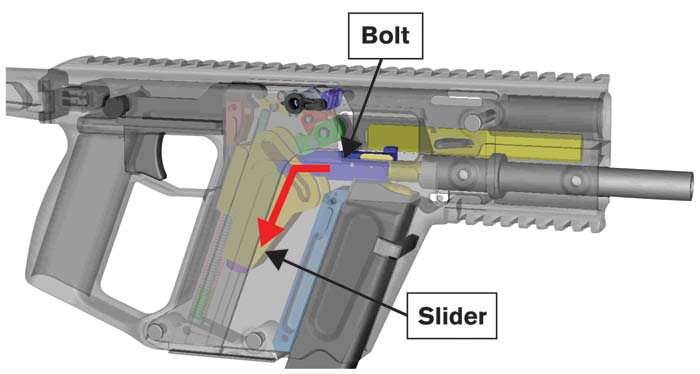
- August 2004 to June 2005. Kerbrat’s design is validated in data resulting from the work at Picatinny and small refinements are incorporated in fabrication of an optimized firing prototype machine pistol. This is built by TDI and – not to be confused with the one Kerbrat built – is also designated as Mk5 NRA. Subsequent test firings at Picatinny in carefully instrumented fixtures prove the mechanism’s unique properties in dramatically reducing felt recoil and muzzle climb in comparison to several representative firearms in its class.
- November 2004. Military trade magazine Armed Forces Journal ignites curiosity in the international gun community with an exclusive live fire feature in its December issue on TDI’s never-before-seen “Kriss Gun.” Fabricated for TDI by Remington R&D, it is nearly identical to the one Kerbrat built for ARDEC’s initial study and is capable of spraying .45 ACP cartridges at an astonishing rate of 20 rounds per second. Noting sporadic feed problems and citing cautions from some canny military observers on site, AFJ prudently takes a wait-and-see attitude in anticipation of further development.
- December 2004. Convinced of the technological validity and commercial potential for Kerbrat’s machine pistol and related designs, Lindsay accepts the position of Vice President for Programs and Engineering, joining TDI full-time in February 2005.
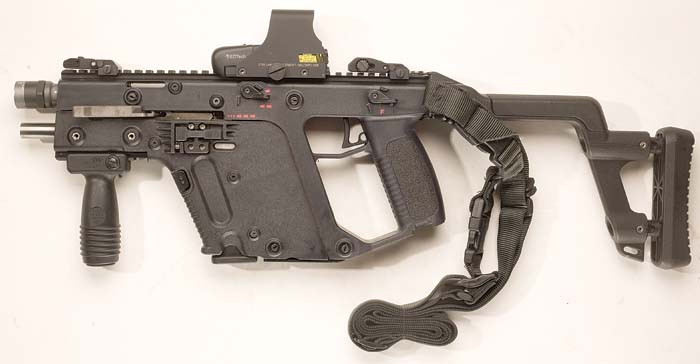
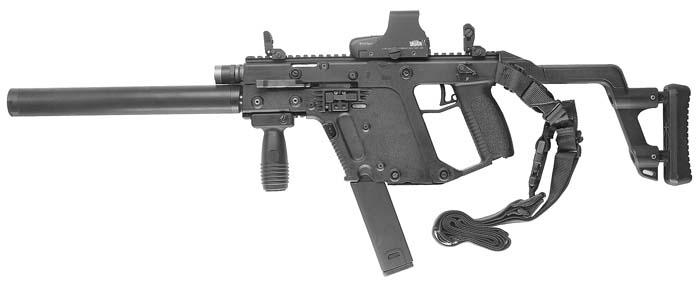
- June 2005 to May 2006. Encouraged by the positive outcome of the testing at ARDEC, Jebsen’s Gamma Group provides funding for what TDI calls Phase 2. Lessons learned at Picatinny, as well as ongoing research and development at TDI’s first facility in Virginia Beach, VA, are combined in a distinctively configured new submachine gun version with a detachable vertical foregrip and folding stock.
- September 2005. Established and funded by its namesake, the Jebsen Center for Counter-Terrorism Studies is formally opened at Tufts University. The center is a “think tank,” providing wide spectrum research on evolving terrorist threats as well as recommendations on means of dealing with them.
- December 2005 to May 2006. Following Computer Assisted Design and Engineering (CAD/CAE), as well as Design of Experiments (DOE) studies to determine and confirm the critical design parameters of a “demonstration and proof-of concept platform,” the team begins work to conceptualize and then develop a detailed design. Starting with a “clean sheet” – moving beyond conventional thinking – they are guided by a set of operational “requirements” and their engineering results. This is largely the result of a collaborative effort between the TDI/Viking Works design team, ARDEC (through the existing CRADA), Applied Marine Technology, Inc. (AMTI), and MagPul Industries. TDI fabricates the serial number 1 Technology Readiness Level 6 (TRL6) weapon, which they call the TRL6 KRISS XSMG. MagPul is lead designer of the outer polymer housings and folding stock which are prototyped at this stage of development using 3D selective laser sintering (SLS) process. The heart of the gun is a further refined version of Kerbrat’s original re-vectored sliding mass operating system, now operating in a much more shooter-friendly housing with critical design parameters in the operating action and receiver reworked for reliability, rate of fire and human factors. By slightly varying the angle of the slider’s camming channel, its rate of fire has been reduced to a more efficient 1,000 rpm. Detailed design is completed in March 2006 and fabrication of the SN#1 prototype begins. This takes about one month.
- February 2006. Mr. Quan Le joins the TDI team as Director, Engineering Viking Works, and immediately takes on the role of Project Lead for the TDI KRISS project. TDI begins to hire additional staff to support weapons development efforts.
- 9 May 2006. The new KRISS XSMG fires its first rounds at TDI’s Viking Works Design and Development center in Virginia Beach, VA. By the end of July 2006, field and marketing demonstrations and evaluation have begun using SN#1 and, soon thereafter SN#2, TRL6 KRISS XSMG prototypes.
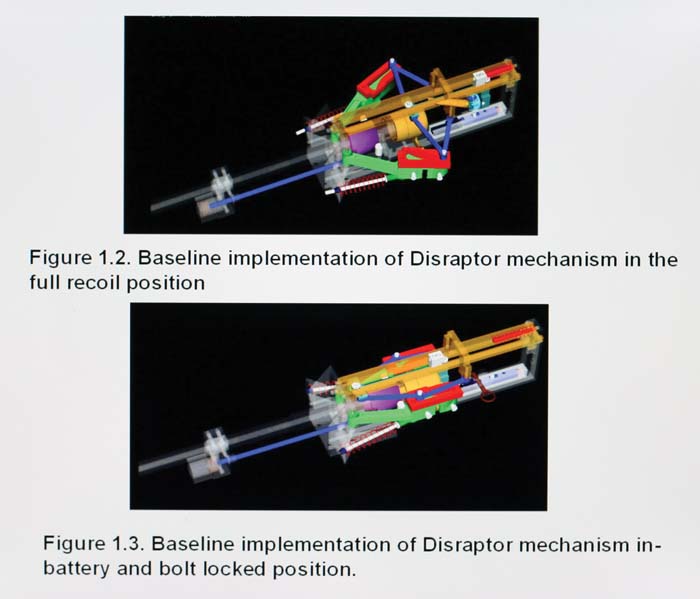
- October 2006 to December 2007. The Super V system takes another giant stride when TDI wins a $617,000 competitive contract from JSSAP for a study of Kerbrat’s concept for a lightweight .50 BMG caliber machine gun. No doubt drawing on his extensive experience at FN Herstal on development of the 15mm BRG-15 machine gun and other projects, Kerbrat builds and delivers a working prototype to Viking Works. It is called the “Disraptor,” a play on words describing Gamma’s intention to disrupt the status quo with a light, simple, powerful, and fast firing gun that has the fearsome characteristics of the raptor family of predatory birds. Live fire experimentation and computer modeling guide the design’s subsequent development, carried out at Viking Works and Picatinny. With minor modifications, notably the addition of a special hydraulic buffer system from Enidine, the mechanism proves markedly superior to a standard M2HB in the program’s two critical objectives: 40% less weight and half the recoil impulse of the M2HB (95% reduction compared to theoretical maximum). Again, ARDEC engineers via the CRADA and consultant Curtis Johnson provide significant support to this effort.
- June 2005 to December 2006. Former US military special operators at AMTI help with maximizing real world combat utility. Informal advice from some of the many Virginia Beach area Naval Special Warfare personnel – notably including SEAL operators – also proves very helpful.
- February 2007. Boldly asserting Kerbrat’s Super V to be “The most significant advance in weapons operating systems in more than 120 years,” TDI’s TRL6 KRISS XSMG grabs instant attention when it is unveiled at the prestigious Shooting Hunting Outdoor Trades (SHOT) show in Orlando, Florida. A well-coordinated publicity campaign, conceived and carried out by Brotman, Winter, Fried Communications (BWFC), has long preceded the event, elevating interest from the gun press. Notable among these is the February issue of National Rifle Association’s prestigious American Rifleman magazine. Live fire opportunities and other special accommodations for the notoriously skeptical news media and occasionally skeptical gun press pay off in creating a growing buzz among law enforcement, military and civilian shooting enthusiasts. The XSMG stars in several nationally-distributed television programs including an installment of the Discovery Channel’s “Future Weapons” series that originally aired on 19 March 2007, and has since become a hit on YouTube.
- March 2007. TDI completes design and development of the TRL7 KRISS XSMG and begins prototyping, developmental testing and accelerated producibility studies for producing the XSMG. TDI also moves into its new Viking Works “art to part” Design and Development facility on 16 March 2007.
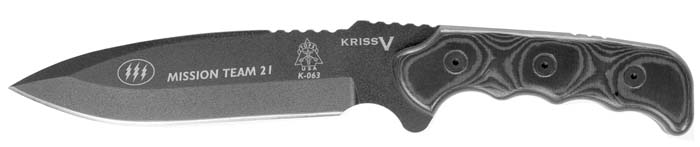
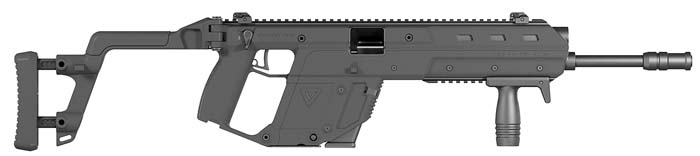
- August 2007 to October 2007. TDI modifies the XSMG to create a semi-automatic carbine with 16 inch barrel, designated the KRISS Super V Vector CRB/SO (for Carbine/Special Ops), for sale to the civilian market. The CRB/SO has ~95% parts compatibility with XSMG.
- October 2007. Charles J. Kushell IV, bringing 30 years of international experience in top level marketing and management, is named as TDI’s Acting Chief Executive Officer and Director. Mr. Kushell’s involvement as a Director of TDI dates to 2005.
- October 2007 to February 2008. Nine TRL 7 XSMGs, built at Viking Works, are delivered to the Army’s Aberdeen Test Center (ATC) for a full range of testing under an extension of TDI’s CRADA with ARDEC. Strict Test Operating Procedures (TOP), specified for this class of US Military small arms, are applied to the guns. Among these are function firing in extreme heat and cold, sand and mud, prolonged exposure to salt fog, rain, freezing rain, unlubricated test, accuracy/dispersion, noise, drop tests, safety tests, and endurance firing. Results of these are tabulated in formal documentation from ATC and the XSMG documentation for the Army’s essential man-rated “safety release” is prepared for approval. All of this demonstrates the weapon’s state of development at TRL7 and will clear the way for US Armed Forces personnel to participate in future live fire evaluations.
- March 2007 to February 2008. Further mechanical, operational and manufacturability refinements of the XSMG, as well as development of a semiautomatic carbine, are carried out at Viking Works. TDI continues its collaboration with MagPul Industries on customized flip-up sights and a sturdy and reliable magazine extension that boosts capacity to 30 rounds. Additional input from numerous hands-on live fire evaluations, notably including a range session for personnel of US Special Operations Command, is used to fine tune location and function of shooter interface components and controls. Meanwhile, TDI explores alternatives for production of the new subguns and carbines, eventually deciding to contract out parts production, then assemble, inspect, test, and ship at Viking Works.
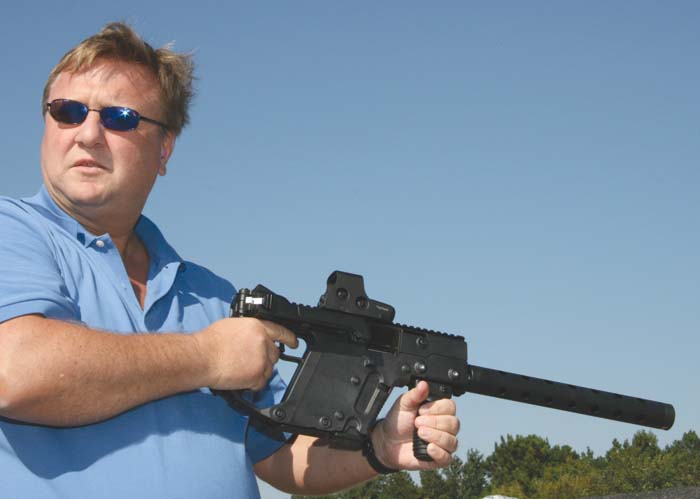
- November 2007. These efforts, incorporating more than 50 design changes that enhance firing performance and manufacturing efficiency, result in standardization of the KRISS Super-V Vector .45 ACP SMG and initial low-rate production begins. This is soon followed by the KRISS Super-V Vector CRB/SO .45 ACP, a Bureau of Alcohol, Tobacco, Firearms and Explosives (BATFE) approved semiautomatic carbine. Closely resembling the subgun except for a 16 inch barrel and modified fire control system that precludes full auto conversion, the distinctive CRB/SO has particular appeal to tactical weapons enthusiasts for combat shooting competition and home defense.
- 11 October 2007. BWFC and TDI host an invitation-only live fire demonstration and hands-on evaluation for prominent representatives of the news media and gun/military/law enforcement press at Blackwater USA. The program includes briefings and Q&A with top company officials as well as a dramatic tactical scenario and the opportunity to test fire the newest version Vector subguns and carbines. Jebsen arrives from Switzerland to see for himself, likely noting that his considerable investment is being well received by the many influential attendees. Additional positive reporting is generated over the next several months.
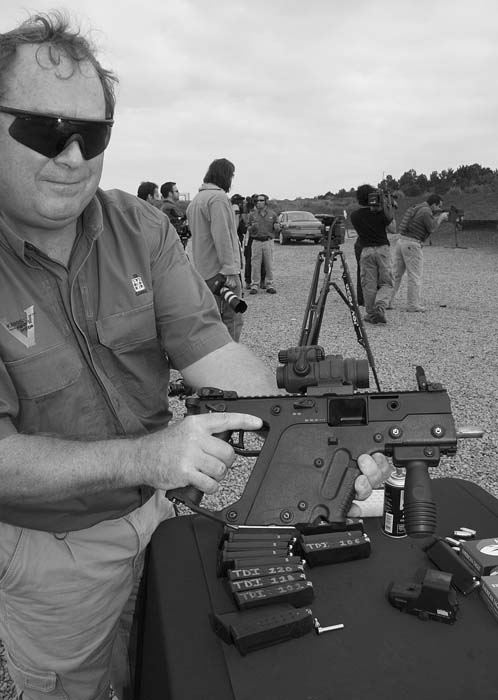
- January 2008. TDI announces an exclusive agreement with industry giant AcuSport as sole distributor for the KRISS Super-V family of semiautomatic firearms and accessories to the US civilian market. Marketing and sales of the submachine gun version, heavily regulated by federal, state and local laws, remain under direct control of TDI.
- 1 February 2008. The now-standardized production model KRISS Super-V Vector submachine gun and carbine receive their public debut at the S.H.O.T. show in Las Vegas, Nevada. Long-tantalizing possibilities are now reality, fueling a million dollars in pre-delivery orders.
- March/April 2008. Under supervision of Finn, Kushell, and retired Marine non-commissioned officer Tom Maffin, Manager of Training and Demonstrations, TDI begins a series of training programs for AcuSports’ exclusive dealer network. Specific outlets for the line of semiautomatic KRISS weapons and accessories have been hand selected for their combination of a storefront operation with substantial sales in law enforcement and tactical items, plus an indoor range for live fire demonstration and user evaluation.
- April 2008. TDI’s Viking Works facility ships the first batch of KRISS Super V Vector CRB/SO carbines. Production will hit its stride at 200 guns per month in April/May 2008 as plans are finalized to triple this figure in the coming months.
Coming Attractions
TDI points proudly to the rapid prototyping capabilities at Viking Works where lead engineer Mr. Quan Le and more than a dozen designers, machinists and support personnel make it possible to go from “art to part” in short order.
This exemplifies Gamma’s transformational concept, Lindsay told us. “One of our primary themes in R&D is to do things smart and fast, to ‘turn the crank’ to iterate quickly,” he said. “We realized early on that we needed to have some core capabilities; not only in people, but also in software and machine tools that would allow us to go from a white board drawing to a Pro/Engineer design, to a Master Cam Toolpath, to cutting the part. In some cases within minutes or hours.”
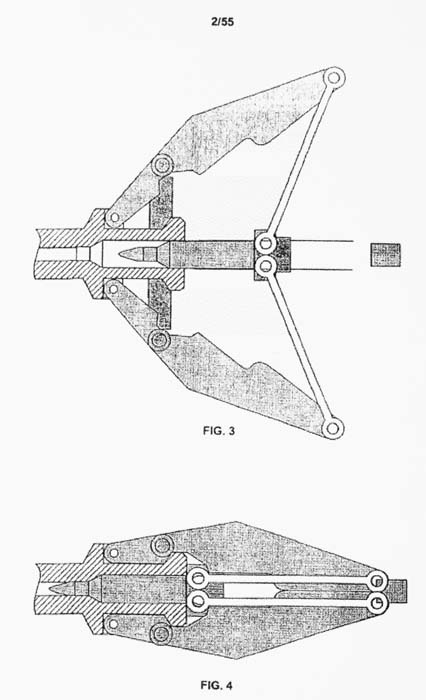
And the Virginia Beach facility will soon double in size to 8,000 square feet, essential room for TDI’s rapidly growing manufacturing operations as production of both subguns and carbines ramps up to triple the current capacity of 200 guns per month.
While there are legions of advocates for the proven combat utility of the .45 ACP round, proponents of other hot pistol loads such as .357 SIG and .40 S&W may take heart. TDI says they’re well prepared to accommodate your preference as long as production numbers make it economically viable. Additionally, they’re closely watching for indications that the US military’s perennially pursued but never reached replacement of the current M9 pistol might be revived once again. Tailoring Kerbrat’s clever Super V sliding lock for various calibers and loadings is easily done – whether for a pistol, a personal defense weapon, or the tenuously described “Compact Weapon” of late.
Rifle caliber versions are also under active consideration. Kerbrat’s original Recoil Device patent application includes detailed drawings and descriptions of a Super V selective fire battle rifle in 7.62mm. TDI is monitoring his recent design work in various calibers and also conducting its own experimentation at Viking Works.
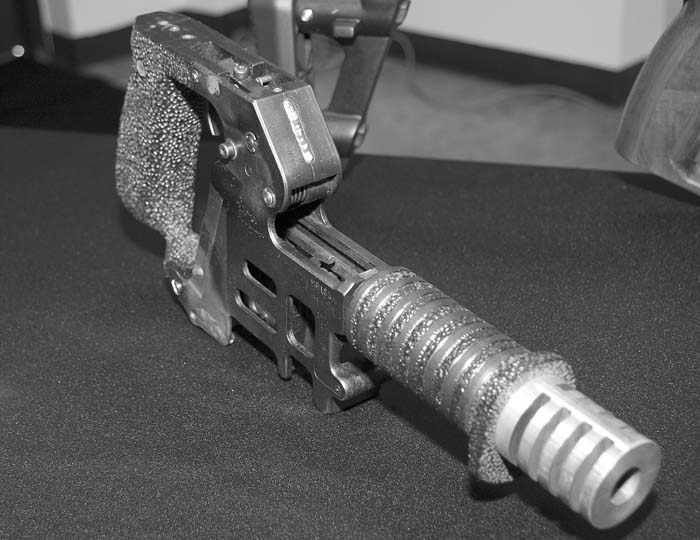
Wisely noting the marked preference among civilians for military style weaponry, TDI hired California based Innovative Design Group to supercharge the CRB/SO with a “Black Rifle” type profile. Among several candidates offered, the lean and mean A2-b proved most compelling, placing the Vector mechanism in an assault rifle type housing with plenty of Picatinny Rail for accessories, as well as a skeletonized buttstock.
Pre-production work is well underway and this “50 State Legal” modular design may be customized to customer preference or to comply with local restrictions, most notoriously those of California.
Kerbrat’s concept for a semiautomatic 12 gauge shotgun has been explored at TDI. While it showed great promise, a parallel design by Viking Works engineers has proven more practical to maintain the traditional lines, balance and handling that experienced shooters demand. The KRISS MVS 12, providing dramatically reduced recoil and muzzle climb in a featherweight 5.5 pound package, is expected to hit the market in late 2009, subject to time and money available for development. Computer aided design modeling and analysis completed by TDI has already demonstrated the physics of reducing felt recoil by more than 40% in this lightweight gun while not sacrificing the classic shotgun aesthetic – even before considering contributions of semi-auto cycling action or traditional buffer or compensation techniques.
Lightweight “heavy machine guns” are of intense interest throughout the US Armed Forces in mounted applications for land, sea and air combat, with particular emphasis on the rapidly growing field of robotic platforms. Following its evaluation of engineering and test data from initial examination of the .50 caliber Disraptor, ARDEC has indicated a readiness to continue development in Phase 2 as funding permits. Additionally, ARDEC has requested proposals from TDI for a .50 caliber sniper rifle and a medium caliber machine gun, all utilizing Kerbrat’s Super V system.
In exciting news to proponents of robot-warriors, TDI is collaborating with a large defense contractor in integrating a KRISS Super V .45 ACP system onto a very lightweight (less than 40 lbs) unmanned ground vehicle for close quarters battle in urban operations.
Gamma also holds US and international patents for an adaptation of plasma torch technology to more efficiently fire mortars and cannon. This is potentially a great improvement over conventional percussion primers that sometimes fail, creating the extremely dangerous potential for a “hangfire” when the dud round detonates during the process of removal from the breech. This pulsed plasma jet firing mechanism has been built and tested at Gamma’s Nyon R&D facilities, proving the concept as workable and practical.
Bottom Line
It cannot be over-emphasized that Kerbrat’s internationally patented “Recoil Control Device” is applicable in various configurations to most any type of cartridge weapon from handgun to howitzer. Offered by TDI for licensing under the trademarked name KRISS Super V, the family of weapons is on track to expand beyond the current subgun, carbine and shotgun.
While mystical powers of the kris sword may not be measurable, dramatic reductions in recoil, muzzle rise and weapon weight are. Stay tuned.
Find Out More
Transformational Defense Industries, Inc. has a particularly information-rich website with hot links to technical information, press coverage, test videos, and more at www.kriss-tdi.com.
AcuSport Corp. www.acusport.com.
YouTube videos of KRISS XSMG (the Discovery Channel’s “Future Weapons” segment is also linked on TDI website) at www.youtube.com search “KRISS”
| This article first appeared in Small Arms Review V12N4 (January 2009) |