


Small Arms Review
  • Home
  • Articles
    • Guns & Parts
    • Suppressors
    • Optics & Thermals
    • Ammunition
    • Gear
    • News & Opinion
    • Columns
    • Museums & Factory Tours
    • ID Guides
    • Interviews
    • Event Coverage
    • Articles by Issue
      • Volume 1
        • V1N1 (Oct 1997)
        • V1N2 (Nov 1997)
        • V1N3 (Dec 1997)
        • V1N4 (Jan 1998)
        • V1N5 (Feb 1998)
        • V1N6 (Mar 1998)
        • V1N7 (Apr 1998)
        • V1N8 (May 1998)
        • V1N9 (Jun 1998)
        • V1N10 (Jul 1998)
        • V1N11 (Aug 1998)
        • V1N12 (Sep 1998)
      • Volume 2
        • V2N1 (Oct 1998)
        • V2N2 (Nov 1998)
        • V2N3 (Dec 1998)
        • V2N4 (Jan 1999)
        • V2N5 (Feb 1999)
        • V2N6 (Mar 1999)
        • V2N7 (Apr 1999)
        • V2N8 (May 1999)
        • V2N9 (Jun 1999)
        • V2N10 (Jul 1999)
        • V2N11 (Aug 1999)
        • V2N12 (Sep 1999)
      • Volume 3
        • V3N1 (Oct 1999)
        • V3N2 (Nov 1999)
        • V3N3 (Dec 1999)
        • V3N4 (Jan 2000)
        • V3N5 (Feb 2000)
        • V3N6 (Mar 2000)
        • V3N7 (Apr 2000)
        • V3N8 (May 2000)
        • V3N9 (Jun 2000)
        • V3N10 (Jul 2000)
        • V3N11 (Aug 2000)
        • V3N12 (Sep 2000)
      • Volume 4
        • V4N1 (Oct 2000)
        • V4N2 (Nov 2000)
        • V4N3 (Dec 2000)
        • V4N4 (Jan 2001)
        • V4N5 (Feb 2001)
        • V4N6 (Mar 2001)
        • V4N7 (Apr 2001)
        • V4N8 (May 2001)
        • V4N9 (Jun 2001)
        • V4N10 (Jul 2001)
        • V4N11 (Aug 2001)
        • V4N12 (Sep 2001)
      • Volume 5
        • V5N1 (Oct 2001)
        • V5N2 (Nov 2001)
        • V5N3 (Dec 2001)
        • V5N4 (Jan 2002)
        • V5N5 (Feb 2002)
        • V5N6 (Mar 2002)
        • V5N7 (Apr 2002)
        • V5N8 (May 2002)
        • V5N9 (Jun 2002)
        • V5N10 (Jul 2002)
        • V5N11 (Aug 2002)
        • V5N12 (Sep 2002)
      • Volume 6
        • V6N1 (Oct 2002)
        • V6N2 (Nov 2002)
        • V6N3 (Dec 2002)
        • V6N4 (Jan 2003)
        • V6N5 (Feb 2003)
        • V6N6 (Mar 2003)
        • V6N7 (Apr 2003)
        • V6N8 (May 2003)
        • V6N9 (Jun 2003)
        • V6N10 (Jul 2003)
        • V6N11 (Aug 2003)
        • V6N12 (Sep 2003)
      • Volume 7
        • V7N1 (Oct 2003)
        • V7N2 (Nov 2003)
        • V7N3 (Dec 2003)
        • V7N4 (Jan 2004)
        • V7N5 (Feb 2004)
        • V7N6 (Mar 2004)
        • V7N7 (Apr 2004)
        • V7N8 (May 2004)
        • V7N9 (Jun 2004)
        • V7N10 (Jul 2004)
        • V7N11 (Aug 2004)
        • V7N12 (Sep 2004)
      • Volume 8
        • V8N1 (Oct 2004)
        • V8N2 (Nov 2004)
        • V8N3 (Dec 2004)
        • V8N4 (Jan 2005)
        • V8N5 (Feb 2005)
        • V8N6 (Mar 2005)
        • V8N7 (Apr 2005)
        • V8N8 (May 2005)
        • V8N9 (Jun 2005)
        • V8N10 (Jul 2005)
        • V8N11 (Aug 2005)
        • V8N12 (Sep 2005)
      • Volume 9
        • V9N1 (Oct 2005)
        • V9N2 (Nov 2005)
        • V9N3 (Dec 2005)
        • V9N4 (Jan 2006)
        • V9N5 (Feb 2006)
        • V9N6 (Mar 2006)
        • V9N7 (Apr 2006)
        • V9N8 (May 2006)
        • V9N9 (Jun 2006)
        • V9N10 (Jul 2006)
        • V9N11 (Aug 2006)
        • V9N12 (Sep 2006)
      • Volume 10
        • V10N1 (Oct 2006)
        • V10N2 (Nov 2006)
        • V10N3 (Dec 2006)
        • V10N4 (Jan 2007)
        • V10N5 (Feb 2007)
        • V10N6 (Mar 2007)
        • V10N7 (Apr 2007)
        • V10N8 (May 2007)
        • V10N9 (Jun 2007)
        • V10N10 (Jul 2007)
        • V10N11 (Aug 2007)
        • V10N12 (Sep 2007)
      • Volume 11
        • V11N1 (Oct 2007)
        • V11N2 (Nov 2007)
        • V11N3 (Dec 2007)
        • V11N4 (Jan 2008)
        • V11N5 (Feb 2008)
        • V11N6 (Mar 2008)
        • V11N7 (Apr 2008)
        • V11N8 (May 2008)
        • V11N9 (Jun 2008)
        • V11N10 (Jul 2008)
        • V11N11 (Aug 2008)
        • V11N12 (Sep 2008)
      • Volume 12
        • V12N1 (Oct 2008)
        • V12N2 (Nov 2008)
        • V12N3 (Dec 2008)
        • V12N4 (Jan 2009)
        • V12N5 (Feb 2009)
        • V12N6 (Mar 2009)
        • V12N7 (Apr 2009)
        • V12N8 (May 2009)
        • V12N9 (Jun 2009)
        • V12N10 (Jul 2009)
        • V12N11 (Aug 2009)
        • V12N12 (Sep 2009)
      • Volume 13
        • V13N1 (Oct 2009)
        • V13N2 (Nov 2009)
        • V13N3 (Dec 2009)
        • V13N4 (Jan 2010)
        • V13N5 (Feb 2010)
        • V13N6 (Mar 2010)
        • V13N7 (Apr 2010)
        • V13N8 (May 2010)
        • V13N9 (Jun 2010)
        • V13N10 (Jul 2010)
        • V13N11 (Aug 2010)
        • V13N12 (Sep 2010)
      • Volume 14
        • V14N1 (Oct 2010)
        • V14N2 (Nov 2010)
        • V14N3 (Dec 2010)
          • Ammunition
        • V14N4 (Jan 2011)
        • V14N5 (Feb 2011)
        • V14N6 (Mar 2011)
        • V14N7 (Apr 2011)
        • V14N8 (May 2011)
        • V14N9 (Jun 2011)
        • V14N10 (Jul 2011)
        • V14N11 (Aug 2011)
        • V14N12 (Sep 2011)
      • Volume 15
        • V15N1 (Oct 2011)
        • V15N2 (Nov 2011)
        • V15N4 (Jan 2012)
        • V15N5 (Feb 2012)
      • Volume 16
        • V16N1 (1st Quarter 2012)
        • V16N2 (2nd Quarter 2012)
        • V16N3 (3rd Quarter 2012)
        • V16N4 (4th Quarter 2012)
      • Volume 17
        • V17N1 (1st Quarter 2013)
        • V17N2 (2nd Quarter 2013)
        • V17N3 (3rd Quarter 2013)
        • V17N4 (4th Quarter 2013)
      • Volume 18
        • V18N1 (Jan Feb 2014)
        • V18N2 (Mar Apr 2014)
        • V18N3 (May Jun 2014)
        • V18N4 (Jul Aug 2014)
        • V18N5 (Sep Oct 2014)
        • V18N6 (Nov Dec 2014)
      • Volume 19
        • V19N1 (Jan 2015)
        • V19N2 (Feb Mar 2015)
        • V19N3 (Apr 2015)
        • V19N4 (May 2015)
        • V19N5 (Jun 2015)
        • V19N6 (Jul 2015)
        • V19N7 (Aug Sep 2015)
        • V19N8 (Oct 2015)
        • V19N9 (Nov 2015)
        • V19N10 (Dec 2015)
      • Volume 20
        • V20N1 (Jan 2016)
        • V20N2 (Feb Mar 2016)
        • V20N3 (Apr 2016)
        • V20N4 (May 2016)
        • V20N5 (Jun 2016)
        • V20N6 (Jul 2016)
        • V20N7 (Aug Sep 2016)
        • V20N8 (Oct 2016)
        • V20N9 (Nov 2016)
        • V20N10 (Dec 2016)
      • Volume 21
        • V21N1 (Jan 2017)
        • V21N2 (Feb Mar 2017)
        • V21N3 (Apr 2017)
        • V21N4 (May 2017)
        • V21N5 (Jun 2017)
        • V21N6 (Jul 2017)
        • V21N7 (Aug Sep 2017)
        • V21N8 (Oct 2017)
        • V21N9 (Nov 2017)
        • V21N10 (Dec 2017)
      • Volume 22
        • V22N1 (Jan 2018)
        • V22N2 (Feb 2018)
        • V22N3 (March 2018)
        • V22N4 (Apr 2018)
        • V22N5 (May 2018)
        • V22N6 (Jun Jul 2018)
        • V22N7 (Aug Sep 2018)
        • V22N8 (Oct 2018)
        • V22N9 (Nov 2018)
        • V22N10 (Dec 2018)
      • Volume 23
        • V23N1 (Jan 2019)
        • V23N2 (Feb 2019)
        • V23N3 (Mar 2019)
        • V23N4 (Apr 2019)
        • V23N5 (May 2019)
        • V23N6 (Jun Jul 2019)
        • V23N7 (Aug Sep 2019)
        • V23N8 (Oct 2019)
        • V23N9 (Nov 2019)
        • V23N10 (Dec 2019)
      • Volume 24
        • V24N1 (Jan 2020)
        • V24N2 (Feb 2020)
        • V24N3 (Mar 2020)
        • V24N4 (Apr 2020)
        • V24N5 (May 2020)
        • V24N6 (Jun Jul 2020)
        • V24N7 (Aug Sep 2020)
        • V24N8 (Oct 2020)
        • V24N9 (Nov 2020)
        • V24N10 (Dec 2020)
  • The Archive
    • Search The Archive
  • Store
    • Books
    • Back Issues
    • Merchandise
  • Events
  • About
    • About Small Arms Review
    • About Chipotle Publishing
    • Contact Us
    • Other Publications
      • Small Arms Defense Journal
  • Home
  • Articles
    • Guns & Parts
    • Suppressors
    • Optics & Thermals
    • Ammunition
    • Gear
    • News & Opinion
    • Columns
    • Museums & Factory Tours
    • ID Guides
    • Interviews
    • Event Coverage
    • Articles by Issue
      • Volume 1
        • V1N1 (Oct 1997)
        • V1N2 (Nov 1997)
        • V1N3 (Dec 1997)
        • V1N4 (Jan 1998)
        • V1N5 (Feb 1998)
        • V1N6 (Mar 1998)
        • V1N7 (Apr 1998)
        • V1N8 (May 1998)
        • V1N9 (Jun 1998)
        • V1N10 (Jul 1998)
        • V1N11 (Aug 1998)
        • V1N12 (Sep 1998)
      • Volume 2
        • V2N1 (Oct 1998)
        • V2N2 (Nov 1998)
        • V2N3 (Dec 1998)
        • V2N4 (Jan 1999)
        • V2N5 (Feb 1999)
        • V2N6 (Mar 1999)
        • V2N7 (Apr 1999)
        • V2N8 (May 1999)
        • V2N9 (Jun 1999)
        • V2N10 (Jul 1999)
        • V2N11 (Aug 1999)
        • V2N12 (Sep 1999)
      • Volume 3
        • V3N1 (Oct 1999)
        • V3N2 (Nov 1999)
        • V3N3 (Dec 1999)
        • V3N4 (Jan 2000)
        • V3N5 (Feb 2000)
        • V3N6 (Mar 2000)
        • V3N7 (Apr 2000)
        • V3N8 (May 2000)
        • V3N9 (Jun 2000)
        • V3N10 (Jul 2000)
        • V3N11 (Aug 2000)
        • V3N12 (Sep 2000)
      • Volume 4
        • V4N1 (Oct 2000)
        • V4N2 (Nov 2000)
        • V4N3 (Dec 2000)
        • V4N4 (Jan 2001)
        • V4N5 (Feb 2001)
        • V4N6 (Mar 2001)
        • V4N7 (Apr 2001)
        • V4N8 (May 2001)
        • V4N9 (Jun 2001)
        • V4N10 (Jul 2001)
        • V4N11 (Aug 2001)
        • V4N12 (Sep 2001)
      • Volume 5
        • V5N1 (Oct 2001)
        • V5N2 (Nov 2001)
        • V5N3 (Dec 2001)
        • V5N4 (Jan 2002)
        • V5N5 (Feb 2002)
        • V5N6 (Mar 2002)
        • V5N7 (Apr 2002)
        • V5N8 (May 2002)
        • V5N9 (Jun 2002)
        • V5N10 (Jul 2002)
        • V5N11 (Aug 2002)
        • V5N12 (Sep 2002)
      • Volume 6
        • V6N1 (Oct 2002)
        • V6N2 (Nov 2002)
        • V6N3 (Dec 2002)
        • V6N4 (Jan 2003)
        • V6N5 (Feb 2003)
        • V6N6 (Mar 2003)
        • V6N7 (Apr 2003)
        • V6N8 (May 2003)
        • V6N9 (Jun 2003)
        • V6N10 (Jul 2003)
        • V6N11 (Aug 2003)
        • V6N12 (Sep 2003)
      • Volume 7
        • V7N1 (Oct 2003)
        • V7N2 (Nov 2003)
        • V7N3 (Dec 2003)
        • V7N4 (Jan 2004)
        • V7N5 (Feb 2004)
        • V7N6 (Mar 2004)
        • V7N7 (Apr 2004)
        • V7N8 (May 2004)
        • V7N9 (Jun 2004)
        • V7N10 (Jul 2004)
        • V7N11 (Aug 2004)
        • V7N12 (Sep 2004)
      • Volume 8
        • V8N1 (Oct 2004)
        • V8N2 (Nov 2004)
        • V8N3 (Dec 2004)
        • V8N4 (Jan 2005)
        • V8N5 (Feb 2005)
        • V8N6 (Mar 2005)
        • V8N7 (Apr 2005)
        • V8N8 (May 2005)
        • V8N9 (Jun 2005)
        • V8N10 (Jul 2005)
        • V8N11 (Aug 2005)
        • V8N12 (Sep 2005)
      • Volume 9
        • V9N1 (Oct 2005)
        • V9N2 (Nov 2005)
        • V9N3 (Dec 2005)
        • V9N4 (Jan 2006)
        • V9N5 (Feb 2006)
        • V9N6 (Mar 2006)
        • V9N7 (Apr 2006)
        • V9N8 (May 2006)
        • V9N9 (Jun 2006)
        • V9N10 (Jul 2006)
        • V9N11 (Aug 2006)
        • V9N12 (Sep 2006)
      • Volume 10
        • V10N1 (Oct 2006)
        • V10N2 (Nov 2006)
        • V10N3 (Dec 2006)
        • V10N4 (Jan 2007)
        • V10N5 (Feb 2007)
        • V10N6 (Mar 2007)
        • V10N7 (Apr 2007)
        • V10N8 (May 2007)
        • V10N9 (Jun 2007)
        • V10N10 (Jul 2007)
        • V10N11 (Aug 2007)
        • V10N12 (Sep 2007)
      • Volume 11
        • V11N1 (Oct 2007)
        • V11N2 (Nov 2007)
        • V11N3 (Dec 2007)
        • V11N4 (Jan 2008)
        • V11N5 (Feb 2008)
        • V11N6 (Mar 2008)
        • V11N7 (Apr 2008)
        • V11N8 (May 2008)
        • V11N9 (Jun 2008)
        • V11N10 (Jul 2008)
        • V11N11 (Aug 2008)
        • V11N12 (Sep 2008)
      • Volume 12
        • V12N1 (Oct 2008)
        • V12N2 (Nov 2008)
        • V12N3 (Dec 2008)
        • V12N4 (Jan 2009)
        • V12N5 (Feb 2009)
        • V12N6 (Mar 2009)
        • V12N7 (Apr 2009)
        • V12N8 (May 2009)
        • V12N9 (Jun 2009)
        • V12N10 (Jul 2009)
        • V12N11 (Aug 2009)
        • V12N12 (Sep 2009)
      • Volume 13
        • V13N1 (Oct 2009)
        • V13N2 (Nov 2009)
        • V13N3 (Dec 2009)
        • V13N4 (Jan 2010)
        • V13N5 (Feb 2010)
        • V13N6 (Mar 2010)
        • V13N7 (Apr 2010)
        • V13N8 (May 2010)
        • V13N9 (Jun 2010)
        • V13N10 (Jul 2010)
        • V13N11 (Aug 2010)
        • V13N12 (Sep 2010)
      • Volume 14
        • V14N1 (Oct 2010)
        • V14N2 (Nov 2010)
        • V14N3 (Dec 2010)
          • Ammunition
        • V14N4 (Jan 2011)
        • V14N5 (Feb 2011)
        • V14N6 (Mar 2011)
        • V14N7 (Apr 2011)
        • V14N8 (May 2011)
        • V14N9 (Jun 2011)
        • V14N10 (Jul 2011)
        • V14N11 (Aug 2011)
        • V14N12 (Sep 2011)
      • Volume 15
        • V15N1 (Oct 2011)
        • V15N2 (Nov 2011)
        • V15N4 (Jan 2012)
        • V15N5 (Feb 2012)
      • Volume 16
        • V16N1 (1st Quarter 2012)
        • V16N2 (2nd Quarter 2012)
        • V16N3 (3rd Quarter 2012)
        • V16N4 (4th Quarter 2012)
      • Volume 17
        • V17N1 (1st Quarter 2013)
        • V17N2 (2nd Quarter 2013)
        • V17N3 (3rd Quarter 2013)
        • V17N4 (4th Quarter 2013)
      • Volume 18
        • V18N1 (Jan Feb 2014)
        • V18N2 (Mar Apr 2014)
        • V18N3 (May Jun 2014)
        • V18N4 (Jul Aug 2014)
        • V18N5 (Sep Oct 2014)
        • V18N6 (Nov Dec 2014)
      • Volume 19
        • V19N1 (Jan 2015)
        • V19N2 (Feb Mar 2015)
        • V19N3 (Apr 2015)
        • V19N4 (May 2015)
        • V19N5 (Jun 2015)
        • V19N6 (Jul 2015)
        • V19N7 (Aug Sep 2015)
        • V19N8 (Oct 2015)
        • V19N9 (Nov 2015)
        • V19N10 (Dec 2015)
      • Volume 20
        • V20N1 (Jan 2016)
        • V20N2 (Feb Mar 2016)
        • V20N3 (Apr 2016)
        • V20N4 (May 2016)
        • V20N5 (Jun 2016)
        • V20N6 (Jul 2016)
        • V20N7 (Aug Sep 2016)
        • V20N8 (Oct 2016)
        • V20N9 (Nov 2016)
        • V20N10 (Dec 2016)
      • Volume 21
        • V21N1 (Jan 2017)
        • V21N2 (Feb Mar 2017)
        • V21N3 (Apr 2017)
        • V21N4 (May 2017)
        • V21N5 (Jun 2017)
        • V21N6 (Jul 2017)
        • V21N7 (Aug Sep 2017)
        • V21N8 (Oct 2017)
        • V21N9 (Nov 2017)
        • V21N10 (Dec 2017)
      • Volume 22
        • V22N1 (Jan 2018)
        • V22N2 (Feb 2018)
        • V22N3 (March 2018)
        • V22N4 (Apr 2018)
        • V22N5 (May 2018)
        • V22N6 (Jun Jul 2018)
        • V22N7 (Aug Sep 2018)
        • V22N8 (Oct 2018)
        • V22N9 (Nov 2018)
        • V22N10 (Dec 2018)
      • Volume 23
        • V23N1 (Jan 2019)
        • V23N2 (Feb 2019)
        • V23N3 (Mar 2019)
        • V23N4 (Apr 2019)
        • V23N5 (May 2019)
        • V23N6 (Jun Jul 2019)
        • V23N7 (Aug Sep 2019)
        • V23N8 (Oct 2019)
        • V23N9 (Nov 2019)
        • V23N10 (Dec 2019)
      • Volume 24
        • V24N1 (Jan 2020)
        • V24N2 (Feb 2020)
        • V24N3 (Mar 2020)
        • V24N4 (Apr 2020)
        • V24N5 (May 2020)
        • V24N6 (Jun Jul 2020)
        • V24N7 (Aug Sep 2020)
        • V24N8 (Oct 2020)
        • V24N9 (Nov 2020)
        • V24N10 (Dec 2020)
  • The Archive
    • Search The Archive
  • Store
    • Books
    • Back Issues
    • Merchandise
  • Events
  • About
    • About Small Arms Review
    • About Chipotle Publishing
    • Contact Us
    • Other Publications
      • Small Arms Defense Journal
No Result
View All Result
Small Arms Review
No Result
View All Result
Home Firearm History

Kalashnikov AKM 1962: The Upgraded Kalashnikov Assault Rifle

by Pascal Thibert
February 23, 2023
in Firearm History, Articles, Articles by Issue, Search by Issue, V22N4 (Apr 2018), Volume 22
Kalashnikov AKM 1962: The Upgraded Kalashnikov Assault Rifle
Share on FacebookShare on Twitter

By Pascal Thibert

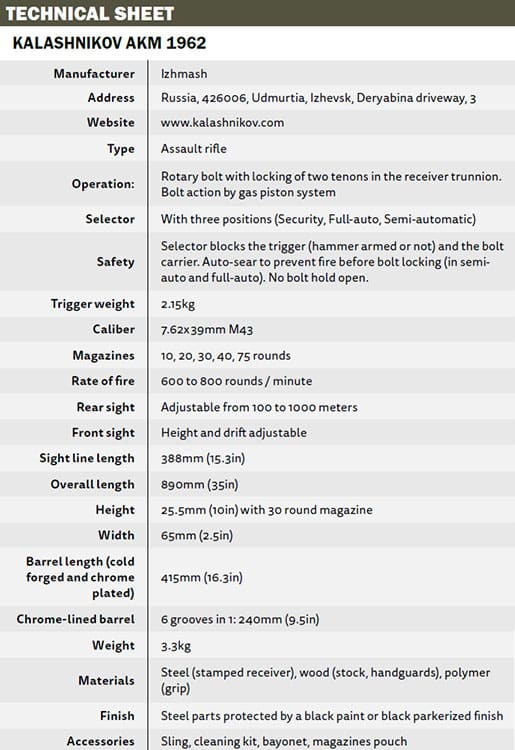
The AKM (Kalashnikov Improved Assault Rifle) is the second version of the AK-47. It was adopted in 1959 by the Russian Army. Built with a receiver stamped on a hydraulic press, it is lighter, more reliable and cheaper to manufacture, but a little less rigid than the AK-47 receiver.

History

The history of the AK-47 is quite well known, and it is inseparable from the birth of the at the time new multi-purpose Soviet cartridge, the 7.62x39mm M43. This caliber was imagined almost at the same time as the German 7.92x33mm ammunition, which the Russians tested after seizing the Sturmgewehr 42 on the battlefield. They also officially tried the USM1 US carbine chambered in .30 carbine (7.62x33mm).

The concept appealed to the Russians, and they set to work as early as 1942 to define their own intermediate rifle caliber adapted to an assault rifle—less power and speed but more capacity and compactness to make the weapon-ammunition package more effective in combat. It took a long time before arriving at the perfect caliber and at the concept of the assault rifle. A 7.92x41mm cartridge was designed and tested in a dozen different weapons. The results were not ideal; the weapons were too heavy so studies resumed. New tests were scheduled for the beginning of 1946 with the appearance of Mikhail Kalashnikov and the presentation of his work. He made a prototype submachine gun which was rejected by the evaluation commission. Then he designed a semi-automatic rifle, inspired by the M1 Garand rifle, called the AK-46 or AK N ° 1. The commission studied three rifles made by Bulkin, Dementiev and Kalashnikov. The latter was evolving his assault rifle, cleverly using the best solutions designed by the weapons engineers of his time. He finally won the official tests with his weapon that offered the best compromise between reliability, lightness, endurance and precision.

Production began in Izhevsk in the Urals during 1947 with press-formed receivers Type I that posed many manufacturing and quality problems. This led to mass producing machined frames Type II before being able to switch to stamped receivers from 1951 on.
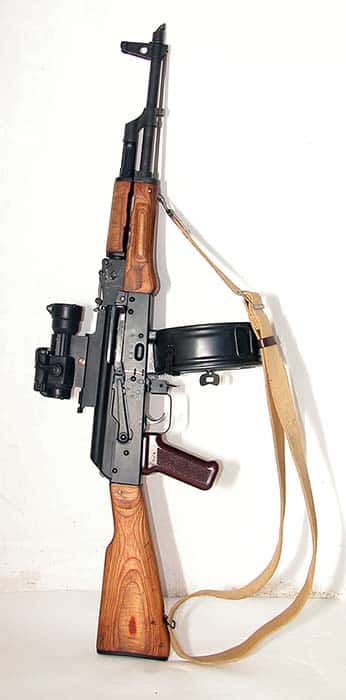
1962 AKM with Aimpoint M2 and a large Chinese magazine.

The AKM Loses a Kilo

The AKM (Improved Kalashnikov Assault Rifle) was adopted in 1959 after studying numerous evolutions and having multiple tests. Despite the competition from other rifle prototypes, sometimes well designed and cheaper to produce, the Russian Army chose the AKM. The main evolution came from its press-formed receiver—lighter, cheaper to manufacture but a little less rigid. It was stamped from a 1mm-thick steel sheet and reinforced by front and rear blocks riveted to the receiver. The front block supported the barrel held in place by a transverse pin, unlike the AK-47 which had a barrel screwed into its machined frame. The cost and time required for manufacturing were also considerably reduced. Indeed, the machining of the steel blocks of the AK-47 to make receivers required more time, skilled workers and more raw materials.

Kalashnikov’s stock and grip were redrawn and lightened. Stock and handguards were made of birch plywood, which were lightweight and inexpensive. A compensator was added on the thread to reduce muzzle rise in automatic fire. The thread also allowed you to install a suppressor. The rear sight measured 800 to 1000 meters maximum, which was very optimistic. It was adjustable in height while the front sight was adjustable in height with the tool provided in the cleaning kit, but also in drift by a gunsmith with a hammer.

The main improvement concerned the weight, which was reduced by 1kg, being lowered from 4.3kg to 3.3kg by the lighter receiver being manufactured from sheet metal, by the slightly less heavy bolt, and by the modified wood. The AKM was black matte parkerized while the AK-47 was blued. Improvements were also made to the barrel and to the gas ports to increase reliability.

A new bayonet was designed to be attached to its rigid sheath, forming a cutting tool for barbed wire. The AKM could be equipped with many accessories; for example, the PBS silencer and the NSPU night-time scope. The 6G15, an adaptable grenade launcher under the barrel, was also developed for the AKM which launched front-loading 40mm VOG-25 grenades.

Auto-Sear also for Semi-Automatic Fire

The operation of the AKM is well known and often copied, with its bolt that locks in the steel block in front of the receiver, called the trunnion, by two lugs. This steel reinforcement is riveted into the housing and supports the barrel. Some manufacturers prefer the screwed in barrel. The front sight and the gas block are also each fixed on the barrel by two transverse pins.

When the bolt carrier approaches the chamber, the bolt rotates about 30 degrees to the right to lock into the receiver, with its two lateral lugs. The front of the bolt is thus in contact with the end of the barrel, and the cartridge is chambered. When you press the trigger, expanding propellant gases activate the piston / bolt carrier. The carrier moves back a little, which causes the unlocking of the bolt (by the action of the milled rail in the carrier that rotates the bolt to the left) and then the rearward motion of the bolt-carrier assembly ensures case ejection.

The trigger mechanism is equipped with an auto sear. This auto sear locks the hammer in the armed position when the bolt moves back, in addition to the hammer lock by the trigger. When the bolt advances, it hooks the auto sear, which unlocks the hammer. This allows hammer activation of the firing pin once the bolt is in the front most position, against the chamber. This operation is valid for semi-automatic shooting and for automatic shooting. Hence the importance of the presence of this trigger on all Kalashnikovs. This type of system also exists on the military M16 or M4, but in the full-auto mode only.
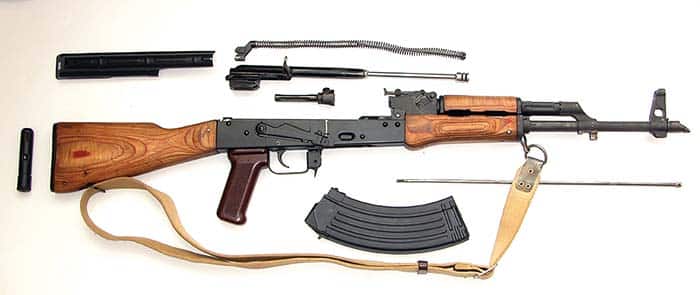
Easy maintenance disassembly and quick cleaning with the .30 barrel.

An Izhmash AKM Dated 1962

The AKM has a three-position selector that has the particularity, like the other rifles derived from the AK, to place the automatic fire position in the middle of its movement, just after the safety position. The safety selector closes the receiver and does not allow dirt to enter. It blocks the carrier from retracting, and the hammer and all the trigger mechanism from operating, cartridge chambered or not. When the magazine is empty, the bolt remains closed; it has no last round locking stop to keep it open. The trigger is well designed with its hook on the top of the hammer, far from its axis, which allows it to obtain a nice and functional release weight, around 2.0kg to 2.2kg, while the military rifles generally have heavier detents.

Disassembling the AKM is very easy for routine maintenance but also for the replacement of the barrel, a stock or a handguard. Pin punches and a gunsmith’s hammer are sufficient to disassemble most of the parts including the trigger, plus a screwdriver for the bakelite grip screw.

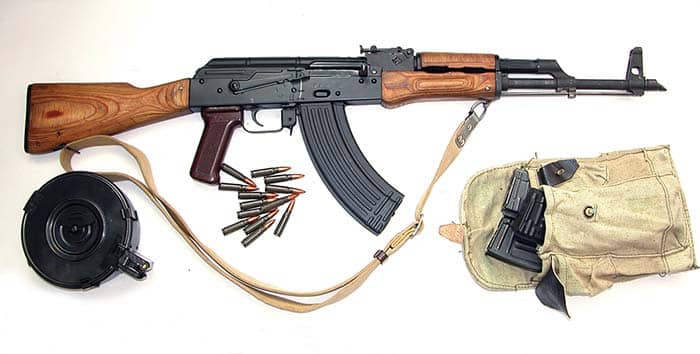
We had the opportunity to test a Russian military version of the AKM from l962, in its original configuration with all its parts and old wood. It bears its manufacture date next to its serial number, the EY42xx, and next to the triangle with arrow inside logo of the manufacturer Izhmash. Its sling also has its period markings; it is therefore the sling put into service in the Russian Army with the AKM. A weapon 56 years old still in excellent mechanical form. Its condition was not perfect at the time of purchase so its owner has made the choice to give it a facelift by polishing the wood (stock, handguards), which has removed the protective varnish but has given back the wood their original coloring.
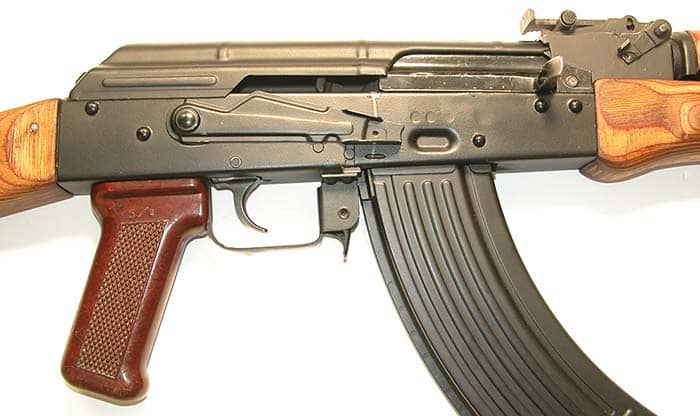
From 1959, AK rifles return to a stamped receiver, after milled.

Installation of Anti-Rise Muzzle Brake

After severe use over the years, the metal parts looked like new after a good cleaning, polishing and two coats of black paint (housing, guide rod gas borrowing, top housing cover). Successive cleaning and retouching had made the receiver look very worn; it was necessary to remove the painted fittings to obtain a uniform surface and color.

This AKM is chambered in the original caliber, the 7.62x39mm Kalashnikov, and it has the famous muzzle brake bevel cut intended to thwart the rise during automatic fire. A Russian pouch for AK or AKM for three magazines, a cleaning kit in the stock, plus the maintenance rod in place under the barrel, completed the set. A proper bayonet remains to be found.

We made our tests at 100 and 200 meters, using the metal sights, followed by the Aimpoint M4 sight and then the Aimpoint T2 sight, mounted lower. These two Aimpoints are made with 2 MOA red dot diameters. All our tests took place without any negative shooting incidents, 100% reliable chambering and ejections. We used a Millett brand firing support to stabilize our AKM. For our tests, we fired factory ammunition but also reloaded ammunition in order to be able to use powerful and quality cartridges with powder and non-corrosive primers— a bit aggressive for the barrel and the bolt. We had the opportunity to fire ammunition with brass cases from PPU Serbian FMJ ball 123 grain, then Wolf steel cases, green cartridges of former East Germany and Russian military cartridges also with steel cases.

.311 and .308 Bullets on Lapua Cases
To continue our tests, we proceeded with reloads on this cartridge with the use of Lapua cases using boxer primers, known for their quality. The die sets come with two calibration rods. It is necessary to install the rod for .30 caliber bullets beforehand to remove primers and full sizing. We chose to reload ammunitions so that we could test several types of bullets—123 grains in .311 caliber and 125 grains, 150, 168 and 200 grains in .308 caliber. For the .311, we used Sellier & Bellot bullets n ° 2907 standard Kalashnikov, then the Hornady .308 in 125 grains, IMI .308 in 150 grains FMJ, Lapua Scenar .308 in 167 grains and Sierra HPBT. 308 in 200 grains. All our reloads were made with Vihtavuori N120 powder; the manufacturer gave several loads depending on the bullet weight. As soon as it was decided to increase the bullet weight, it is imperative to lower the powder load to remain in admissible pressures. The capacity of cases does not allow exceeding certain limits for reasons of volume, the bullets above 125 grains coming easily in contact with the powder.

The results were correct with the factory ammunition as with the reloaded ammunition. Even if the AKM was not at the level of that of the M16, they were very accurate with match ammo. We obtained scores on targets with five cartridges at 100 meters from 85 to 97mm (3.34 to 3.81 inches), then from 113 to 158mm (4.44 to 6.22 inches) at a distance of 200 meters. These scores are honest with respect to some with surplus ammunition or with poorly prepared rifles, but they are not really at the level required for NATO assault rifles.

In automatic fire, the rifle is very lively and moves a lot, so it must be properly controlled. The bolt requires a powerful movement backwards to overcome the hammer resistance to put it in a cocked position.

Present-Day Kalashnikov Group

The latest versions of Kalashnikov rifles can be seen on the Kalashnikov Group website, with an interesting 9mm Parabellum model built on an AK receiver, or a Saïga rifle chambered for a new caliber, the 366 TKM, consisting of a 37mm (on the basis of the 7.62×39 M43 case) and a 9.55mm bullet of 168, 201 or 231 grains. This ammunition was introduced by a Russian manufacturer named Techkrim (a company specializing in sports ammunition and non-lethal ammunition). The other models are still produced, such as the AK-74, still in service in the Russian Army, as well as the Saiga civil versions, now very widespread.

All these AKs are produced on the historic site of Izhevsk, capital of Udmurtia, located in the Urals, which is a major industrial, commercial and scientific center. The history of the city dates back to the spring of 1760, when a dam on the Ij River was built simultaneously with the adjacent metallurgical plant. The development of Izhevsk was due to the installation of the armaments factory which began its activity in 1807. The city had developed its specialization in the field of defense, metallurgy, war weapons and hunting rifles. The first production for war was destined for the Napoleonic Wars of 1812. Izhevsk was a major strategic problem at all times, especially during the Russian Revolution. At the time of the First Five-Year Plan, the city grew rapidly thanks to new industries, such as motorcycles, machine tools and chemistry. In December 1934, Izhevsk was proclaimed capital of the Udmurt Republic.

Important Production Capacities

During the Second World War, the importance of the city as a weapons production center was considerable. The Izhevsk factories could equip an aviation division and an artillery division in one day. The post-war period is characterized by the development of the industrial base with a significant production of arms, motorcycles, automobiles and machine tools, renowned worldwide. Mikhail Kalashnikov is one of the architects of these successes, alongside other engineers. Izhevsk has always been a city of mechanical industries, famous for the arms factory established in 1807. It is, of course, in this factory that the Kalashnikov AK-47 assault rifle was developed and manufactured as its later versions. The Izhmash group also produced cars, IJ brand, as well as motorcycles. The concentration of defense factories in Izhevsk made it a very closed city during Soviet times, and foreigners were not allowed to enter it.

The Kalashnikov Armament Group took its name in 2013 in tribute to its engineer Mikhail Kalashnikov, who died that year. The first private investors arrived in the group suffered heavy losses. Kalashnikov was able to rectify its accounts by proposing new models, but especially by diversifying in particular sectors like clothing and knives. The group is developing its equipment and presents many new products: electric motorcycles, observation drones, non-lethal weapons and robotic destructive tanks. This initiative was taken by CEO, Alexeï Krivorouchko, who arrived during this first wave of privatization. In January 2017, Kalashnikov Group announced that it wanted to increase its workforce by 30%, with the creation of 1,700 additional jobs.

This article first appeared in Small Arms Review V22N4 (April 2018)
Tags: 2018APRIL 2018Kalashniko V AKM 1962: The Upgraded Kalashnikov Assault RiflePascal ThibertV22N4
Previous Post

Success Comes from the Details: S&H Arms Model 30 Integral Blackout AR-Platform Uppers

Next Post

PDW Innovations: From Concept to Purpose-Built

Next Post
PDW Innovations: From Concept to Purpose-Built

PDW Innovations: From Concept to Purpose-Built

TRENDING STORIES

  • The Alofs Reloading Magazine for Shotguns

    The Alofs Reloading Magazine for Shotguns

    0 shares
    Share 0 Tweet 0
  • The New Light and Handy Ruger American Generation II Ranch Rifle

    0 shares
    Share 0 Tweet 0
  • The Complete Guide To Colt M-16 Models: Part I

    0 shares
    Share 0 Tweet 0
  • True to Form: The Tisas 1911A1 ASF

    0 shares
    Share 0 Tweet 0
  • VALKYRIE ARMAMENT BELT-FED CONVERSION

    0 shares
    Share 0 Tweet 0

RECENT POSTS

SIG Sauer’s Full-Size Compact P365 “Fuse”

SIG Sauer’s Full-Size Compact P365 “Fuse”

June 27, 2024
The Importance of Offhand Shooting

The Importance of Offhand Shooting

June 25, 2024
BOOK REVIEW – The Collector’s Guide to the SKS

BOOK REVIEW – The Collector’s Guide to the SKS

June 20, 2024
True to Form: The Tisas 1911A1 ASF

True to Form: The Tisas 1911A1 ASF

June 18, 2024
Setting the Record Straight on the Fedorov Avtomat

Setting the Record Straight on the Fedorov Avtomat

June 6, 2024

QUICK LINKS

  • About Chipotle Publishing
  • About Small Arms Review
  • Advertise with Us
  • Write for Us

CONTACT DETAILS

  • Phone: +1 (702) 565-0746
  • E-mail: office@smallarmsreview.com
  • Web: www.chipotlepublishing.com
  • Chipotle Publishing, LLC 631 N. Stephanie St., No. 282, Henderson, NV 89014
Small Arms Review

FOLLOW US

  • Privacy Policy
  • Disclaimer

© 2022 Chipotle Publishing | All Rights Reserved

Welcome Back!

Login to your account below

Forgotten Password?

Retrieve your password

Please enter your username or email address to reset your password.

Log In

Add New Playlist

No Result
View All Result
  • Home
  • Articles
    • Guns & Parts
    • Suppressors
    • Optics & Thermals
    • Ammunition
    • Gear
    • News & Opinion
    • Columns
    • Museums & Factory Tours
    • ID Guides
    • Interviews
    • Event Coverage
    • Articles by Issue
      • Volume 1
      • Volume 2
      • Volume 3
      • Volume 4
      • Volume 5
      • Volume 6
      • Volume 7
      • Volume 8
      • Volume 9
      • Volume 10
      • Volume 11
      • Volume 12
      • Volume 13
      • Volume 14
      • Volume 15
      • Volume 16
      • Volume 17
      • Volume 18
      • Volume 19
      • Volume 20
      • Volume 21
      • Volume 22
      • Volume 23
      • Volume 24
  • The Archive
    • Search The Archive
  • Store
    • Books
    • Back Issues
    • Merchandise
  • Events
  • About
    • About Small Arms Review
    • About Chipotle Publishing
    • Contact Us
    • Other Publications
      • Small Arms Defense Journal

© 2022 Chipotle Publishing | All Rights Reserved

This website uses cookies. By continuing to use this website you are giving consent to cookies being used. Visit our Privacy and Cookie Policy.

Redirecting to External Website

You are leaving the Small Arms Review website and will be redirected to an external link in a 5 Seconds.
VISIT NOW!