


Small Arms Review
  • Home
  • Articles
    • Guns & Parts
    • Suppressors
    • Optics & Thermals
    • Ammunition
    • Gear
    • News & Opinion
    • Columns
    • Museums & Factory Tours
    • ID Guides
    • Interviews
    • Event Coverage
    • Articles by Issue
      • Volume 1
        • V1N1 (Oct 1997)
        • V1N2 (Nov 1997)
        • V1N3 (Dec 1997)
        • V1N4 (Jan 1998)
        • V1N5 (Feb 1998)
        • V1N6 (Mar 1998)
        • V1N7 (Apr 1998)
        • V1N8 (May 1998)
        • V1N9 (Jun 1998)
        • V1N10 (Jul 1998)
        • V1N11 (Aug 1998)
        • V1N12 (Sep 1998)
      • Volume 2
        • V2N1 (Oct 1998)
        • V2N2 (Nov 1998)
        • V2N3 (Dec 1998)
        • V2N4 (Jan 1999)
        • V2N5 (Feb 1999)
        • V2N6 (Mar 1999)
        • V2N7 (Apr 1999)
        • V2N8 (May 1999)
        • V2N9 (Jun 1999)
        • V2N10 (Jul 1999)
        • V2N11 (Aug 1999)
        • V2N12 (Sep 1999)
      • Volume 3
        • V3N1 (Oct 1999)
        • V3N2 (Nov 1999)
        • V3N3 (Dec 1999)
        • V3N4 (Jan 2000)
        • V3N5 (Feb 2000)
        • V3N6 (Mar 2000)
        • V3N7 (Apr 2000)
        • V3N8 (May 2000)
        • V3N9 (Jun 2000)
        • V3N10 (Jul 2000)
        • V3N11 (Aug 2000)
        • V3N12 (Sep 2000)
      • Volume 4
        • V4N1 (Oct 2000)
        • V4N2 (Nov 2000)
        • V4N3 (Dec 2000)
        • V4N4 (Jan 2001)
        • V4N5 (Feb 2001)
        • V4N6 (Mar 2001)
        • V4N7 (Apr 2001)
        • V4N8 (May 2001)
        • V4N9 (Jun 2001)
        • V4N10 (Jul 2001)
        • V4N11 (Aug 2001)
        • V4N12 (Sep 2001)
      • Volume 5
        • V5N1 (Oct 2001)
        • V5N2 (Nov 2001)
        • V5N3 (Dec 2001)
        • V5N4 (Jan 2002)
        • V5N5 (Feb 2002)
        • V5N6 (Mar 2002)
        • V5N7 (Apr 2002)
        • V5N8 (May 2002)
        • V5N9 (Jun 2002)
        • V5N10 (Jul 2002)
        • V5N11 (Aug 2002)
        • V5N12 (Sep 2002)
      • Volume 6
        • V6N1 (Oct 2002)
        • V6N2 (Nov 2002)
        • V6N3 (Dec 2002)
        • V6N4 (Jan 2003)
        • V6N5 (Feb 2003)
        • V6N6 (Mar 2003)
        • V6N7 (Apr 2003)
        • V6N8 (May 2003)
        • V6N9 (Jun 2003)
        • V6N10 (Jul 2003)
        • V6N11 (Aug 2003)
        • V6N12 (Sep 2003)
      • Volume 7
        • V7N1 (Oct 2003)
        • V7N2 (Nov 2003)
        • V7N3 (Dec 2003)
        • V7N4 (Jan 2004)
        • V7N5 (Feb 2004)
        • V7N6 (Mar 2004)
        • V7N7 (Apr 2004)
        • V7N8 (May 2004)
        • V7N9 (Jun 2004)
        • V7N10 (Jul 2004)
        • V7N11 (Aug 2004)
        • V7N12 (Sep 2004)
      • Volume 8
        • V8N1 (Oct 2004)
        • V8N2 (Nov 2004)
        • V8N3 (Dec 2004)
        • V8N4 (Jan 2005)
        • V8N5 (Feb 2005)
        • V8N6 (Mar 2005)
        • V8N7 (Apr 2005)
        • V8N8 (May 2005)
        • V8N9 (Jun 2005)
        • V8N10 (Jul 2005)
        • V8N11 (Aug 2005)
        • V8N12 (Sep 2005)
      • Volume 9
        • V9N1 (Oct 2005)
        • V9N2 (Nov 2005)
        • V9N3 (Dec 2005)
        • V9N4 (Jan 2006)
        • V9N5 (Feb 2006)
        • V9N6 (Mar 2006)
        • V9N7 (Apr 2006)
        • V9N8 (May 2006)
        • V9N9 (Jun 2006)
        • V9N10 (Jul 2006)
        • V9N11 (Aug 2006)
        • V9N12 (Sep 2006)
      • Volume 10
        • V10N1 (Oct 2006)
        • V10N2 (Nov 2006)
        • V10N3 (Dec 2006)
        • V10N4 (Jan 2007)
        • V10N5 (Feb 2007)
        • V10N6 (Mar 2007)
        • V10N7 (Apr 2007)
        • V10N8 (May 2007)
        • V10N9 (Jun 2007)
        • V10N10 (Jul 2007)
        • V10N11 (Aug 2007)
        • V10N12 (Sep 2007)
      • Volume 11
        • V11N1 (Oct 2007)
        • V11N2 (Nov 2007)
        • V11N3 (Dec 2007)
        • V11N4 (Jan 2008)
        • V11N5 (Feb 2008)
        • V11N6 (Mar 2008)
        • V11N7 (Apr 2008)
        • V11N8 (May 2008)
        • V11N9 (Jun 2008)
        • V11N10 (Jul 2008)
        • V11N11 (Aug 2008)
        • V11N12 (Sep 2008)
      • Volume 12
        • V12N1 (Oct 2008)
        • V12N2 (Nov 2008)
        • V12N3 (Dec 2008)
        • V12N4 (Jan 2009)
        • V12N5 (Feb 2009)
        • V12N6 (Mar 2009)
        • V12N7 (Apr 2009)
        • V12N8 (May 2009)
        • V12N9 (Jun 2009)
        • V12N10 (Jul 2009)
        • V12N11 (Aug 2009)
        • V12N12 (Sep 2009)
      • Volume 13
        • V13N1 (Oct 2009)
        • V13N2 (Nov 2009)
        • V13N3 (Dec 2009)
        • V13N4 (Jan 2010)
        • V13N5 (Feb 2010)
        • V13N6 (Mar 2010)
        • V13N7 (Apr 2010)
        • V13N8 (May 2010)
        • V13N9 (Jun 2010)
        • V13N10 (Jul 2010)
        • V13N11 (Aug 2010)
        • V13N12 (Sep 2010)
      • Volume 14
        • V14N1 (Oct 2010)
        • V14N2 (Nov 2010)
        • V14N3 (Dec 2010)
          • Ammunition
        • V14N4 (Jan 2011)
        • V14N5 (Feb 2011)
        • V14N6 (Mar 2011)
        • V14N7 (Apr 2011)
        • V14N8 (May 2011)
        • V14N9 (Jun 2011)
        • V14N10 (Jul 2011)
        • V14N11 (Aug 2011)
        • V14N12 (Sep 2011)
      • Volume 15
        • V15N1 (Oct 2011)
        • V15N2 (Nov 2011)
        • V15N4 (Jan 2012)
        • V15N5 (Feb 2012)
      • Volume 16
        • V16N1 (1st Quarter 2012)
        • V16N2 (2nd Quarter 2012)
        • V16N3 (3rd Quarter 2012)
        • V16N4 (4th Quarter 2012)
      • Volume 17
        • V17N1 (1st Quarter 2013)
        • V17N2 (2nd Quarter 2013)
        • V17N3 (3rd Quarter 2013)
        • V17N4 (4th Quarter 2013)
      • Volume 18
        • V18N1 (Jan Feb 2014)
        • V18N2 (Mar Apr 2014)
        • V18N3 (May Jun 2014)
        • V18N4 (Jul Aug 2014)
        • V18N5 (Sep Oct 2014)
        • V18N6 (Nov Dec 2014)
      • Volume 19
        • V19N1 (Jan 2015)
        • V19N2 (Feb Mar 2015)
        • V19N3 (Apr 2015)
        • V19N4 (May 2015)
        • V19N5 (Jun 2015)
        • V19N6 (Jul 2015)
        • V19N7 (Aug Sep 2015)
        • V19N8 (Oct 2015)
        • V19N9 (Nov 2015)
        • V19N10 (Dec 2015)
      • Volume 20
        • V20N1 (Jan 2016)
        • V20N2 (Feb Mar 2016)
        • V20N3 (Apr 2016)
        • V20N4 (May 2016)
        • V20N5 (Jun 2016)
        • V20N6 (Jul 2016)
        • V20N7 (Aug Sep 2016)
        • V20N8 (Oct 2016)
        • V20N9 (Nov 2016)
        • V20N10 (Dec 2016)
      • Volume 21
        • V21N1 (Jan 2017)
        • V21N2 (Feb Mar 2017)
        • V21N3 (Apr 2017)
        • V21N4 (May 2017)
        • V21N5 (Jun 2017)
        • V21N6 (Jul 2017)
        • V21N7 (Aug Sep 2017)
        • V21N8 (Oct 2017)
        • V21N9 (Nov 2017)
        • V21N10 (Dec 2017)
      • Volume 22
        • V22N1 (Jan 2018)
        • V22N2 (Feb 2018)
        • V22N3 (March 2018)
        • V22N4 (Apr 2018)
        • V22N5 (May 2018)
        • V22N6 (Jun Jul 2018)
        • V22N7 (Aug Sep 2018)
        • V22N8 (Oct 2018)
        • V22N9 (Nov 2018)
        • V22N10 (Dec 2018)
      • Volume 23
        • V23N1 (Jan 2019)
        • V23N2 (Feb 2019)
        • V23N3 (Mar 2019)
        • V23N4 (Apr 2019)
        • V23N5 (May 2019)
        • V23N6 (Jun Jul 2019)
        • V23N7 (Aug Sep 2019)
        • V23N8 (Oct 2019)
        • V23N9 (Nov 2019)
        • V23N10 (Dec 2019)
      • Volume 24
        • V24N1 (Jan 2020)
        • V24N2 (Feb 2020)
        • V24N3 (Mar 2020)
        • V24N4 (Apr 2020)
        • V24N5 (May 2020)
        • V24N6 (Jun Jul 2020)
        • V24N7 (Aug Sep 2020)
        • V24N8 (Oct 2020)
        • V24N9 (Nov 2020)
        • V24N10 (Dec 2020)
  • The Archive
    • Search The Archive
  • Store
    • Books
    • Back Issues
    • Merchandise
  • Events
  • About
    • About Small Arms Review
    • About Chipotle Publishing
    • Contact Us
    • Other Publications
      • Small Arms Defense Journal
  • Home
  • Articles
    • Guns & Parts
    • Suppressors
    • Optics & Thermals
    • Ammunition
    • Gear
    • News & Opinion
    • Columns
    • Museums & Factory Tours
    • ID Guides
    • Interviews
    • Event Coverage
    • Articles by Issue
      • Volume 1
        • V1N1 (Oct 1997)
        • V1N2 (Nov 1997)
        • V1N3 (Dec 1997)
        • V1N4 (Jan 1998)
        • V1N5 (Feb 1998)
        • V1N6 (Mar 1998)
        • V1N7 (Apr 1998)
        • V1N8 (May 1998)
        • V1N9 (Jun 1998)
        • V1N10 (Jul 1998)
        • V1N11 (Aug 1998)
        • V1N12 (Sep 1998)
      • Volume 2
        • V2N1 (Oct 1998)
        • V2N2 (Nov 1998)
        • V2N3 (Dec 1998)
        • V2N4 (Jan 1999)
        • V2N5 (Feb 1999)
        • V2N6 (Mar 1999)
        • V2N7 (Apr 1999)
        • V2N8 (May 1999)
        • V2N9 (Jun 1999)
        • V2N10 (Jul 1999)
        • V2N11 (Aug 1999)
        • V2N12 (Sep 1999)
      • Volume 3
        • V3N1 (Oct 1999)
        • V3N2 (Nov 1999)
        • V3N3 (Dec 1999)
        • V3N4 (Jan 2000)
        • V3N5 (Feb 2000)
        • V3N6 (Mar 2000)
        • V3N7 (Apr 2000)
        • V3N8 (May 2000)
        • V3N9 (Jun 2000)
        • V3N10 (Jul 2000)
        • V3N11 (Aug 2000)
        • V3N12 (Sep 2000)
      • Volume 4
        • V4N1 (Oct 2000)
        • V4N2 (Nov 2000)
        • V4N3 (Dec 2000)
        • V4N4 (Jan 2001)
        • V4N5 (Feb 2001)
        • V4N6 (Mar 2001)
        • V4N7 (Apr 2001)
        • V4N8 (May 2001)
        • V4N9 (Jun 2001)
        • V4N10 (Jul 2001)
        • V4N11 (Aug 2001)
        • V4N12 (Sep 2001)
      • Volume 5
        • V5N1 (Oct 2001)
        • V5N2 (Nov 2001)
        • V5N3 (Dec 2001)
        • V5N4 (Jan 2002)
        • V5N5 (Feb 2002)
        • V5N6 (Mar 2002)
        • V5N7 (Apr 2002)
        • V5N8 (May 2002)
        • V5N9 (Jun 2002)
        • V5N10 (Jul 2002)
        • V5N11 (Aug 2002)
        • V5N12 (Sep 2002)
      • Volume 6
        • V6N1 (Oct 2002)
        • V6N2 (Nov 2002)
        • V6N3 (Dec 2002)
        • V6N4 (Jan 2003)
        • V6N5 (Feb 2003)
        • V6N6 (Mar 2003)
        • V6N7 (Apr 2003)
        • V6N8 (May 2003)
        • V6N9 (Jun 2003)
        • V6N10 (Jul 2003)
        • V6N11 (Aug 2003)
        • V6N12 (Sep 2003)
      • Volume 7
        • V7N1 (Oct 2003)
        • V7N2 (Nov 2003)
        • V7N3 (Dec 2003)
        • V7N4 (Jan 2004)
        • V7N5 (Feb 2004)
        • V7N6 (Mar 2004)
        • V7N7 (Apr 2004)
        • V7N8 (May 2004)
        • V7N9 (Jun 2004)
        • V7N10 (Jul 2004)
        • V7N11 (Aug 2004)
        • V7N12 (Sep 2004)
      • Volume 8
        • V8N1 (Oct 2004)
        • V8N2 (Nov 2004)
        • V8N3 (Dec 2004)
        • V8N4 (Jan 2005)
        • V8N5 (Feb 2005)
        • V8N6 (Mar 2005)
        • V8N7 (Apr 2005)
        • V8N8 (May 2005)
        • V8N9 (Jun 2005)
        • V8N10 (Jul 2005)
        • V8N11 (Aug 2005)
        • V8N12 (Sep 2005)
      • Volume 9
        • V9N1 (Oct 2005)
        • V9N2 (Nov 2005)
        • V9N3 (Dec 2005)
        • V9N4 (Jan 2006)
        • V9N5 (Feb 2006)
        • V9N6 (Mar 2006)
        • V9N7 (Apr 2006)
        • V9N8 (May 2006)
        • V9N9 (Jun 2006)
        • V9N10 (Jul 2006)
        • V9N11 (Aug 2006)
        • V9N12 (Sep 2006)
      • Volume 10
        • V10N1 (Oct 2006)
        • V10N2 (Nov 2006)
        • V10N3 (Dec 2006)
        • V10N4 (Jan 2007)
        • V10N5 (Feb 2007)
        • V10N6 (Mar 2007)
        • V10N7 (Apr 2007)
        • V10N8 (May 2007)
        • V10N9 (Jun 2007)
        • V10N10 (Jul 2007)
        • V10N11 (Aug 2007)
        • V10N12 (Sep 2007)
      • Volume 11
        • V11N1 (Oct 2007)
        • V11N2 (Nov 2007)
        • V11N3 (Dec 2007)
        • V11N4 (Jan 2008)
        • V11N5 (Feb 2008)
        • V11N6 (Mar 2008)
        • V11N7 (Apr 2008)
        • V11N8 (May 2008)
        • V11N9 (Jun 2008)
        • V11N10 (Jul 2008)
        • V11N11 (Aug 2008)
        • V11N12 (Sep 2008)
      • Volume 12
        • V12N1 (Oct 2008)
        • V12N2 (Nov 2008)
        • V12N3 (Dec 2008)
        • V12N4 (Jan 2009)
        • V12N5 (Feb 2009)
        • V12N6 (Mar 2009)
        • V12N7 (Apr 2009)
        • V12N8 (May 2009)
        • V12N9 (Jun 2009)
        • V12N10 (Jul 2009)
        • V12N11 (Aug 2009)
        • V12N12 (Sep 2009)
      • Volume 13
        • V13N1 (Oct 2009)
        • V13N2 (Nov 2009)
        • V13N3 (Dec 2009)
        • V13N4 (Jan 2010)
        • V13N5 (Feb 2010)
        • V13N6 (Mar 2010)
        • V13N7 (Apr 2010)
        • V13N8 (May 2010)
        • V13N9 (Jun 2010)
        • V13N10 (Jul 2010)
        • V13N11 (Aug 2010)
        • V13N12 (Sep 2010)
      • Volume 14
        • V14N1 (Oct 2010)
        • V14N2 (Nov 2010)
        • V14N3 (Dec 2010)
          • Ammunition
        • V14N4 (Jan 2011)
        • V14N5 (Feb 2011)
        • V14N6 (Mar 2011)
        • V14N7 (Apr 2011)
        • V14N8 (May 2011)
        • V14N9 (Jun 2011)
        • V14N10 (Jul 2011)
        • V14N11 (Aug 2011)
        • V14N12 (Sep 2011)
      • Volume 15
        • V15N1 (Oct 2011)
        • V15N2 (Nov 2011)
        • V15N4 (Jan 2012)
        • V15N5 (Feb 2012)
      • Volume 16
        • V16N1 (1st Quarter 2012)
        • V16N2 (2nd Quarter 2012)
        • V16N3 (3rd Quarter 2012)
        • V16N4 (4th Quarter 2012)
      • Volume 17
        • V17N1 (1st Quarter 2013)
        • V17N2 (2nd Quarter 2013)
        • V17N3 (3rd Quarter 2013)
        • V17N4 (4th Quarter 2013)
      • Volume 18
        • V18N1 (Jan Feb 2014)
        • V18N2 (Mar Apr 2014)
        • V18N3 (May Jun 2014)
        • V18N4 (Jul Aug 2014)
        • V18N5 (Sep Oct 2014)
        • V18N6 (Nov Dec 2014)
      • Volume 19
        • V19N1 (Jan 2015)
        • V19N2 (Feb Mar 2015)
        • V19N3 (Apr 2015)
        • V19N4 (May 2015)
        • V19N5 (Jun 2015)
        • V19N6 (Jul 2015)
        • V19N7 (Aug Sep 2015)
        • V19N8 (Oct 2015)
        • V19N9 (Nov 2015)
        • V19N10 (Dec 2015)
      • Volume 20
        • V20N1 (Jan 2016)
        • V20N2 (Feb Mar 2016)
        • V20N3 (Apr 2016)
        • V20N4 (May 2016)
        • V20N5 (Jun 2016)
        • V20N6 (Jul 2016)
        • V20N7 (Aug Sep 2016)
        • V20N8 (Oct 2016)
        • V20N9 (Nov 2016)
        • V20N10 (Dec 2016)
      • Volume 21
        • V21N1 (Jan 2017)
        • V21N2 (Feb Mar 2017)
        • V21N3 (Apr 2017)
        • V21N4 (May 2017)
        • V21N5 (Jun 2017)
        • V21N6 (Jul 2017)
        • V21N7 (Aug Sep 2017)
        • V21N8 (Oct 2017)
        • V21N9 (Nov 2017)
        • V21N10 (Dec 2017)
      • Volume 22
        • V22N1 (Jan 2018)
        • V22N2 (Feb 2018)
        • V22N3 (March 2018)
        • V22N4 (Apr 2018)
        • V22N5 (May 2018)
        • V22N6 (Jun Jul 2018)
        • V22N7 (Aug Sep 2018)
        • V22N8 (Oct 2018)
        • V22N9 (Nov 2018)
        • V22N10 (Dec 2018)
      • Volume 23
        • V23N1 (Jan 2019)
        • V23N2 (Feb 2019)
        • V23N3 (Mar 2019)
        • V23N4 (Apr 2019)
        • V23N5 (May 2019)
        • V23N6 (Jun Jul 2019)
        • V23N7 (Aug Sep 2019)
        • V23N8 (Oct 2019)
        • V23N9 (Nov 2019)
        • V23N10 (Dec 2019)
      • Volume 24
        • V24N1 (Jan 2020)
        • V24N2 (Feb 2020)
        • V24N3 (Mar 2020)
        • V24N4 (Apr 2020)
        • V24N5 (May 2020)
        • V24N6 (Jun Jul 2020)
        • V24N7 (Aug Sep 2020)
        • V24N8 (Oct 2020)
        • V24N9 (Nov 2020)
        • V24N10 (Dec 2020)
  • The Archive
    • Search The Archive
  • Store
    • Books
    • Back Issues
    • Merchandise
  • Events
  • About
    • About Small Arms Review
    • About Chipotle Publishing
    • Contact Us
    • Other Publications
      • Small Arms Defense Journal
No Result
View All Result
Small Arms Review
No Result
View All Result
Home Product Review

CANiK TTI Combat: Collaboration Blends the Best of Defense and Competition

by Todd Burgreen
April 2, 2024
in Product Review
CANiK TTI Combat: Collaboration Blends the Best of Defense and Competition

The TTI Combat is a premium CANiK model showing off the full potential of the platform. (Todd Burgreen)

Share on FacebookShare on Twitter

CANiK has made a strong start in 2024, maintaining its 2023 momentum. An unprecedented collaboration with  Taran Tactical Innovations (TTI) in the form of the CANiK TTI Combat is the latest offering. In interviews, Taran Butler expressed his familiarity with CANiK, citing years of competition success showcased by CANiK pro shooter Nils Jonasson. Butler did not hesitate when an opportunity to collaborate with CANiK presented itself. After nearly two years of development and testing, the TTI Combat was ready for its 2024 SHOT Show debut.

EVOLUTION, TTI STYLE

CANiK is off to a strong start in 2024 with an unprecedented collaboration with Taran Tactical Innovations (TTI) in the form of the CANiK TTI Combat. (Todd Burgreen)

The TTI Combat is a premium CANiK model showcasing the full potential of the platform. Butler’s own multi-discipline world champion competition experience and the business producing custom enhanced pistols, rifles, shotguns, and components lend credibility to the TTI Combat that is hard to resist. This doesn’t even mention his prominence in becoming the go-to trainer of Hollywood stars, providing cutting-edge gun skills that thrill on the screen.

You know something is different about this CANiK as soon as you open the TTI Combat’s double-layered hard case. Inside are different-sized grip backstraps, multiple optic mounting plates, a toolkit/punch, TTI aluminum magazine base pads, a speed loader, an extra guide rod recoil spring assembly, a holster, and a commemorative coin, among other items. The tools and support items in the case are not mere window dressing. These items are extremely helpful in modifying/altering the TTI Combat in terms of mounting red dots, changing backstraps, swapping magazine base pads, and cleaning the handgun. The bits and drives are well-made and show no sign of wear even after multiple uses.
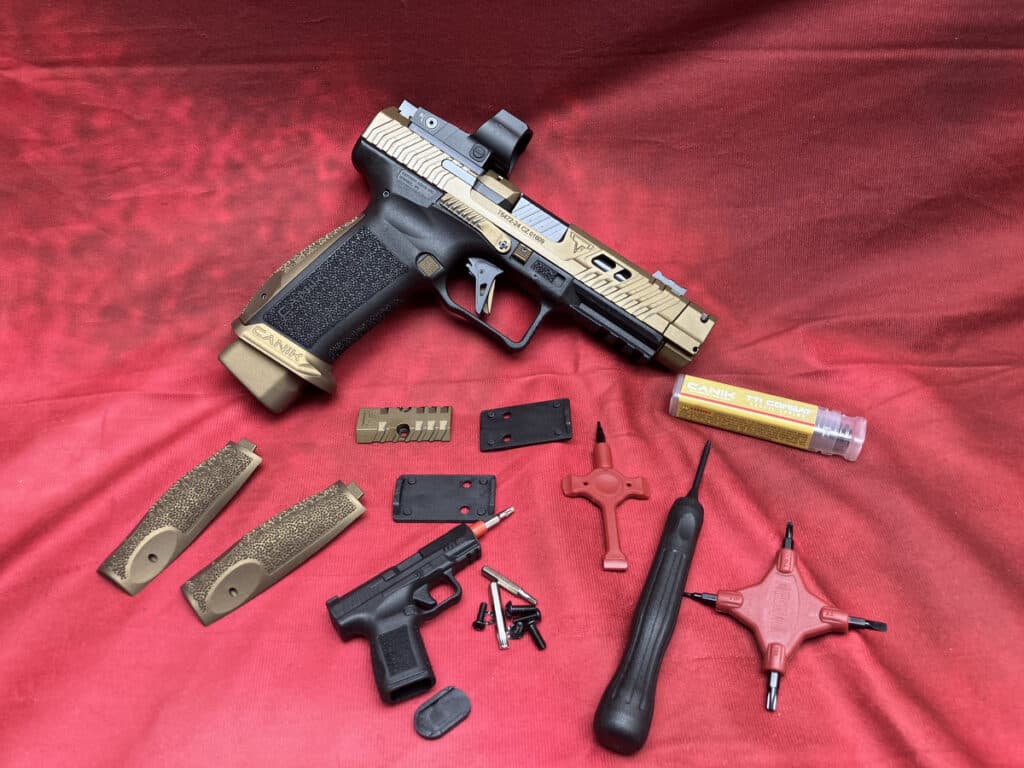
The tools and support items in the case are not mere window dressing. These items are extremely helpful in altering the TTI Combat in terms of mounting red dot, changing the pistol’s modular backstraps, swapping magazine base pads, and cleaning the handgun. (Todd Burgreen)

TTI did not merely provide copyright permission for their logo with the CANiK TTI Combat. Yes, CANiK is the manufacturer, but Butler also contributed design input that involved overall aesthetic, a ported barrel, compensator, magazine base pads, frame shape, and trigger characteristics. The slide serrations and cutouts at the front of the slide demonstrate TTI’s input and CANiK’s meticulous attention to detail, executed successfully.

Picking up and manipulating the TTI Combat only further reinforces the good vibes created by its aesthetics. The light 90-degree breaking aluminum flat trigger with a short reset leaves no doubt that the TTI Combat is not your typical polymer striker-fired handgun. The CANiK TTI Combat was created to compete and to defend. You can see a little Sand Viper in the CANiK TTI Combat. Why not take advantage of the CANiK price point to quality ratio factor? Anyone wanting to own a weapon that TTI has had a hand in will benefit from this collaboration.

The TTI Combat arrives with a unique CANiK polymer frame and slide designed by Butler. Aggressive grip texturing is present, as is an integrated flared magwell with a removable aluminum competition magwell. The double undercut trigger guard allows for the shooter’s hand to sit as high as possible on the frame. This assists in limiting muzzle flip during recoil due to the low center of gravity.
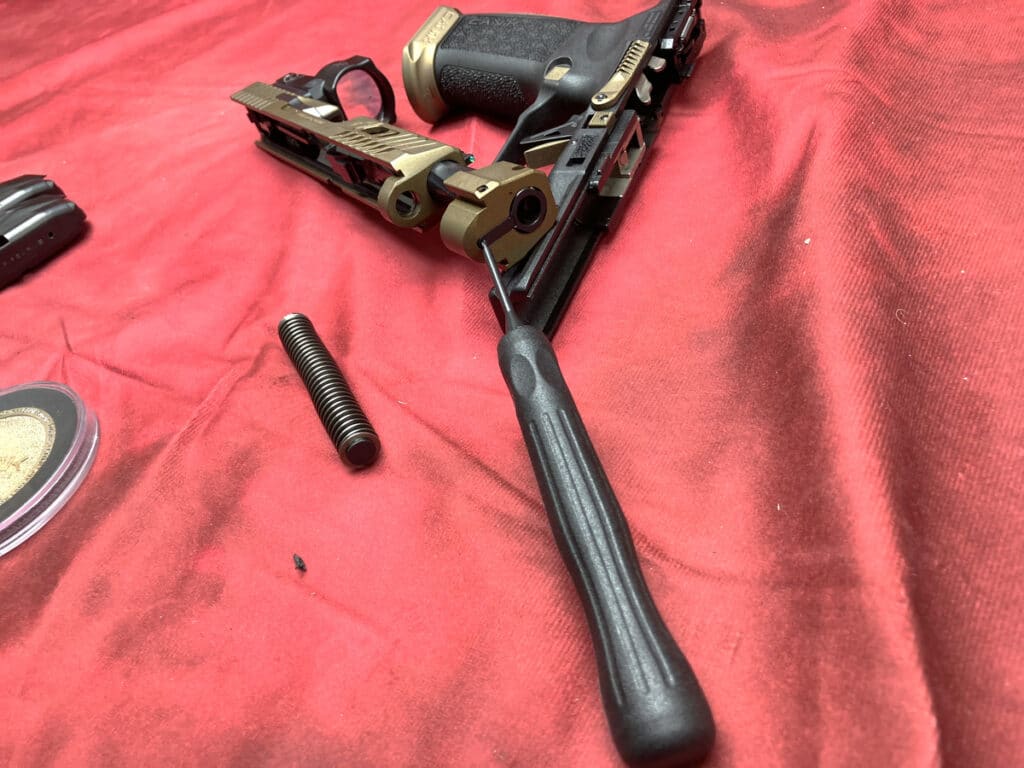
This is the pivot pin release for removing the compensator from the TTI Combat’s ported barrel. You will not find a simpler, more ingenious method of attaching a compensator. (Todd Burgreen)

Did I mention that CANiK’s first-ever compensator is also present on the TTI Combat? It is based on Butler’s input with an ingenious attachment method not requiring a threaded barrel. This is good news for those living in jurisdictions that prohibit threaded barrels. The TTI’s compensator is machined in a way to give a unified appearance with the slide and frame, allowing the TTI Combat to fit into a wide array of available holsters for the CANiK lineup.
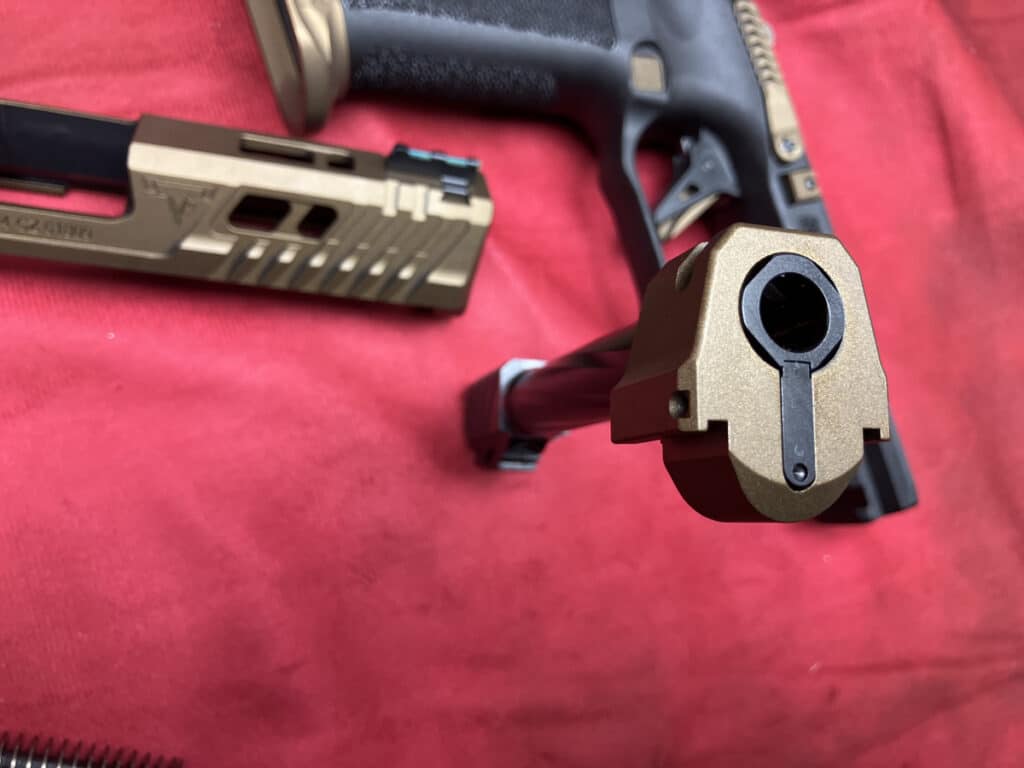
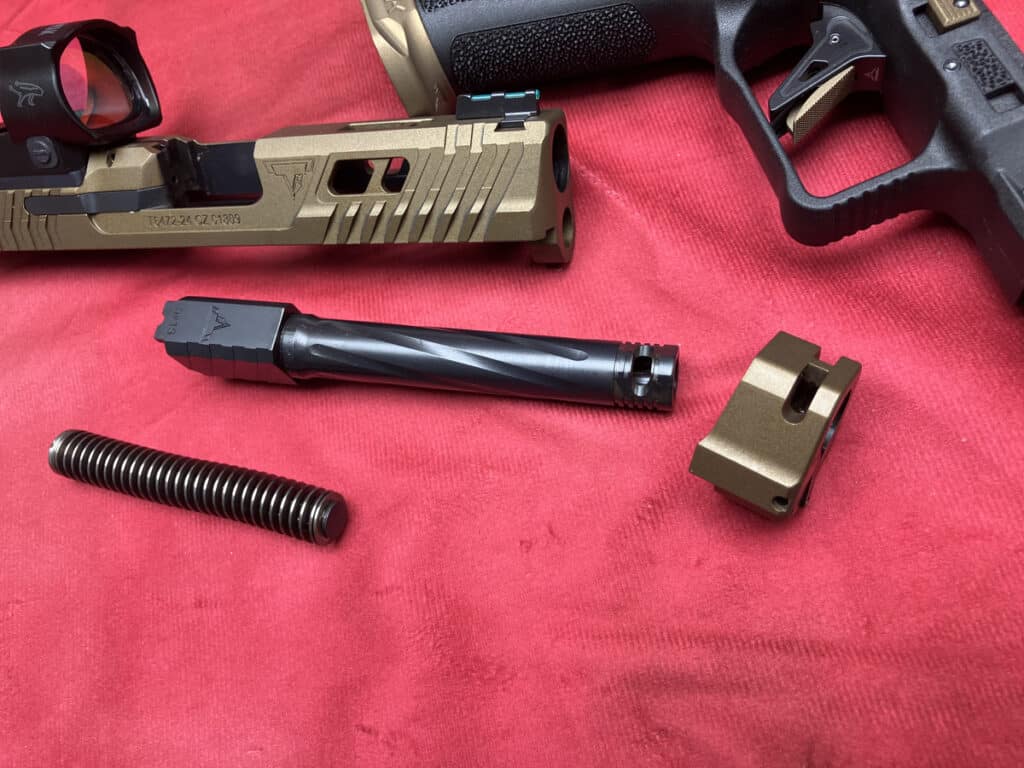
TTI designed a unique barrel to compensator connection method. (Todd Burgreen)
TTI Combat’s ported 4.6-inch barrel that fits under the compensator. (Todd Burgreen)

The TTI Combat arrives with a ported and spiral-fluted 4.6-inch barrel, a flat-faced 90-degree break trigger, fully adjustable sights, two 18-round magazines with one flush-fit TTI base pad and one +3 TTI base pad, a serrated and ambidextrous slide release, three backstrap size options, and multiple mounting plates to accommodate various red dot sights. The TTI Combat slide features a low-profile optic cut for the direct mount of CANiK’s MECANiK line of optics. The MECANiK red dot uses the Trijicon RMR pattern.

MAXIMUM EFFORT

Besides training, what are the most efficient ways to increase handgun efficiency gear-wise? It’s about having a pistol that provides reduced muzzle flip, sights that increase the ability to place rounds where desired, and a smooth trigger pull. It’s not about style but performance. Running your handgun more efficiently makes you deadlier when you’re in a fight for your life.

Personal defense has no responsibility to be “fair” or “even” contest. That’s why aftermarket products attract with the promise of superior performance. With the CANiK TTI Combat, you have something out of the box addressing these concerns, especially if you choose the model that comes with the MECANiK red dot sight (or mount one of your choosing.)

Compensators are expanding beyond competition applications and becoming more prominent in personal defense weapons. For this reason, compensator size is shrinking while still maintaining effectiveness. The TTI single-port comp extends only 0.62 inches from the slide. The CANiK compensator connects to the pistol’s fluted barrel via a camlock mount, not the typical screw-on to a threaded muzzle. The angled front faces on the TTI Combat compensator aid in holstering.

The compensator on the TTI Combat is considered a crucial part of the CANiK upgrade. Part of the challenge of using a handgun is controlling muzzle flip. Muzzle flip reduces the speed at which you can accurately fire multiple rounds on target as well as transition effectively to the next target. This is crucial in a personal defense encounter. Recoil and muzzle flip also cause the pistol to move in the hand. The weapon must return to alignment so the sight picture can be recovered before firing again. A compensator mitigates these effects.

BOTH EYES OPEN

The most obvious personal defense handgun equipment upgrade over the last 10 years must be red dot sights. Though technology should not be used as a crutch for diligent practice and training, red dots are a positive addition compared to the centuries-old iron sight concept. With a red dot, a user can focus on the target, as nature intends. Moreover, because indexing a red dot is far easier than aligning multiple pieces of steel on opposite ends of a reciprocating slide, shooters find they can shoot faster than they could with irons.

A CANiK MECANiK 03 was mounted to the TTI Combat. The MECANiK 03 uses a top-mounted CR2032 battery, offering 60,000 hours of run time. It features a 6 MOA dot. The anodized aluminum housing is durable while still weighing only 1.6 ounces. The MECANiK 03 is IPX7 waterproof rated. The low mounting position of the TTI Combat’s slide cut is appreciated, with the MECANiK 03’s dot seamlessly located. The choice of this red dot may elicit a snicker from elitists based on its Chinese origin. All I can say is that the one used for this article has been performing without issue for over 500 fast-paced rounds. Frankly, I like the field of view offered by its large window and thin housing.
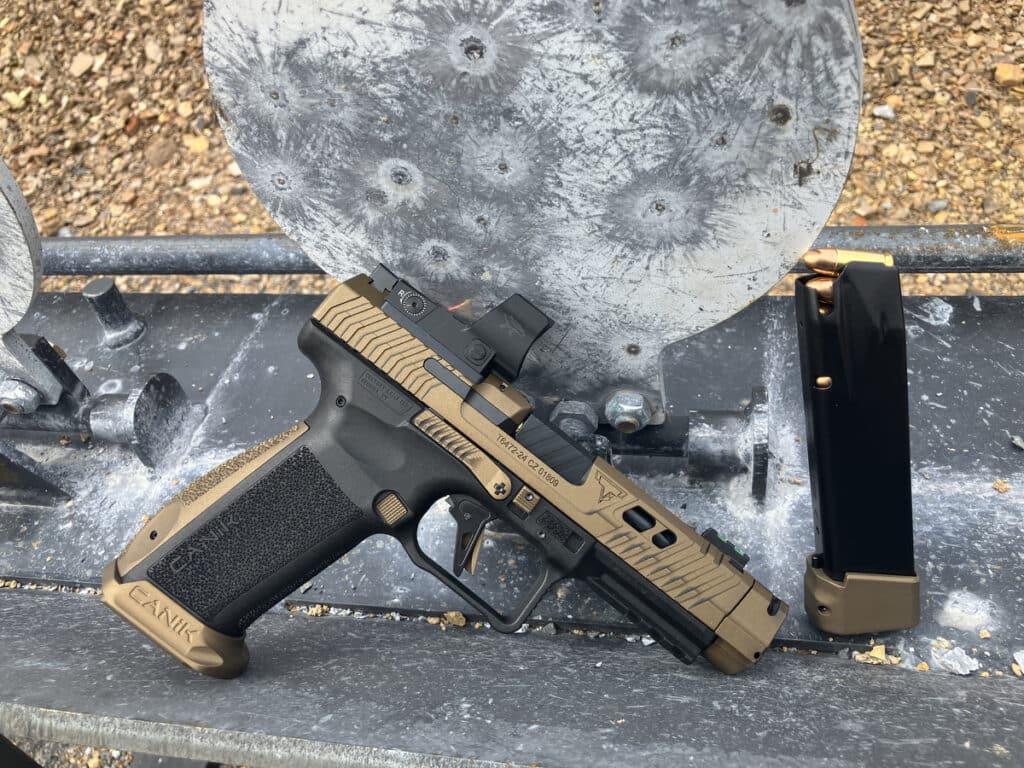
The most obvious personal defense handgun equipment upgrade over the last 10 years has to be red dot sights with compensators now joining in. CANiK TTI Combat has the ability to feature both. (Todd Burgreen)

The Butler/TTI-pattern CANiK frame maximizes the natural pointability of the TTI Combat. This is very important in the realm of both eyes open focusing on the target. The MECANiK 03 red dot plays its part as well. The large rectangular “windshield” offers a superior field of view compared to most other red dot options. The glass is clear with no color cast or other optical artifacts being obvious. The dot is crisp with no halos or disfiguration. The CANiK TTI Combat, combined with the MECANiK 03, proved very capable at quick target engagement, with shots broken faster than it takes to read the description.

Along with grip, the importance of the trigger cannot be overestimated. This is usually the realm of aftermarket upgrades. Which isn’t needed with the TTI Combat thanks to its enhanced CANiK aluminum trigger with a wide trigger shoe and safety tab to match. The trigger break was in the 3.5 to 4-pound range per my old school RCBS trigger pull scale. However, a very short and firm tactile reset puts it over the top in terms of effective triggers. An interview with Nils Jonasson sums it up best when he stated, “The whole point of our enhanced trigger is to allow the gun to fire without moving the front sight.”

The broad, flat face of the trigger allows a straight rearward press. All of this translates into a handgun that can send rounds downrange rapidly and accurately. The quality of the TTI Combat trigger is the real surprise and contributes to the feeling of getting more than expected, an envious position for any product. The key with the TTI Combat is it offers the same extraordinary trigger pull every time. The trigger is definitely an asset.

EVALUATION

After strapping on the holster provided in the TTI Combat kit, a variety of 9mm loads were tested, including Federal, Hornady, Wilson Combat, and Black Hills Ammunition. Plate racks and dueling trees were engaged. Thanks to the minimal recoil and muzzle flip, the MECANiK 03 dot could be oriented to the next target seamlessly. In other scenarios, the big question on my mind was how did the compensator affect muzzle flip. The MECANiK 03 stayed on target, fluttering around the IPSC “A” zone, but never wandered out of it, even during multiple round drills. The TTI Combat’s simplicity of operation, consistent trigger pull, and compensator allowed for the rapid engagement of targets. This is further accentuated with well-laid-out ergonomics ensuring that the hand is near the optimum grip position as soon as the TTI Combat clears the holster.
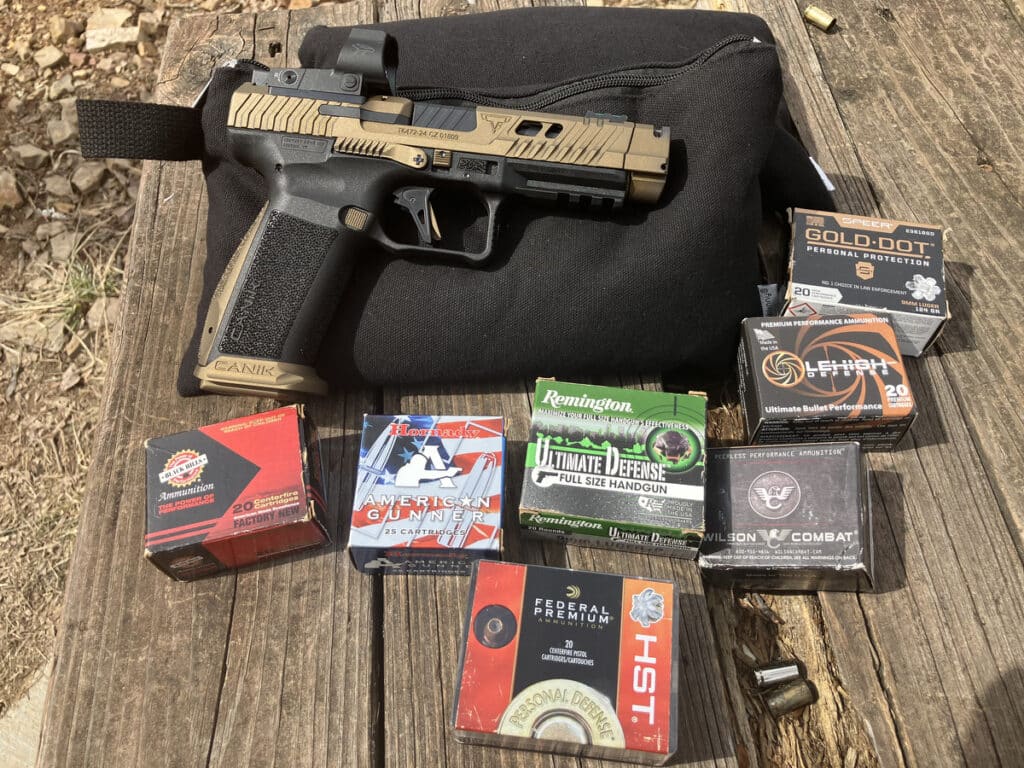
Sampling of the ammunition used with the CANiK TTI Combat along with .30 cal. cans of FMJ. (Todd Burgreen)

I fell back on my recent experience attending a Justified Defensive Concepts (JDC) Red Dot Pistol Essential class at EVTC with the CANiK TTI Combat. Brett Harnish, the founder and driving force behind JDC, structured the syllabus for the Red Dot course perfectly. To paraphrase, “It shows the benefits of red dot while helping you solve the biggest drawback folks face when using one reliably; finding your dot during the draw and maintaining visual contact with the red dot during strings of fire and after weapon manipulation.” JDC Red Dot Essentials provided solid training, something you would expect with Brett’s resume—Marine, Border Patrol agent, other law enforcement positions.
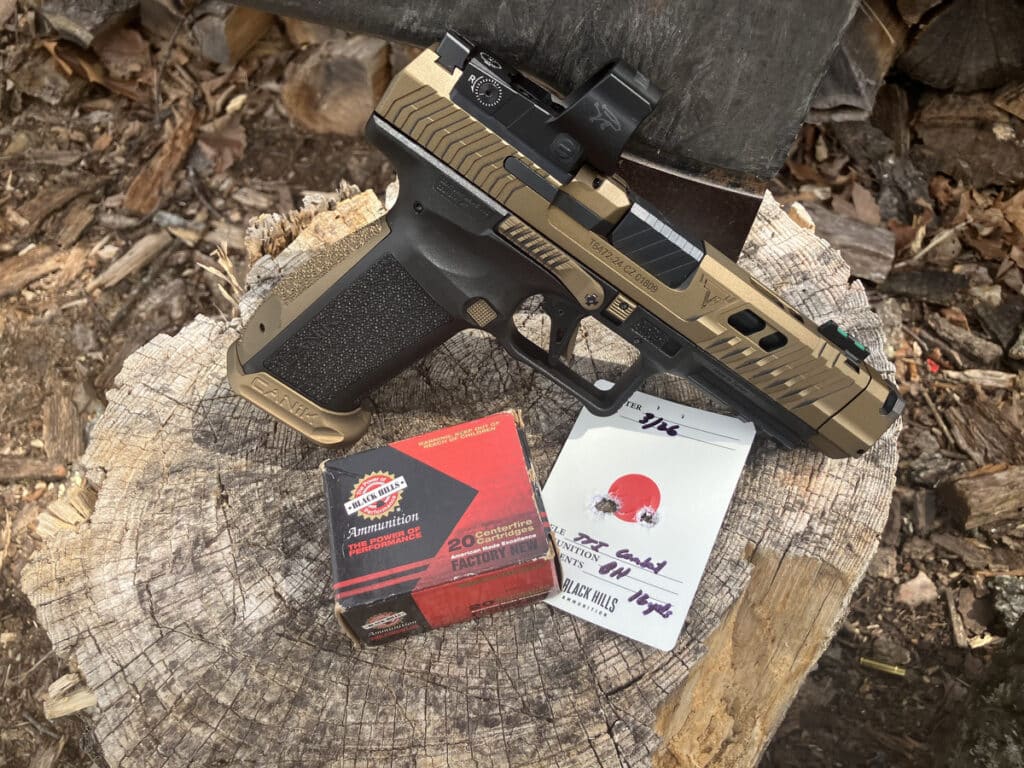
Example of accuracy exhibited by CANiK TTI Combat during sight in procedures. 5-rounds at 12 yards using Black Hills Ammunition. (Todd Burgreen)

The TTI was fired one-handed, including the use of the non-dominant hand to test the pistol for reliability issues that my stem from ammo sensitivity, especially with the compensator present. Premium self-defense JHP and target 9mm loads including 115-, 124-, and 147-grain bullets were fired. The TTI Combat digested anything fed to it. Being finicky is not an endearing trait with a competition or personal defense handgun. I put nearly 500 rounds through the TTI Combat for this article.

PERFORMANCE

 Avg. FPSAvg. 5-Shot Group 25 yards (In.)Best 5-Shot Group 25 yards (In.)
Remington 124gr JHP                               11522.251.75
Black Hills 124gr JHP11662.251.66
Hornady 147gr XTB 9312.251.75
Federal 124gr HST11732.52
Accuracy test protocol consisted of three five-shot groups with each ammunition type; Group sizes were averaged. Velocity figures obtained by averaging five rounds fired over Caldwell Precision Shooting chronograph. 

Diagnostic instructional scenarios in the form of the Bill Drill and IDPA 5×5 qualifier drills were used to explore what the TTI Combat offered. Each of these drills places a premium on recoil control, trigger manipulation, and sight tracking. JDC’s emphasis on the importance of grip for initial red dot placement as well as target focus was beneficial in performing these drills. Tracking the red dot up and down on target during multiple round drills reinforced that grip is the key. Proper grip starts from the holster and sets the stage for the most efficient use of a red dot-equipped handgun. The majority of aiming any pistol, red dot or not, is achieved through kinesthetic awareness. Kinesthetic awareness is the body’s knowledge of the relative location and engagement of tension in its parts. This especially pertains to red dots, with proper grip and tension applied to the pistol as soon as possible.

With the Bill Drill, you start with the handgun in the holster with hands in the “surrender” position at shoulder level or hanging down at your sides. A target is placed 7 yards downrange. On command, you draw and fire six rounds as rapidly as solid hits allow. Following your sights during recoil is crucial. When done properly, the front sight is never stationary… you just “ride” the recoil long enough to confirm the front post is back in the “A” zone and send another round into the target. The CANiK TTI Combat allowed me to generate times in the 2.5- to 2.8-second range.
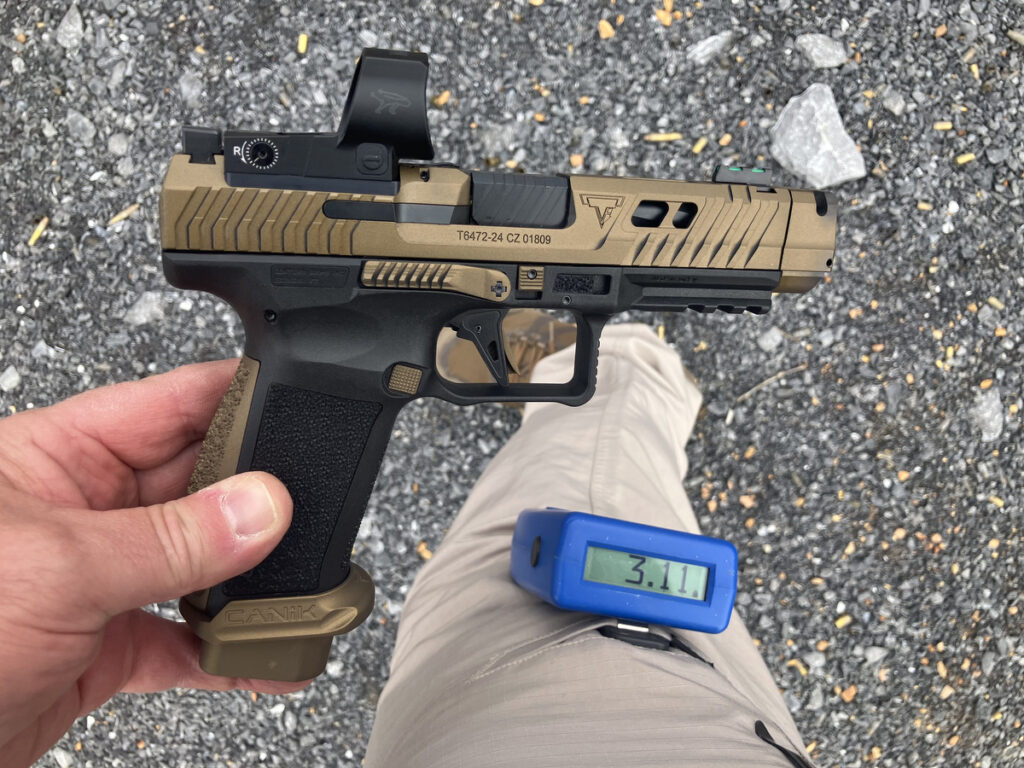
Out of the box time running a six plate-rack array from the holster with the CANiK TTI Combat. (Todd Burgreen)

The IDPA 5×5 classifier is another good indicator of how well you and the handgun meld together, especially if you track your performance with different handgun styles. The target is 10 yards away. Four strings of fire are used to generate a total time with penalties for anything out of the “A” zone. String 1 is draw and fire 5 rounds freestyle, String 2 is draw and fire 5 rounds strong hand only, String 3 is load 5 rounds into a magazine, draw and fire, then perform an emergency reload and fire 5 more rounds, and String 4 is draw and fire 4 rounds into the body and 1 round to the head, freestyle. The CANiK TTI Combat helped me generate times in the 22- to 24-second range for the IDPA classifier.

I felt I was letting the TTI Combat down at times during all the drills. The times recorded with the TTI Combat were some of my best, of late, and impressive considering it’s still a relatively new partnership between me and the weapon. You could tell the TTI Combat MECANiK 03 combo wanted to go faster, but my abilities were not up to it. This is a credit to the weapon. The MECANiK 03 sight combined with the compensator and TTI Combat ergonomics, minimizing muzzle flip, allowed for superior sight tracking between shots. The TTI Combat’s trigger pull was another significant advantage. The TTI Combat magwell behaved like a funnel during magazine changes. There were no reliability issues during the high-volume, fast-paced drills.

FINAL WORD

A few quick observations based on time spent on the range with the TTI Combat: CANiK advises that the MECANiK 03’s concave face housing is designed to rack the pistol with one hand if needed, without touching the lens. I do not favor this method. Why use your optic to leverage the slide open? Take advantage of the aggressive front and rear slide serrations to get the job done. However, be mindful of your hand placement when manually racking the slide. Do not grab too far forward on the slide near the comp. Two bad things can happen—you might pinch your hand between the slide and comp, or the slide might not move as you’re grabbing the compensator instead of the slide.
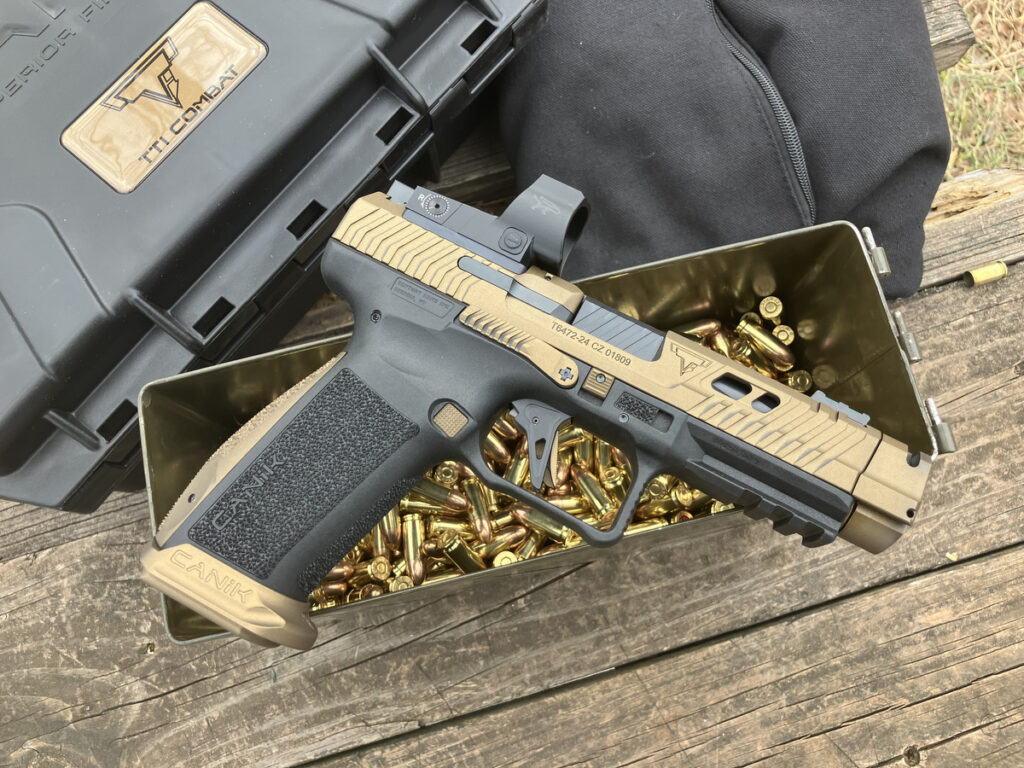
Many may ask what the TTI Combat offers to shooters compared to other polymer framed striker fired handguns already on the market. Red dot compatibility and compensator certainly obvious nice touch. (Todd Burgreen)

Lastly, concerns of blinding muzzle flash when using a compensator were not confirmed. Slow-motion videos and burst photography did not reveal this phenomenon. You could definitely see the gas cloud of muzzle blast directed upward, which counteracts muzzle flip—but no ignition.

The CANiK TTI Combat will be recognized as a combination of positive features found on striker-fired predecessors as well as many innovative tweaks, thanks to the TTI collaboration. Many may ask what the TTI Combat offers to shooters compared to other polymer-framed striker-fired handguns already on the market. Red dot compatibility and a compensator are certainly nice touches. The TTI Combat benefits from lessons from both CANiK and TTI, combined with a manufacturer intimately familiar with quality weapon production and how to tastefully improve upon a platform.

SPECIFICATIONS

MakeCANiK
ModelTTI Combat
Caliber9mm
Weight (empty)29.3 oz.
Overall Length7.85 in. (with comp)
Barrel4.6 in.
Magazine Capacity18-round
MSRP$949.99
URLTTI Combat (canikusa.com)

Author

  • Todd Burgreen
    Todd Burgreen

    View all posts
Tags: CanikPistolTaran Tactical InnovationsTTI
Previous Post

Book Review: Diving Deeper into the Browing Machine Gun

Next Post

Emmageeman’s Corner: Have a Pint of Maxim!

Next Post
Emmageeman’s Corner: Have a Pint of Maxim!

Emmageeman’s Corner: Have a Pint of Maxim!

TRENDING STORIES

  • The New Light and Handy Ruger American Generation II Ranch Rifle

    The New Light and Handy Ruger American Generation II Ranch Rifle

    0 shares
    Share 0 Tweet 0
  • True to Form: The Tisas 1911A1 ASF

    0 shares
    Share 0 Tweet 0
  • Winchester Model 70 Alaskan .375 Return of the Rifleman’s Rifle

    0 shares
    Share 0 Tweet 0
  • The Complete Guide To Colt M-16 Models: Part I

    0 shares
    Share 0 Tweet 0
  • Forgotten M16A1 Rifle Manufacturers: GM/Hydra-Matic and Harrington & Richardson – Part I

    0 shares
    Share 0 Tweet 0

RECENT POSTS

SIG Sauer’s Full-Size Compact P365 “Fuse”

SIG Sauer’s Full-Size Compact P365 “Fuse”

June 27, 2024
The Importance of Offhand Shooting

The Importance of Offhand Shooting

June 25, 2024
BOOK REVIEW – The Collector’s Guide to the SKS

BOOK REVIEW – The Collector’s Guide to the SKS

June 20, 2024
True to Form: The Tisas 1911A1 ASF

True to Form: The Tisas 1911A1 ASF

June 18, 2024
Setting the Record Straight on the Fedorov Avtomat

Setting the Record Straight on the Fedorov Avtomat

June 6, 2024

QUICK LINKS

  • About Chipotle Publishing
  • About Small Arms Review
  • Advertise with Us
  • Write for Us

CONTACT DETAILS

  • Phone: +1 (702) 565-0746
  • E-mail: office@smallarmsreview.com
  • Web: www.chipotlepublishing.com
  • Chipotle Publishing, LLC 631 N. Stephanie St., No. 282, Henderson, NV 89014
Small Arms Review

FOLLOW US

  • Privacy Policy
  • Disclaimer

© 2022 Chipotle Publishing | All Rights Reserved

Welcome Back!

Login to your account below

Forgotten Password?

Retrieve your password

Please enter your username or email address to reset your password.

Log In

Add New Playlist

No Result
View All Result
  • Home
  • Articles
    • Guns & Parts
    • Suppressors
    • Optics & Thermals
    • Ammunition
    • Gear
    • News & Opinion
    • Columns
    • Museums & Factory Tours
    • ID Guides
    • Interviews
    • Event Coverage
    • Articles by Issue
      • Volume 1
      • Volume 2
      • Volume 3
      • Volume 4
      • Volume 5
      • Volume 6
      • Volume 7
      • Volume 8
      • Volume 9
      • Volume 10
      • Volume 11
      • Volume 12
      • Volume 13
      • Volume 14
      • Volume 15
      • Volume 16
      • Volume 17
      • Volume 18
      • Volume 19
      • Volume 20
      • Volume 21
      • Volume 22
      • Volume 23
      • Volume 24
  • The Archive
    • Search The Archive
  • Store
    • Books
    • Back Issues
    • Merchandise
  • Events
  • About
    • About Small Arms Review
    • About Chipotle Publishing
    • Contact Us
    • Other Publications
      • Small Arms Defense Journal

© 2022 Chipotle Publishing | All Rights Reserved

This website uses cookies. By continuing to use this website you are giving consent to cookies being used. Visit our Privacy and Cookie Policy.

Redirecting to External Website

You are leaving the Small Arms Review website and will be redirected to an external link in a 5 Seconds.
VISIT NOW!