

Small Arms Review
  • Home
  • Articles
    • Guns & Parts
    • Suppressors
    • Optics & Thermals
    • Ammunition
    • Gear
    • News & Opinion
    • Columns
    • Museums & Factory Tours
    • ID Guides
    • Interviews
    • Event Coverage
    • Articles by Issue
      • Volume 1
        • V1N1 (Oct 1997)
        • V1N2 (Nov 1997)
        • V1N3 (Dec 1997)
        • V1N4 (Jan 1998)
        • V1N5 (Feb 1998)
        • V1N6 (Mar 1998)
        • V1N7 (Apr 1998)
        • V1N8 (May 1998)
        • V1N9 (Jun 1998)
        • V1N10 (Jul 1998)
        • V1N11 (Aug 1998)
        • V1N12 (Sep 1998)
      • Volume 2
        • V2N1 (Oct 1998)
        • V2N2 (Nov 1998)
        • V2N3 (Dec 1998)
        • V2N4 (Jan 1999)
        • V2N5 (Feb 1999)
        • V2N6 (Mar 1999)
        • V2N7 (Apr 1999)
        • V2N8 (May 1999)
        • V2N9 (Jun 1999)
        • V2N10 (Jul 1999)
        • V2N11 (Aug 1999)
        • V2N12 (Sep 1999)
      • Volume 3
        • V3N1 (Oct 1999)
        • V3N2 (Nov 1999)
        • V3N3 (Dec 1999)
        • V3N4 (Jan 2000)
        • V3N5 (Feb 2000)
        • V3N6 (Mar 2000)
        • V3N7 (Apr 2000)
        • V3N8 (May 2000)
        • V3N9 (Jun 2000)
        • V3N10 (Jul 2000)
        • V3N11 (Aug 2000)
        • V3N12 (Sep 2000)
      • Volume 4
        • V4N1 (Oct 2000)
        • V4N2 (Nov 2000)
        • V4N3 (Dec 2000)
        • V4N4 (Jan 2001)
        • V4N5 (Feb 2001)
        • V4N6 (Mar 2001)
        • V4N7 (Apr 2001)
        • V4N8 (May 2001)
        • V4N9 (Jun 2001)
        • V4N10 (Jul 2001)
        • V4N11 (Aug 2001)
        • V4N12 (Sep 2001)
      • Volume 5
        • V5N1 (Oct 2001)
        • V5N2 (Nov 2001)
        • V5N3 (Dec 2001)
        • V5N4 (Jan 2002)
        • V5N5 (Feb 2002)
        • V5N6 (Mar 2002)
        • V5N7 (Apr 2002)
        • V5N8 (May 2002)
        • V5N9 (Jun 2002)
        • V5N10 (Jul 2002)
        • V5N11 (Aug 2002)
        • V5N12 (Sep 2002)
      • Volume 6
        • V6N1 (Oct 2002)
        • V6N2 (Nov 2002)
        • V6N3 (Dec 2002)
        • V6N4 (Jan 2003)
        • V6N5 (Feb 2003)
        • V6N6 (Mar 2003)
        • V6N7 (Apr 2003)
        • V6N8 (May 2003)
        • V6N9 (Jun 2003)
        • V6N10 (Jul 2003)
        • V6N11 (Aug 2003)
        • V6N12 (Sep 2003)
      • Volume 7
        • V7N1 (Oct 2003)
        • V7N2 (Nov 2003)
        • V7N3 (Dec 2003)
        • V7N4 (Jan 2004)
        • V7N5 (Feb 2004)
        • V7N6 (Mar 2004)
        • V7N7 (Apr 2004)
        • V7N8 (May 2004)
        • V7N9 (Jun 2004)
        • V7N10 (Jul 2004)
        • V7N11 (Aug 2004)
        • V7N12 (Sep 2004)
      • Volume 8
        • V8N1 (Oct 2004)
        • V8N2 (Nov 2004)
        • V8N3 (Dec 2004)
        • V8N4 (Jan 2005)
        • V8N5 (Feb 2005)
        • V8N6 (Mar 2005)
        • V8N7 (Apr 2005)
        • V8N8 (May 2005)
        • V8N9 (Jun 2005)
        • V8N10 (Jul 2005)
        • V8N11 (Aug 2005)
        • V8N12 (Sep 2005)
      • Volume 9
        • V9N1 (Oct 2005)
        • V9N2 (Nov 2005)
        • V9N3 (Dec 2005)
        • V9N4 (Jan 2006)
        • V9N5 (Feb 2006)
        • V9N6 (Mar 2006)
        • V9N7 (Apr 2006)
        • V9N8 (May 2006)
        • V9N9 (Jun 2006)
        • V9N10 (Jul 2006)
        • V9N11 (Aug 2006)
        • V9N12 (Sep 2006)
      • Volume 10
        • V10N1 (Oct 2006)
        • V10N2 (Nov 2006)
        • V10N3 (Dec 2006)
        • V10N4 (Jan 2007)
        • V10N5 (Feb 2007)
        • V10N6 (Mar 2007)
        • V10N7 (Apr 2007)
        • V10N8 (May 2007)
        • V10N9 (Jun 2007)
        • V10N10 (Jul 2007)
        • V10N11 (Aug 2007)
        • V10N12 (Sep 2007)
      • Volume 11
        • V11N1 (Oct 2007)
        • V11N2 (Nov 2007)
        • V11N3 (Dec 2007)
        • V11N4 (Jan 2008)
        • V11N5 (Feb 2008)
        • V11N6 (Mar 2008)
        • V11N7 (Apr 2008)
        • V11N8 (May 2008)
        • V11N9 (Jun 2008)
        • V11N10 (Jul 2008)
        • V11N11 (Aug 2008)
        • V11N12 (Sep 2008)
      • Volume 12
        • V12N1 (Oct 2008)
        • V12N2 (Nov 2008)
        • V12N3 (Dec 2008)
        • V12N4 (Jan 2009)
        • V12N5 (Feb 2009)
        • V12N6 (Mar 2009)
        • V12N7 (Apr 2009)
        • V12N8 (May 2009)
        • V12N9 (Jun 2009)
        • V12N10 (Jul 2009)
        • V12N11 (Aug 2009)
        • V12N12 (Sep 2009)
      • Volume 13
        • V13N1 (Oct 2009)
        • V13N2 (Nov 2009)
        • V13N3 (Dec 2009)
        • V13N4 (Jan 2010)
        • V13N5 (Feb 2010)
        • V13N6 (Mar 2010)
        • V13N7 (Apr 2010)
        • V13N8 (May 2010)
        • V13N9 (Jun 2010)
        • V13N10 (Jul 2010)
        • V13N11 (Aug 2010)
        • V13N12 (Sep 2010)
      • Volume 14
        • V14N1 (Oct 2010)
        • V14N2 (Nov 2010)
        • V14N3 (Dec 2010)
          • Ammunition
        • V14N4 (Jan 2011)
        • V14N5 (Feb 2011)
        • V14N6 (Mar 2011)
        • V14N7 (Apr 2011)
        • V14N8 (May 2011)
        • V14N9 (Jun 2011)
        • V14N10 (Jul 2011)
        • V14N11 (Aug 2011)
        • V14N12 (Sep 2011)
      • Volume 15
        • V15N1 (Oct 2011)
        • V15N2 (Nov 2011)
        • V15N4 (Jan 2012)
        • V15N5 (Feb 2012)
      • Volume 16
        • V16N1 (1st Quarter 2012)
        • V16N2 (2nd Quarter 2012)
        • V16N3 (3rd Quarter 2012)
        • V16N4 (4th Quarter 2012)
      • Volume 17
        • V17N1 (1st Quarter 2013)
        • V17N2 (2nd Quarter 2013)
        • V17N3 (3rd Quarter 2013)
        • V17N4 (4th Quarter 2013)
      • Volume 18
        • V18N1 (Jan Feb 2014)
        • V18N2 (Mar Apr 2014)
        • V18N3 (May Jun 2014)
        • V18N4 (Jul Aug 2014)
        • V18N5 (Sep Oct 2014)
        • V18N6 (Nov Dec 2014)
      • Volume 19
        • V19N1 (Jan 2015)
        • V19N2 (Feb Mar 2015)
        • V19N3 (Apr 2015)
        • V19N4 (May 2015)
        • V19N5 (Jun 2015)
        • V19N6 (Jul 2015)
        • V19N7 (Aug Sep 2015)
        • V19N8 (Oct 2015)
        • V19N9 (Nov 2015)
        • V19N10 (Dec 2015)
      • Volume 20
        • V20N1 (Jan 2016)
        • V20N2 (Feb Mar 2016)
        • V20N3 (Apr 2016)
        • V20N4 (May 2016)
        • V20N5 (Jun 2016)
        • V20N6 (Jul 2016)
        • V20N7 (Aug Sep 2016)
        • V20N8 (Oct 2016)
        • V20N9 (Nov 2016)
        • V20N10 (Dec 2016)
      • Volume 21
        • V21N1 (Jan 2017)
        • V21N2 (Feb Mar 2017)
        • V21N3 (Apr 2017)
        • V21N4 (May 2017)
        • V21N5 (Jun 2017)
        • V21N6 (Jul 2017)
        • V21N7 (Aug Sep 2017)
        • V21N8 (Oct 2017)
        • V21N9 (Nov 2017)
        • V21N10 (Dec 2017)
      • Volume 22
        • V22N1 (Jan 2018)
        • V22N2 (Feb 2018)
        • V22N3 (March 2018)
        • V22N4 (Apr 2018)
        • V22N5 (May 2018)
        • V22N6 (Jun Jul 2018)
        • V22N7 (Aug Sep 2018)
        • V22N8 (Oct 2018)
        • V22N9 (Nov 2018)
        • V22N10 (Dec 2018)
      • Volume 23
        • V23N1 (Jan 2019)
        • V23N2 (Feb 2019)
        • V23N3 (Mar 2019)
        • V23N4 (Apr 2019)
        • V23N5 (May 2019)
        • V23N6 (Jun Jul 2019)
        • V23N7 (Aug Sep 2019)
        • V23N8 (Oct 2019)
        • V23N9 (Nov 2019)
        • V23N10 (Dec 2019)
      • Volume 24
        • V24N1 (Jan 2020)
        • V24N2 (Feb 2020)
        • V24N3 (Mar 2020)
        • V24N4 (Apr 2020)
        • V24N5 (May 2020)
        • V24N6 (Jun Jul 2020)
        • V24N7 (Aug Sep 2020)
        • V24N8 (Oct 2020)
        • V24N9 (Nov 2020)
        • V24N10 (Dec 2020)
  • The Archive
    • Search The Archive
  • Store
    • Books
    • Back Issues
    • Merchandise
  • Events
  • About
    • About Small Arms Review
    • About Chipotle Publishing
    • Contact Us
    • Other Publications
      • Small Arms Defense Journal
  • Home
  • Articles
    • Guns & Parts
    • Suppressors
    • Optics & Thermals
    • Ammunition
    • Gear
    • News & Opinion
    • Columns
    • Museums & Factory Tours
    • ID Guides
    • Interviews
    • Event Coverage
    • Articles by Issue
      • Volume 1
        • V1N1 (Oct 1997)
        • V1N2 (Nov 1997)
        • V1N3 (Dec 1997)
        • V1N4 (Jan 1998)
        • V1N5 (Feb 1998)
        • V1N6 (Mar 1998)
        • V1N7 (Apr 1998)
        • V1N8 (May 1998)
        • V1N9 (Jun 1998)
        • V1N10 (Jul 1998)
        • V1N11 (Aug 1998)
        • V1N12 (Sep 1998)
      • Volume 2
        • V2N1 (Oct 1998)
        • V2N2 (Nov 1998)
        • V2N3 (Dec 1998)
        • V2N4 (Jan 1999)
        • V2N5 (Feb 1999)
        • V2N6 (Mar 1999)
        • V2N7 (Apr 1999)
        • V2N8 (May 1999)
        • V2N9 (Jun 1999)
        • V2N10 (Jul 1999)
        • V2N11 (Aug 1999)
        • V2N12 (Sep 1999)
      • Volume 3
        • V3N1 (Oct 1999)
        • V3N2 (Nov 1999)
        • V3N3 (Dec 1999)
        • V3N4 (Jan 2000)
        • V3N5 (Feb 2000)
        • V3N6 (Mar 2000)
        • V3N7 (Apr 2000)
        • V3N8 (May 2000)
        • V3N9 (Jun 2000)
        • V3N10 (Jul 2000)
        • V3N11 (Aug 2000)
        • V3N12 (Sep 2000)
      • Volume 4
        • V4N1 (Oct 2000)
        • V4N2 (Nov 2000)
        • V4N3 (Dec 2000)
        • V4N4 (Jan 2001)
        • V4N5 (Feb 2001)
        • V4N6 (Mar 2001)
        • V4N7 (Apr 2001)
        • V4N8 (May 2001)
        • V4N9 (Jun 2001)
        • V4N10 (Jul 2001)
        • V4N11 (Aug 2001)
        • V4N12 (Sep 2001)
      • Volume 5
        • V5N1 (Oct 2001)
        • V5N2 (Nov 2001)
        • V5N3 (Dec 2001)
        • V5N4 (Jan 2002)
        • V5N5 (Feb 2002)
        • V5N6 (Mar 2002)
        • V5N7 (Apr 2002)
        • V5N8 (May 2002)
        • V5N9 (Jun 2002)
        • V5N10 (Jul 2002)
        • V5N11 (Aug 2002)
        • V5N12 (Sep 2002)
      • Volume 6
        • V6N1 (Oct 2002)
        • V6N2 (Nov 2002)
        • V6N3 (Dec 2002)
        • V6N4 (Jan 2003)
        • V6N5 (Feb 2003)
        • V6N6 (Mar 2003)
        • V6N7 (Apr 2003)
        • V6N8 (May 2003)
        • V6N9 (Jun 2003)
        • V6N10 (Jul 2003)
        • V6N11 (Aug 2003)
        • V6N12 (Sep 2003)
      • Volume 7
        • V7N1 (Oct 2003)
        • V7N2 (Nov 2003)
        • V7N3 (Dec 2003)
        • V7N4 (Jan 2004)
        • V7N5 (Feb 2004)
        • V7N6 (Mar 2004)
        • V7N7 (Apr 2004)
        • V7N8 (May 2004)
        • V7N9 (Jun 2004)
        • V7N10 (Jul 2004)
        • V7N11 (Aug 2004)
        • V7N12 (Sep 2004)
      • Volume 8
        • V8N1 (Oct 2004)
        • V8N2 (Nov 2004)
        • V8N3 (Dec 2004)
        • V8N4 (Jan 2005)
        • V8N5 (Feb 2005)
        • V8N6 (Mar 2005)
        • V8N7 (Apr 2005)
        • V8N8 (May 2005)
        • V8N9 (Jun 2005)
        • V8N10 (Jul 2005)
        • V8N11 (Aug 2005)
        • V8N12 (Sep 2005)
      • Volume 9
        • V9N1 (Oct 2005)
        • V9N2 (Nov 2005)
        • V9N3 (Dec 2005)
        • V9N4 (Jan 2006)
        • V9N5 (Feb 2006)
        • V9N6 (Mar 2006)
        • V9N7 (Apr 2006)
        • V9N8 (May 2006)
        • V9N9 (Jun 2006)
        • V9N10 (Jul 2006)
        • V9N11 (Aug 2006)
        • V9N12 (Sep 2006)
      • Volume 10
        • V10N1 (Oct 2006)
        • V10N2 (Nov 2006)
        • V10N3 (Dec 2006)
        • V10N4 (Jan 2007)
        • V10N5 (Feb 2007)
        • V10N6 (Mar 2007)
        • V10N7 (Apr 2007)
        • V10N8 (May 2007)
        • V10N9 (Jun 2007)
        • V10N10 (Jul 2007)
        • V10N11 (Aug 2007)
        • V10N12 (Sep 2007)
      • Volume 11
        • V11N1 (Oct 2007)
        • V11N2 (Nov 2007)
        • V11N3 (Dec 2007)
        • V11N4 (Jan 2008)
        • V11N5 (Feb 2008)
        • V11N6 (Mar 2008)
        • V11N7 (Apr 2008)
        • V11N8 (May 2008)
        • V11N9 (Jun 2008)
        • V11N10 (Jul 2008)
        • V11N11 (Aug 2008)
        • V11N12 (Sep 2008)
      • Volume 12
        • V12N1 (Oct 2008)
        • V12N2 (Nov 2008)
        • V12N3 (Dec 2008)
        • V12N4 (Jan 2009)
        • V12N5 (Feb 2009)
        • V12N6 (Mar 2009)
        • V12N7 (Apr 2009)
        • V12N8 (May 2009)
        • V12N9 (Jun 2009)
        • V12N10 (Jul 2009)
        • V12N11 (Aug 2009)
        • V12N12 (Sep 2009)
      • Volume 13
        • V13N1 (Oct 2009)
        • V13N2 (Nov 2009)
        • V13N3 (Dec 2009)
        • V13N4 (Jan 2010)
        • V13N5 (Feb 2010)
        • V13N6 (Mar 2010)
        • V13N7 (Apr 2010)
        • V13N8 (May 2010)
        • V13N9 (Jun 2010)
        • V13N10 (Jul 2010)
        • V13N11 (Aug 2010)
        • V13N12 (Sep 2010)
      • Volume 14
        • V14N1 (Oct 2010)
        • V14N2 (Nov 2010)
        • V14N3 (Dec 2010)
          • Ammunition
        • V14N4 (Jan 2011)
        • V14N5 (Feb 2011)
        • V14N6 (Mar 2011)
        • V14N7 (Apr 2011)
        • V14N8 (May 2011)
        • V14N9 (Jun 2011)
        • V14N10 (Jul 2011)
        • V14N11 (Aug 2011)
        • V14N12 (Sep 2011)
      • Volume 15
        • V15N1 (Oct 2011)
        • V15N2 (Nov 2011)
        • V15N4 (Jan 2012)
        • V15N5 (Feb 2012)
      • Volume 16
        • V16N1 (1st Quarter 2012)
        • V16N2 (2nd Quarter 2012)
        • V16N3 (3rd Quarter 2012)
        • V16N4 (4th Quarter 2012)
      • Volume 17
        • V17N1 (1st Quarter 2013)
        • V17N2 (2nd Quarter 2013)
        • V17N3 (3rd Quarter 2013)
        • V17N4 (4th Quarter 2013)
      • Volume 18
        • V18N1 (Jan Feb 2014)
        • V18N2 (Mar Apr 2014)
        • V18N3 (May Jun 2014)
        • V18N4 (Jul Aug 2014)
        • V18N5 (Sep Oct 2014)
        • V18N6 (Nov Dec 2014)
      • Volume 19
        • V19N1 (Jan 2015)
        • V19N2 (Feb Mar 2015)
        • V19N3 (Apr 2015)
        • V19N4 (May 2015)
        • V19N5 (Jun 2015)
        • V19N6 (Jul 2015)
        • V19N7 (Aug Sep 2015)
        • V19N8 (Oct 2015)
        • V19N9 (Nov 2015)
        • V19N10 (Dec 2015)
      • Volume 20
        • V20N1 (Jan 2016)
        • V20N2 (Feb Mar 2016)
        • V20N3 (Apr 2016)
        • V20N4 (May 2016)
        • V20N5 (Jun 2016)
        • V20N6 (Jul 2016)
        • V20N7 (Aug Sep 2016)
        • V20N8 (Oct 2016)
        • V20N9 (Nov 2016)
        • V20N10 (Dec 2016)
      • Volume 21
        • V21N1 (Jan 2017)
        • V21N2 (Feb Mar 2017)
        • V21N3 (Apr 2017)
        • V21N4 (May 2017)
        • V21N5 (Jun 2017)
        • V21N6 (Jul 2017)
        • V21N7 (Aug Sep 2017)
        • V21N8 (Oct 2017)
        • V21N9 (Nov 2017)
        • V21N10 (Dec 2017)
      • Volume 22
        • V22N1 (Jan 2018)
        • V22N2 (Feb 2018)
        • V22N3 (March 2018)
        • V22N4 (Apr 2018)
        • V22N5 (May 2018)
        • V22N6 (Jun Jul 2018)
        • V22N7 (Aug Sep 2018)
        • V22N8 (Oct 2018)
        • V22N9 (Nov 2018)
        • V22N10 (Dec 2018)
      • Volume 23
        • V23N1 (Jan 2019)
        • V23N2 (Feb 2019)
        • V23N3 (Mar 2019)
        • V23N4 (Apr 2019)
        • V23N5 (May 2019)
        • V23N6 (Jun Jul 2019)
        • V23N7 (Aug Sep 2019)
        • V23N8 (Oct 2019)
        • V23N9 (Nov 2019)
        • V23N10 (Dec 2019)
      • Volume 24
        • V24N1 (Jan 2020)
        • V24N2 (Feb 2020)
        • V24N3 (Mar 2020)
        • V24N4 (Apr 2020)
        • V24N5 (May 2020)
        • V24N6 (Jun Jul 2020)
        • V24N7 (Aug Sep 2020)
        • V24N8 (Oct 2020)
        • V24N9 (Nov 2020)
        • V24N10 (Dec 2020)
  • The Archive
    • Search The Archive
  • Store
    • Books
    • Back Issues
    • Merchandise
  • Events
  • About
    • About Small Arms Review
    • About Chipotle Publishing
    • Contact Us
    • Other Publications
      • Small Arms Defense Journal
No Result
View All Result
Small Arms Review
No Result
View All Result
Home Firearm History

Roth-Steyr M-1907: The Origin of the Rotary Barrel

by Pierangelo Tendas
May 7, 2024
in Firearm History
Roth-Steyr M-1907: The Origin of the Rotary Barrel

The Repetierpistole M.7 – a.k.a. the Roth-Steyr Model 1907 semi-automatic pistol – has the honor of being the world’s first semi-automatic pistol to be widely adopted by a major military power; the first rotary barrel firearm; and the first to use a “Safe Action” trigger.

Share on FacebookShare on Twitter

The history of the Steyr Arms company of Austria, formerly known as Steyr-Mannlicher, and previously as Steyr-Daimler Puch, Steyr-Werke, and OWG or “Österreichische Waffenfabriksgesellschaft Steyr”, is strictly intertwined with the development of the rotary barrel locking system for handheld firearms.

Most gun enthusiasts will know that the Swiss-made B&T MP9 rotary barrel sub-machine gun was developed by Steyr-Mannlicher and manufactured in Austria from 1992 to 2001 as the Steyr TMP; but that’s just scratching the surface. Things between Steyr and the rotary barrel go way back – to the early 20th Century, to be more precise.

A LOT OF FIRSTS

At the turn of the 20th Century, the Austro-Hungarian Empire was a centuries-old, declining global power, but a major power nonetheless; a status that it would formally retain until its defeat in World War I and its subsequent dissolution.

An exceptionally rare Roth-Theodorovic prototype pistol, designed by Austrian inventor Wasa Theodorovic under the financial support of Georg Roth. The Roth-Theodorovic never entered mass production, but the project would be modified by Karel Krnka into the Repetierpistole M.7. (Morphy Auction House)

As such, it retained a massive military that strived to remain equipped with the latest, cutting-edge technology. In 1898, the Austro-Hungarian army had adopted a new sidearm in the form of the Mod.1898 Rast & Gasser revolver. It was chambered for a proprietary 8mm Gasser rimmed cartridge. Despite fairly modern (for the time) features such as an eight-round cylinder and a double-action trigger, the Rast & Gasser retained other characteristics, including an Abadie gate-loading system and an ejector rod, that made it obsolete right from the very get go.
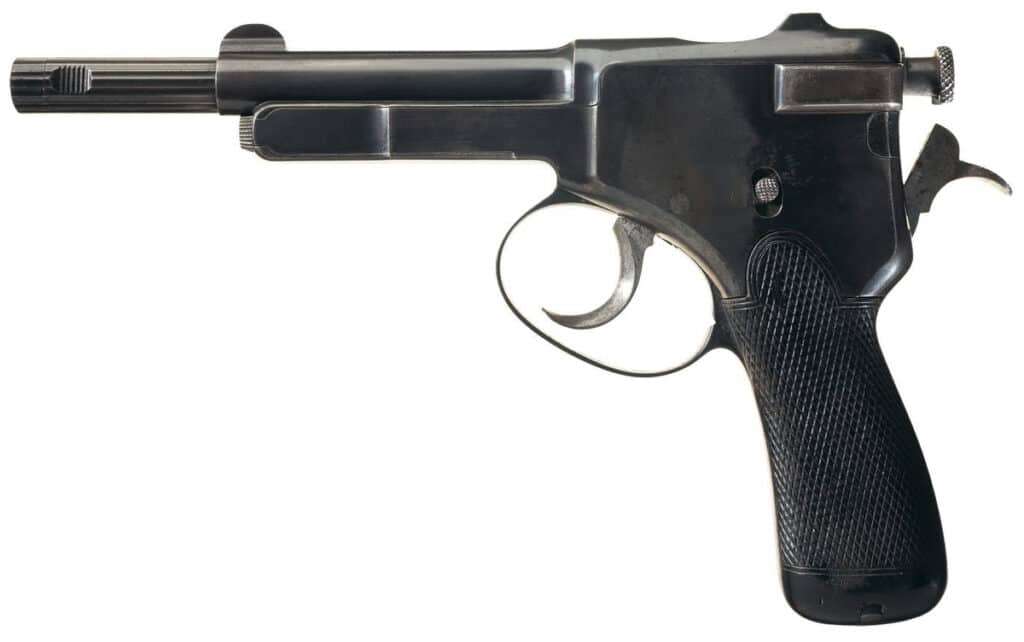
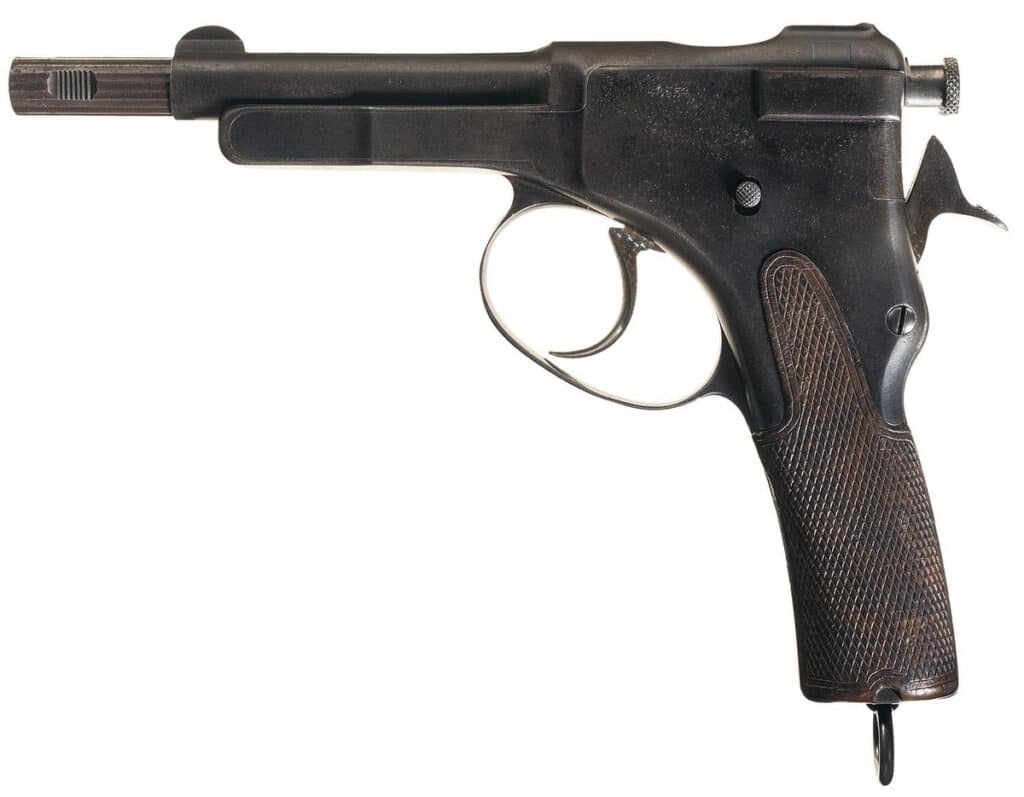
Three Roth-Krnka prototypes from 1895, major steps of the first major steps towards the final form of the Repetierpistole M.7, upgraded from the Roth-Theodorovic design as the project proceeded. The Rock Island Auction Company sold these samples respectively in December 2013 for $23,000, in September 2014 for $13,800, and in December 2016 for a staggering $37,325.
Born on April 6, 1856, and passed away on February 25, 1926, Karel Krnka is considered by many as the “John Moses Browning of the Austro-Hungarian Empire” (VHU – Military History Institute of Prague, Czech Republic).

And this, at a time when designers worldwide were already experimenting with increasingly reliable semi-automatic pistols that were seeing limited military adoption by the militaries of smaller countries and, in certain cases, by specialized troops and the navies of major powers, the Mauser C.96 was ordered by the Turkish Army, the Italian Navy, and saw success in China, while the Luger pistol first entered service in Switzerland, then with the Imperial Navy in Germany, a foreshadowing of the full-scale adoption that was to come.

Little did those countries know, the Habsburg empire would outrun them all, and with a domestic design nonetheless, the brainchild of Karel Krnka.

Born on April 6, 1856, and passed away on February 25, 1926, Karel Krnka is considered by many as the “John Moses Browning of the Austro-Hungarian Empire” (VHU – Military History Institute of Prague, Czech Republic).

Born in Bohemia (which was part of the Austro-Hungarian Empire and would now be in the Czech Republic), Karel Krnka followed in the footsteps of his father Sylvester, who had designed the breech-loading conversion for the 1857 Six-Line musket used by the Russian Empire. Early in his career, he designed a few ill-fated breech-loading, straight-pull, and bolt-action rifles. In the late 19th Century, after a stint in England, he started working on handguns under the patronage of Georg Roth, owner of one of the biggest ammunition manufacturing companies in the empire.

Some years earlier, another handgun designer by the name of Wasa Theodorovic had worked under the patronage of Roth, coming up with a series of pistol prototypes, aptly dubbed the Roth-Theodorovic, that the company had not been able to successfully pitch. Karel Krnka extensively reworked the original Theodorovic design into various prototypes, adding or removing features as the development phase went by. Among other things, Krnka did without an external hammer and any manual safety of sorts, briefly experimenting with a grip safety before settling on a peculiar striker-fired trigger system that looks very familiar today.

The final iteration of the pistol, now known as the Roth-Krnka, was submitted to the Austro-Hungarian military in 1906 and officially adopted in 1907, hence the official denomination “Repetierpistole M.7” for “Model 1907 repeating pistol”. The Austro-Hungarian government acquired all rights and appointed the two major firearm manufacturers of the Empire to produce it broad numbers for the entire military, with cavalry units being designed as early adopters due to the specific features that made the Repetierpistole M.7 ideal for cavalry units.

The biggest manufacturer was, of course, OWG (a.k.a. Steyr), which further refined the project from an industrial point of view, adapting it to broad-scale manufacturing. It produced approximately 60,000 samples, which is why the pistol is today known as “Roth-Steyr”. However, the FEMARU Fegyvergyár Részvénytársaság of Budapest (later known as FÉG) was also in the game, manufacturing about 30,000 samples from 1907 until the end of World War I.

Just like that, Austria-Hungary had beaten all major powers in adopting a semi-automatic pistol as the standard service sidearm for its armed forces.

FAMILIAR FEATURES

The Repetierpistole M.7 is a hefty piece of machined steel, with a very long, sliding bolt assembly entirely enclosed in the frame. Locking is achieved by two cams machined on the barrel itself, which engage two slots within the front of the bolt assembly that wraps around the barrel.

The project for the Roth-Steyr Model 1907 pistol was finalized in 1906. The pistol entered Austro-Hungarian military trials the same year and was adopted as the Repetierpistole M.7.

As the pistol is fired, the barrel moves with the bolt for approximately 13 mm (½-inch) until a set of two front cams integral to its cylindrical body engage with a corresponding set of helical guides machined into the barrel bushing, blocking its rearward movement. This disengages the barrel from the bolt body and forces it to rotate 90-degrees clockwise while the bolt assembly completes its rearward movement, ejecting a spent case and picking a new round from the magazine and feeding it to the chamber as it is pushed back to the locked position by the return spring.
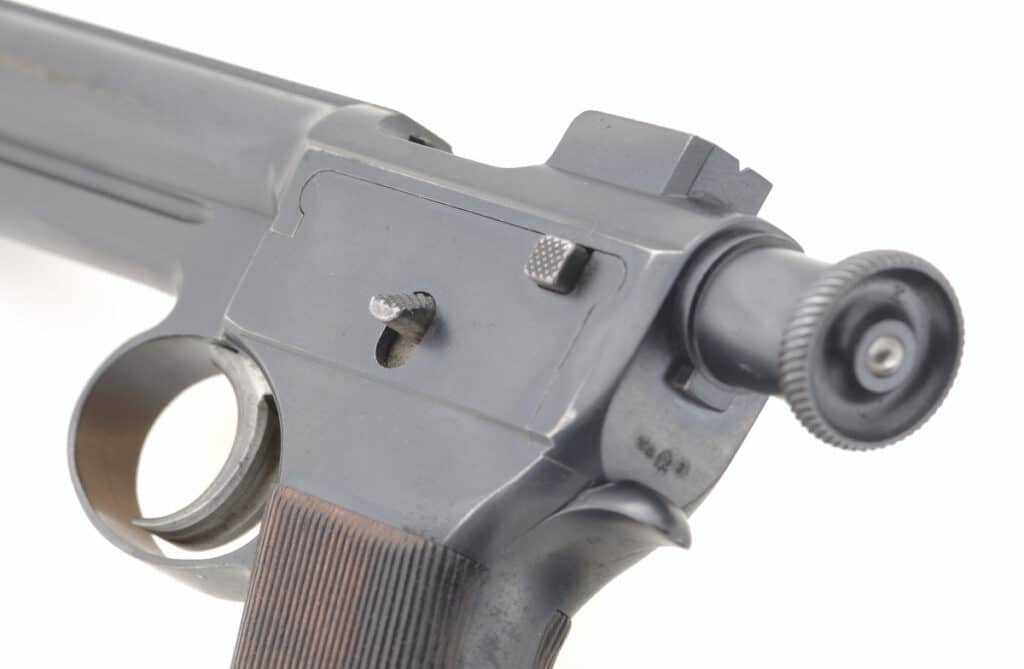
The controls of the Repetierpistole M.7. Behind the plunger that doubles as a cocking handle is the hold-open release catch, underneath is the magazine unloader.

The Repetierpistole M.7 is a striker-fired pistol, with a trigger that can be described as half-way between a single and double action. When the plunger (which hosts the striker) at the rear of the pistol’s body is pulled back and released, the rear portion of the striker’s body protrudes from the end cap to signal the cocking status; but the striker is actually only half-cocked. As pressure is applied to the trigger, the sear pushes the striker all the way back to a fully armed position until it disengages it, allowing the striker to spring down and hit the chambered round.

Should the round fail to fire, the striker must be manually cocked by pulling again on the plunger; a built-in safety intercept system prevents the striker from reaching the primer and igniting the round if the gun is fired when out of battery. When all ammunition is spent, the bolt assembly locks back to the open position; once the Repetierpistole M.7 is reloaded, it’s brought back to the locked position by pushing on a slide stop tab located above the grip.

What we are looking at, here, is essentially not only the first semi-automatic pistol to be adopted by a major military, and not only the world’s first rotary barrel pistol, but also the first “Safe Action” pistol. Glock’s signature trigger goes back a long way, but its roots are traced back to Austria. The trigger system was one of the reasons why the Roth-Steyr design was considered to be particularly adequate to the needs of cavalry units; the gun simply can’t fire by accident and features a hold-open device for one-handed operation.
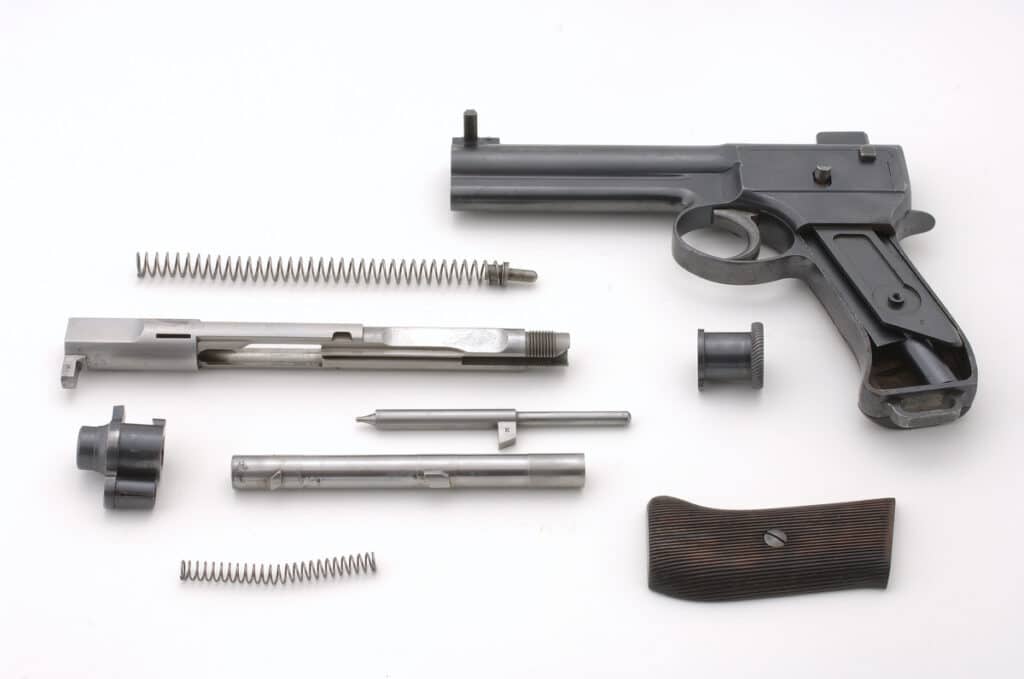
A fully disassembled Roth-Steyr Model 1907 pistol, showing the cammed rotating barrel and the long bolt assembly that partially wraps around it when closed. We also removed a grip panel to show the internal ten-round magazine.

The grip of the Repetierpistole M.7 is one with the frame, features wood panels, and double as the pistol’s magazine, which is loaded from the top via the ejection port using stripper clips. The M.7 held ten rounds of a proprietary .32 caliber (dubbed 8mm Steyr or, more accurately, 8×19mm Roth-Steyr). Slightly more powerful than 32 ACP, it was originally made available to the Austro-Hungarian military by its own ordnance factories in a 113-grain load with greased, unplated steel-jacketed bullets, although some private suppliers, including Georg Roth’s own factory, did manufacture cupro-nickel jacketed loads.

The Repetierpistole M.7 used 10-rounds stripper clips with a plunger to facilitate reloading. While reusable, the clips were often discarded. They are not exactly rare today, but not exceedingly rare either.
The engravings on the metal medallion within the wooden grips appear to indicate the year of issuance and the unit of the Austrian-Hungarian army that received the specific sample, but we were unable to verify.

Regardless, all ammunition for the M.7 came pre-loaded in a stripper clip with a plunger to assist loading and prevent mishaps that could cause rounds to be ejected uncontrollably under the pressure of the follower springs. The stripper clips were packaged individually, and the M.7 featured a tab located above the grip that could be pushed when the bolt was locked in the open position to unload the magazine by, you guessed it, just ejecting the rounds from the top window.

Original WWI 8mm Roth-Steyr ammunition and their loading clips packaged in cardboard boxes. Stripper clips in their original boxes, manufactured by the Georg Roth factory, nonetheless, are exceedingly rare. (Hermann Historica, Germany)
Front and rear sights of the Roth-Steyr pistol. They’re purely in the style of military pistol sights of the time, absolutely elementary in design.

FORGED IN FIRE

The service history of the Repetierpistole M.7 is inextricably tied to the downfall of the Austro-Hungarian Empire, as the pistol had its baptism of fire on the cruel battlefields of World War I. Outside of a small batch of German-produced Sauer variants of the design sold on the civilian market starting in 1900, in fact, the Roth-Steyr Model 1907 failed all military bids outside of Austria-Hungary, including two separate pitches to the militaries of the U.K. and the U.S., where it was unsuccessfully offered in a .45 caliber variant.

As the fortunes of war turned against the Central Empires, the number of M.7s in service quickly turned out to be insufficient. Starting in 1912, the Austro-Hungarian military had been complementing it with the Repetierpistole M.12, a.k.a. the Model 1912 Steyr Hahn, a hammer-fired, stripper-clip fed pistol that was easier to manufacture and more powerful than the Roth-Steyr, being chambered in 9×23mm Steyr and 9mm Luger.

Nevertheless, the Habsburg Empire’s need for handguns during the war ended up vastly outpacing the local industry capabilities; like their counterparts in the German Empire, the Austro-Hungarian troops had to resort to the “Behelfpistole” (“Necessity pistols”), often privately equipping themselves with commercial handguns chambered in a myriad of different calibers. As the defeated Empire collapsed and disintegrated after World War I, a myriad of new independent states were born where it once stood. These states, including the Austrian republic, Hungary, and Yugoslavia, ended up inheriting vast quantities of Repetierpistole M.7s and all fielded them before and (in small numbers) during World War II.

Austria’s arch-enemy Italy ended up capturing swathes of Roth-Steyr pistols during World War I and received many more as reparations; those guns were retained in service as rear-echelon sidearms for decades, so much so that Italy’s biggest ammunition manufacturer, Fiocchi, produced vast quantities of jacketed 8mm Roth-Steyr ammunition. The 1920s and 1930s saw those guns issued to Askari units with the Italian colonial troops in Africa, and in the final chaotic months of World War II, the Italian fascist troops that remained loyal to Mussolini and to the Germans fielded them in the last desperate attempts to stop the Allied offensive across the country.

That was the swan song of the Roth-Steyr Repetierpistole Model of 1907. Today, a small (but not small enough to make them rare) number of these survive on the civilian collector market in Europe and the United States. Their conditions may vary, but those that are still in good condition can return decent results at the range. Among other companies, Fiocchi still manufactures an 8mm Roth-Steyr load with Boxer primers and 113-grain FMJ bullets, developing approximately 329 fps of muzzle velocity and 290-foot pounds of muzzle energy, considered safe for these old timers.

An exceptionally rare Roth-Theodorovic prototype pistol, designed by Austrian inventor Wasa Theodorovic under the financial support of Georg Roth. The Roth-Theodorovic never entered mass production, but the project would be modified by Karel Krnka into the Repetierpistole M.7. (Morphy Auction House)
Produced in Germany for commercial sales and chambered in a proprietary 7.65 Roth caliber, the Roth-Sauer pistol of 1900 already sported all the key features of what would become the Repetierpistole M.7 in a scaled-down package (Rock Island Auction Company)

However, if well kept, the Roth-Steyr Repetierpistole M.7 can reasonably be tested with original ammunition. I remember such a case from early on in my career when I worked for the historical (and now defunct) Italian gun magazine “Diana Armi” in the early 2000s. My colleagues and firearm collectors Roberto Allara and Oscar Groppo fortuitously came into possession of ten 8mm Roth-Steyr rounds (marked “GR” (for Georg Roth!) and manufactured in 1910) that were recovered by a friend in the woods of northern Italy, the location of many bloody gunfights between fascist troops and partisans in the final months of World War II.

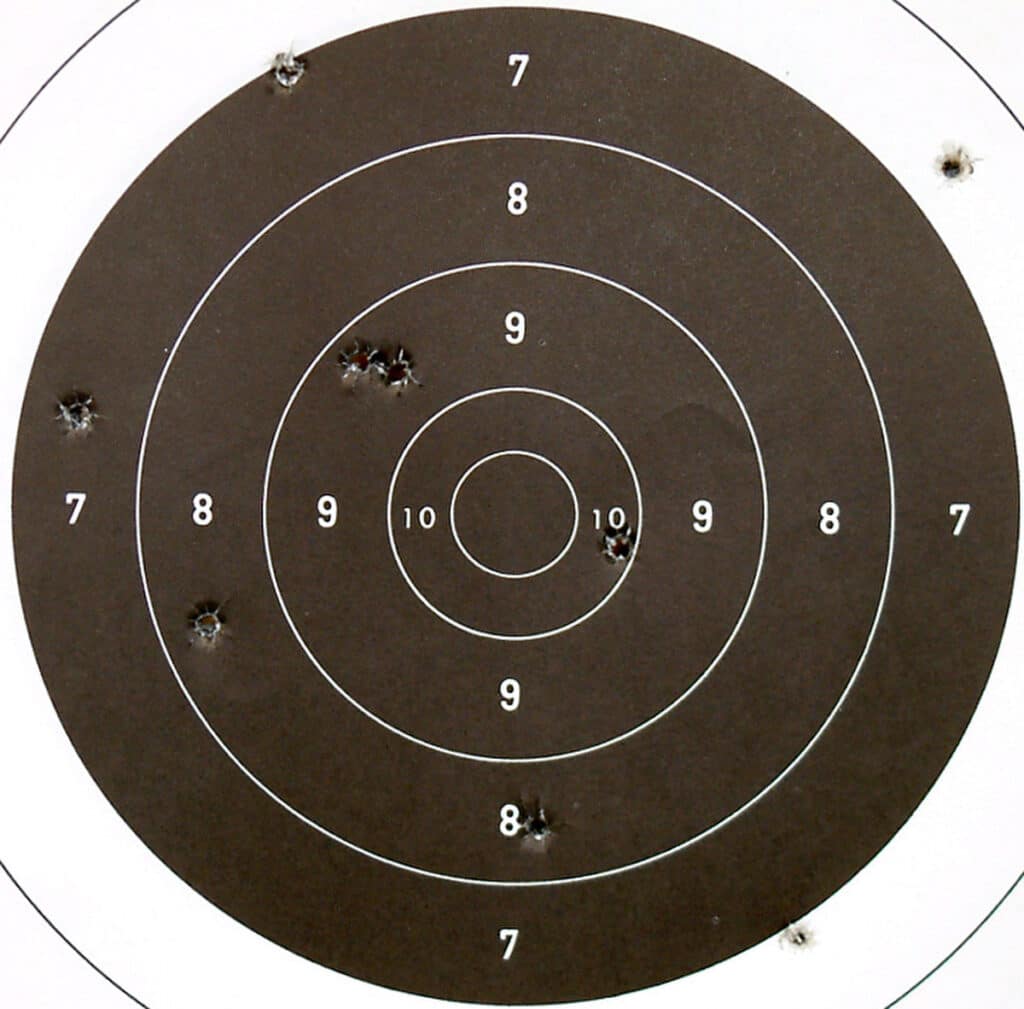
In the early days of the author’s career, in Italy, this very same Roth-Steyr pistol was tested with original 1910 manufactured Georg Roth ammunition found in northern Italy. Painstakingly checked and restored, the ammunition had spent almost a decade unused but didn’t show traces of corrosion.
The results of that accuracy test using the original-era ammunition: nine rounds out of ten on target, progressively getting closer to the bullseye. 8mm Roth-Steyr ammunition is still manufactured by Fiocchi and other firms, and the surviving Repetierpistole M.7s, if in good shape, can still return satisfactory results at the range.

Once each round was inspected for lack of corrosion and painstakingly restored, and, fighting back the protests of antique ammunition collectors who wanted to prevent such a waste, the two colleagues brought a third party on board who happened to own a Roth-Steyr M-1907 pistol. Two attempts to use the original stripper clip failed, but third time is always a charm… and there they went, on a 15-meter range, putting nine rounds out of ten on target, progressively getting closer to the bullseye. That’s what you get from a 100-year-old pistol and 100-year-old ammunition… if you’re brave enough.

The things we do for science…

TECHNICAL SPECIFICATIONS
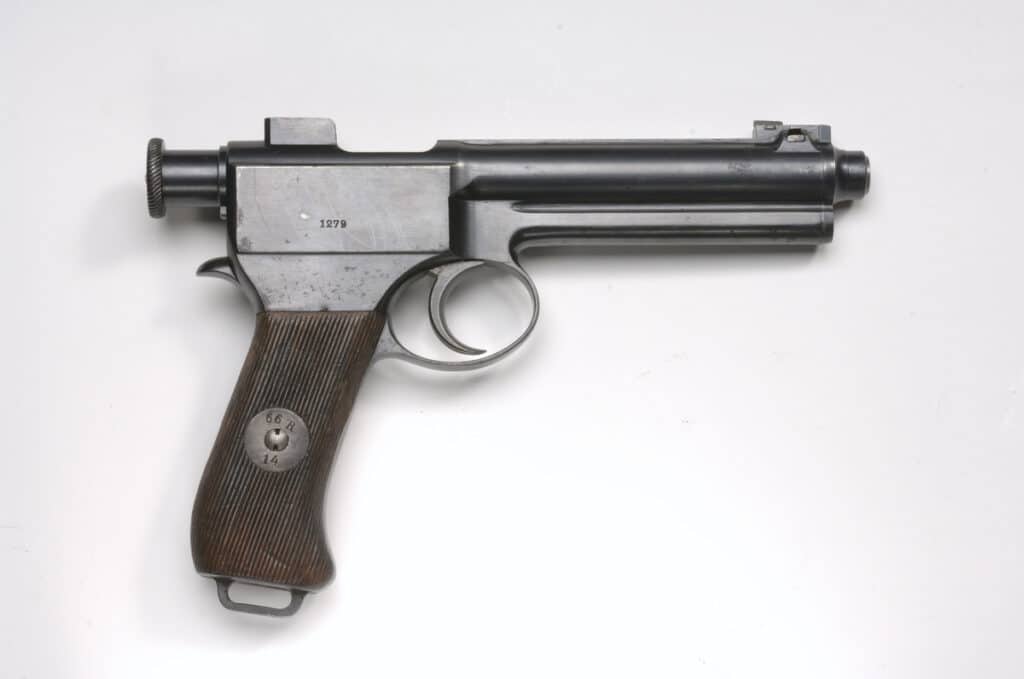
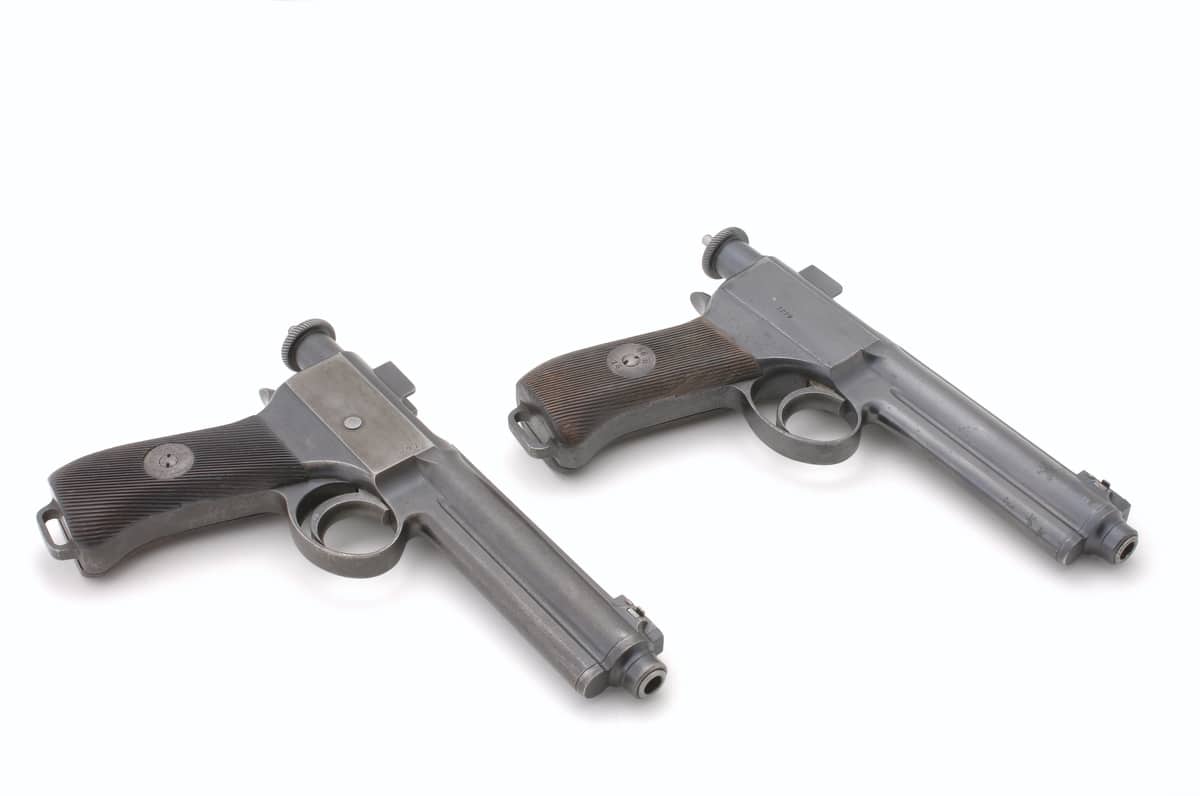
A Repetierpistole M.7 seen from the right side. The Roth-Steyr was only ever used by the Austrian-Hungarian Empire, failing at least two foreign military bids.
Left side of the Repetierpistole M.7. Notice the small “K” etched under the magazine unloading lever, indicating this sample was made by OWG a.k.a. Steyr.
ManufacturerOWG Steyr, FEMARU
ModelRoth-Steyr Repetierpistole Model 1907
TypeSemi-automatic pistol
Caliber8mm Roth-Steyr (8×19mm)
ActionSemi-automatic, striker-fired hybrid trigger, rotary barrel locking
SafetyNone – manual, automatic firing pin safety
CapacityTen rounds in internal magazine, loaded by stripper clip
Sight systemsFixed front post and rear
Barrel length5.1 in. 4-groove, RH
Total length9.1 in.
Weight (empty)2.2 lb.
MaterialsWood, steel

Author

  • Pierangelo Tendas
    Pierangelo Tendas

    Pierangelo Tendas (born in Italy in 1983) holds a university degree in journalism and has been active as a gun writer in Europe since 2004. In the past two decades, his articles have been published on Diana Armi, Armi e munizioni, Armi - The European magazine, Tecnologia e difesa and GUNSweek.com in Italy; All4shooters.com in Germany; Střelecká revue in the Czech Republic; and Small Arms Review and Small Arms Defense Journal in the United States. Lives in Sardinia, Italy.

    View all posts
Tags: OWGRotary BarrelSteyrWWI
Previous Post

Streamlight’s New Beartrap 360 Work Light

Next Post

B.E. Meyers Unveils the DAGIR Multi-Platform Aiming Laser System at SOF Week 2024

Next Post
B.E. Meyers Unveils the DAGIR Multi-Platform Aiming Laser System at SOF Week 2024

B.E. Meyers Unveils the DAGIR Multi-Platform Aiming Laser System at SOF Week 2024

TRENDING STORIES

  • The Alofs Reloading Magazine for Shotguns

    The Alofs Reloading Magazine for Shotguns

    0 shares
    Share 0 Tweet 0
  • The New Light and Handy Ruger American Generation II Ranch Rifle

    0 shares
    Share 0 Tweet 0
  • The Complete Guide To Colt M-16 Models: Part I

    0 shares
    Share 0 Tweet 0
  • True to Form: The Tisas 1911A1 ASF

    0 shares
    Share 0 Tweet 0
  • VALKYRIE ARMAMENT BELT-FED CONVERSION

    0 shares
    Share 0 Tweet 0

RECENT POSTS

SIG Sauer’s Full-Size Compact P365 “Fuse”

SIG Sauer’s Full-Size Compact P365 “Fuse”

June 27, 2024
The Importance of Offhand Shooting

The Importance of Offhand Shooting

June 25, 2024
BOOK REVIEW – The Collector’s Guide to the SKS

BOOK REVIEW – The Collector’s Guide to the SKS

June 20, 2024
True to Form: The Tisas 1911A1 ASF

True to Form: The Tisas 1911A1 ASF

June 18, 2024
Setting the Record Straight on the Fedorov Avtomat

Setting the Record Straight on the Fedorov Avtomat

June 6, 2024

QUICK LINKS

  • About Chipotle Publishing
  • About Small Arms Review
  • Advertise with Us
  • Write for Us

CONTACT DETAILS

  • Phone: +1 (702) 565-0746
  • E-mail: office@smallarmsreview.com
  • Web: www.chipotlepublishing.com
  • Chipotle Publishing, LLC 631 N. Stephanie St., No. 282, Henderson, NV 89014
Small Arms Review

FOLLOW US

  • Privacy Policy
  • Disclaimer

© 2022 Chipotle Publishing | All Rights Reserved

Welcome Back!

Login to your account below

Forgotten Password?

Retrieve your password

Please enter your username or email address to reset your password.

Log In

Add New Playlist

No Result
View All Result
  • Home
  • Articles
    • Guns & Parts
    • Suppressors
    • Optics & Thermals
    • Ammunition
    • Gear
    • News & Opinion
    • Columns
    • Museums & Factory Tours
    • ID Guides
    • Interviews
    • Event Coverage
    • Articles by Issue
      • Volume 1
      • Volume 2
      • Volume 3
      • Volume 4
      • Volume 5
      • Volume 6
      • Volume 7
      • Volume 8
      • Volume 9
      • Volume 10
      • Volume 11
      • Volume 12
      • Volume 13
      • Volume 14
      • Volume 15
      • Volume 16
      • Volume 17
      • Volume 18
      • Volume 19
      • Volume 20
      • Volume 21
      • Volume 22
      • Volume 23
      • Volume 24
  • The Archive
    • Search The Archive
  • Store
    • Books
    • Back Issues
    • Merchandise
  • Events
  • About
    • About Small Arms Review
    • About Chipotle Publishing
    • Contact Us
    • Other Publications
      • Small Arms Defense Journal

© 2022 Chipotle Publishing | All Rights Reserved

This website uses cookies. By continuing to use this website you are giving consent to cookies being used. Visit our Privacy and Cookie Policy.

Redirecting to External Website

You are leaving the Small Arms Review website and will be redirected to an external link in a 5 Seconds.
VISIT NOW!