


Small Arms Review
  • Home
  • Articles
    • Guns & Parts
    • Suppressors
    • Optics & Thermals
    • Ammunition
    • Gear
    • News & Opinion
    • Columns
    • Museums & Factory Tours
    • ID Guides
    • Interviews
    • Event Coverage
    • Articles by Issue
      • Volume 1
        • V1N1 (Oct 1997)
        • V1N2 (Nov 1997)
        • V1N3 (Dec 1997)
        • V1N4 (Jan 1998)
        • V1N5 (Feb 1998)
        • V1N6 (Mar 1998)
        • V1N7 (Apr 1998)
        • V1N8 (May 1998)
        • V1N9 (Jun 1998)
        • V1N10 (Jul 1998)
        • V1N11 (Aug 1998)
        • V1N12 (Sep 1998)
      • Volume 2
        • V2N1 (Oct 1998)
        • V2N2 (Nov 1998)
        • V2N3 (Dec 1998)
        • V2N4 (Jan 1999)
        • V2N5 (Feb 1999)
        • V2N6 (Mar 1999)
        • V2N7 (Apr 1999)
        • V2N8 (May 1999)
        • V2N9 (Jun 1999)
        • V2N10 (Jul 1999)
        • V2N11 (Aug 1999)
        • V2N12 (Sep 1999)
      • Volume 3
        • V3N1 (Oct 1999)
        • V3N2 (Nov 1999)
        • V3N3 (Dec 1999)
        • V3N4 (Jan 2000)
        • V3N5 (Feb 2000)
        • V3N6 (Mar 2000)
        • V3N7 (Apr 2000)
        • V3N8 (May 2000)
        • V3N9 (Jun 2000)
        • V3N10 (Jul 2000)
        • V3N11 (Aug 2000)
        • V3N12 (Sep 2000)
      • Volume 4
        • V4N1 (Oct 2000)
        • V4N2 (Nov 2000)
        • V4N3 (Dec 2000)
        • V4N4 (Jan 2001)
        • V4N5 (Feb 2001)
        • V4N6 (Mar 2001)
        • V4N7 (Apr 2001)
        • V4N8 (May 2001)
        • V4N9 (Jun 2001)
        • V4N10 (Jul 2001)
        • V4N11 (Aug 2001)
        • V4N12 (Sep 2001)
      • Volume 5
        • V5N1 (Oct 2001)
        • V5N2 (Nov 2001)
        • V5N3 (Dec 2001)
        • V5N4 (Jan 2002)
        • V5N5 (Feb 2002)
        • V5N6 (Mar 2002)
        • V5N7 (Apr 2002)
        • V5N8 (May 2002)
        • V5N9 (Jun 2002)
        • V5N10 (Jul 2002)
        • V5N11 (Aug 2002)
        • V5N12 (Sep 2002)
      • Volume 6
        • V6N1 (Oct 2002)
        • V6N2 (Nov 2002)
        • V6N3 (Dec 2002)
        • V6N4 (Jan 2003)
        • V6N5 (Feb 2003)
        • V6N6 (Mar 2003)
        • V6N7 (Apr 2003)
        • V6N8 (May 2003)
        • V6N9 (Jun 2003)
        • V6N10 (Jul 2003)
        • V6N11 (Aug 2003)
        • V6N12 (Sep 2003)
      • Volume 7
        • V7N1 (Oct 2003)
        • V7N2 (Nov 2003)
        • V7N3 (Dec 2003)
        • V7N4 (Jan 2004)
        • V7N5 (Feb 2004)
        • V7N6 (Mar 2004)
        • V7N7 (Apr 2004)
        • V7N8 (May 2004)
        • V7N9 (Jun 2004)
        • V7N10 (Jul 2004)
        • V7N11 (Aug 2004)
        • V7N12 (Sep 2004)
      • Volume 8
        • V8N1 (Oct 2004)
        • V8N2 (Nov 2004)
        • V8N3 (Dec 2004)
        • V8N4 (Jan 2005)
        • V8N5 (Feb 2005)
        • V8N6 (Mar 2005)
        • V8N7 (Apr 2005)
        • V8N8 (May 2005)
        • V8N9 (Jun 2005)
        • V8N10 (Jul 2005)
        • V8N11 (Aug 2005)
        • V8N12 (Sep 2005)
      • Volume 9
        • V9N1 (Oct 2005)
        • V9N2 (Nov 2005)
        • V9N3 (Dec 2005)
        • V9N4 (Jan 2006)
        • V9N5 (Feb 2006)
        • V9N6 (Mar 2006)
        • V9N7 (Apr 2006)
        • V9N8 (May 2006)
        • V9N9 (Jun 2006)
        • V9N10 (Jul 2006)
        • V9N11 (Aug 2006)
        • V9N12 (Sep 2006)
      • Volume 10
        • V10N1 (Oct 2006)
        • V10N2 (Nov 2006)
        • V10N3 (Dec 2006)
        • V10N4 (Jan 2007)
        • V10N5 (Feb 2007)
        • V10N6 (Mar 2007)
        • V10N7 (Apr 2007)
        • V10N8 (May 2007)
        • V10N9 (Jun 2007)
        • V10N10 (Jul 2007)
        • V10N11 (Aug 2007)
        • V10N12 (Sep 2007)
      • Volume 11
        • V11N1 (Oct 2007)
        • V11N2 (Nov 2007)
        • V11N3 (Dec 2007)
        • V11N4 (Jan 2008)
        • V11N5 (Feb 2008)
        • V11N6 (Mar 2008)
        • V11N7 (Apr 2008)
        • V11N8 (May 2008)
        • V11N9 (Jun 2008)
        • V11N10 (Jul 2008)
        • V11N11 (Aug 2008)
        • V11N12 (Sep 2008)
      • Volume 12
        • V12N1 (Oct 2008)
        • V12N2 (Nov 2008)
        • V12N3 (Dec 2008)
        • V12N4 (Jan 2009)
        • V12N5 (Feb 2009)
        • V12N6 (Mar 2009)
        • V12N7 (Apr 2009)
        • V12N8 (May 2009)
        • V12N9 (Jun 2009)
        • V12N10 (Jul 2009)
        • V12N11 (Aug 2009)
        • V12N12 (Sep 2009)
      • Volume 13
        • V13N1 (Oct 2009)
        • V13N2 (Nov 2009)
        • V13N3 (Dec 2009)
        • V13N4 (Jan 2010)
        • V13N5 (Feb 2010)
        • V13N6 (Mar 2010)
        • V13N7 (Apr 2010)
        • V13N8 (May 2010)
        • V13N9 (Jun 2010)
        • V13N10 (Jul 2010)
        • V13N11 (Aug 2010)
        • V13N12 (Sep 2010)
      • Volume 14
        • V14N1 (Oct 2010)
        • V14N2 (Nov 2010)
        • V14N3 (Dec 2010)
          • Ammunition
        • V14N4 (Jan 2011)
        • V14N5 (Feb 2011)
        • V14N6 (Mar 2011)
        • V14N7 (Apr 2011)
        • V14N8 (May 2011)
        • V14N9 (Jun 2011)
        • V14N10 (Jul 2011)
        • V14N11 (Aug 2011)
        • V14N12 (Sep 2011)
      • Volume 15
        • V15N1 (Oct 2011)
        • V15N2 (Nov 2011)
        • V15N4 (Jan 2012)
        • V15N5 (Feb 2012)
      • Volume 16
        • V16N1 (1st Quarter 2012)
        • V16N2 (2nd Quarter 2012)
        • V16N3 (3rd Quarter 2012)
        • V16N4 (4th Quarter 2012)
      • Volume 17
        • V17N1 (1st Quarter 2013)
        • V17N2 (2nd Quarter 2013)
        • V17N3 (3rd Quarter 2013)
        • V17N4 (4th Quarter 2013)
      • Volume 18
        • V18N1 (Jan Feb 2014)
        • V18N2 (Mar Apr 2014)
        • V18N3 (May Jun 2014)
        • V18N4 (Jul Aug 2014)
        • V18N5 (Sep Oct 2014)
        • V18N6 (Nov Dec 2014)
      • Volume 19
        • V19N1 (Jan 2015)
        • V19N2 (Feb Mar 2015)
        • V19N3 (Apr 2015)
        • V19N4 (May 2015)
        • V19N5 (Jun 2015)
        • V19N6 (Jul 2015)
        • V19N7 (Aug Sep 2015)
        • V19N8 (Oct 2015)
        • V19N9 (Nov 2015)
        • V19N10 (Dec 2015)
      • Volume 20
        • V20N1 (Jan 2016)
        • V20N2 (Feb Mar 2016)
        • V20N3 (Apr 2016)
        • V20N4 (May 2016)
        • V20N5 (Jun 2016)
        • V20N6 (Jul 2016)
        • V20N7 (Aug Sep 2016)
        • V20N8 (Oct 2016)
        • V20N9 (Nov 2016)
        • V20N10 (Dec 2016)
      • Volume 21
        • V21N1 (Jan 2017)
        • V21N2 (Feb Mar 2017)
        • V21N3 (Apr 2017)
        • V21N4 (May 2017)
        • V21N5 (Jun 2017)
        • V21N6 (Jul 2017)
        • V21N7 (Aug Sep 2017)
        • V21N8 (Oct 2017)
        • V21N9 (Nov 2017)
        • V21N10 (Dec 2017)
      • Volume 22
        • V22N1 (Jan 2018)
        • V22N2 (Feb 2018)
        • V22N3 (March 2018)
        • V22N4 (Apr 2018)
        • V22N5 (May 2018)
        • V22N6 (Jun Jul 2018)
        • V22N7 (Aug Sep 2018)
        • V22N8 (Oct 2018)
        • V22N9 (Nov 2018)
        • V22N10 (Dec 2018)
      • Volume 23
        • V23N1 (Jan 2019)
        • V23N2 (Feb 2019)
        • V23N3 (Mar 2019)
        • V23N4 (Apr 2019)
        • V23N5 (May 2019)
        • V23N6 (Jun Jul 2019)
        • V23N7 (Aug Sep 2019)
        • V23N8 (Oct 2019)
        • V23N9 (Nov 2019)
        • V23N10 (Dec 2019)
      • Volume 24
        • V24N1 (Jan 2020)
        • V24N2 (Feb 2020)
        • V24N3 (Mar 2020)
        • V24N4 (Apr 2020)
        • V24N5 (May 2020)
        • V24N6 (Jun Jul 2020)
        • V24N7 (Aug Sep 2020)
        • V24N8 (Oct 2020)
        • V24N9 (Nov 2020)
        • V24N10 (Dec 2020)
  • The Archive
    • Search The Archive
  • Store
    • Books
    • Back Issues
    • Merchandise
  • Events
  • About
    • About Small Arms Review
    • About Chipotle Publishing
    • Contact Us
    • Other Publications
      • Small Arms Defense Journal
  • Home
  • Articles
    • Guns & Parts
    • Suppressors
    • Optics & Thermals
    • Ammunition
    • Gear
    • News & Opinion
    • Columns
    • Museums & Factory Tours
    • ID Guides
    • Interviews
    • Event Coverage
    • Articles by Issue
      • Volume 1
        • V1N1 (Oct 1997)
        • V1N2 (Nov 1997)
        • V1N3 (Dec 1997)
        • V1N4 (Jan 1998)
        • V1N5 (Feb 1998)
        • V1N6 (Mar 1998)
        • V1N7 (Apr 1998)
        • V1N8 (May 1998)
        • V1N9 (Jun 1998)
        • V1N10 (Jul 1998)
        • V1N11 (Aug 1998)
        • V1N12 (Sep 1998)
      • Volume 2
        • V2N1 (Oct 1998)
        • V2N2 (Nov 1998)
        • V2N3 (Dec 1998)
        • V2N4 (Jan 1999)
        • V2N5 (Feb 1999)
        • V2N6 (Mar 1999)
        • V2N7 (Apr 1999)
        • V2N8 (May 1999)
        • V2N9 (Jun 1999)
        • V2N10 (Jul 1999)
        • V2N11 (Aug 1999)
        • V2N12 (Sep 1999)
      • Volume 3
        • V3N1 (Oct 1999)
        • V3N2 (Nov 1999)
        • V3N3 (Dec 1999)
        • V3N4 (Jan 2000)
        • V3N5 (Feb 2000)
        • V3N6 (Mar 2000)
        • V3N7 (Apr 2000)
        • V3N8 (May 2000)
        • V3N9 (Jun 2000)
        • V3N10 (Jul 2000)
        • V3N11 (Aug 2000)
        • V3N12 (Sep 2000)
      • Volume 4
        • V4N1 (Oct 2000)
        • V4N2 (Nov 2000)
        • V4N3 (Dec 2000)
        • V4N4 (Jan 2001)
        • V4N5 (Feb 2001)
        • V4N6 (Mar 2001)
        • V4N7 (Apr 2001)
        • V4N8 (May 2001)
        • V4N9 (Jun 2001)
        • V4N10 (Jul 2001)
        • V4N11 (Aug 2001)
        • V4N12 (Sep 2001)
      • Volume 5
        • V5N1 (Oct 2001)
        • V5N2 (Nov 2001)
        • V5N3 (Dec 2001)
        • V5N4 (Jan 2002)
        • V5N5 (Feb 2002)
        • V5N6 (Mar 2002)
        • V5N7 (Apr 2002)
        • V5N8 (May 2002)
        • V5N9 (Jun 2002)
        • V5N10 (Jul 2002)
        • V5N11 (Aug 2002)
        • V5N12 (Sep 2002)
      • Volume 6
        • V6N1 (Oct 2002)
        • V6N2 (Nov 2002)
        • V6N3 (Dec 2002)
        • V6N4 (Jan 2003)
        • V6N5 (Feb 2003)
        • V6N6 (Mar 2003)
        • V6N7 (Apr 2003)
        • V6N8 (May 2003)
        • V6N9 (Jun 2003)
        • V6N10 (Jul 2003)
        • V6N11 (Aug 2003)
        • V6N12 (Sep 2003)
      • Volume 7
        • V7N1 (Oct 2003)
        • V7N2 (Nov 2003)
        • V7N3 (Dec 2003)
        • V7N4 (Jan 2004)
        • V7N5 (Feb 2004)
        • V7N6 (Mar 2004)
        • V7N7 (Apr 2004)
        • V7N8 (May 2004)
        • V7N9 (Jun 2004)
        • V7N10 (Jul 2004)
        • V7N11 (Aug 2004)
        • V7N12 (Sep 2004)
      • Volume 8
        • V8N1 (Oct 2004)
        • V8N2 (Nov 2004)
        • V8N3 (Dec 2004)
        • V8N4 (Jan 2005)
        • V8N5 (Feb 2005)
        • V8N6 (Mar 2005)
        • V8N7 (Apr 2005)
        • V8N8 (May 2005)
        • V8N9 (Jun 2005)
        • V8N10 (Jul 2005)
        • V8N11 (Aug 2005)
        • V8N12 (Sep 2005)
      • Volume 9
        • V9N1 (Oct 2005)
        • V9N2 (Nov 2005)
        • V9N3 (Dec 2005)
        • V9N4 (Jan 2006)
        • V9N5 (Feb 2006)
        • V9N6 (Mar 2006)
        • V9N7 (Apr 2006)
        • V9N8 (May 2006)
        • V9N9 (Jun 2006)
        • V9N10 (Jul 2006)
        • V9N11 (Aug 2006)
        • V9N12 (Sep 2006)
      • Volume 10
        • V10N1 (Oct 2006)
        • V10N2 (Nov 2006)
        • V10N3 (Dec 2006)
        • V10N4 (Jan 2007)
        • V10N5 (Feb 2007)
        • V10N6 (Mar 2007)
        • V10N7 (Apr 2007)
        • V10N8 (May 2007)
        • V10N9 (Jun 2007)
        • V10N10 (Jul 2007)
        • V10N11 (Aug 2007)
        • V10N12 (Sep 2007)
      • Volume 11
        • V11N1 (Oct 2007)
        • V11N2 (Nov 2007)
        • V11N3 (Dec 2007)
        • V11N4 (Jan 2008)
        • V11N5 (Feb 2008)
        • V11N6 (Mar 2008)
        • V11N7 (Apr 2008)
        • V11N8 (May 2008)
        • V11N9 (Jun 2008)
        • V11N10 (Jul 2008)
        • V11N11 (Aug 2008)
        • V11N12 (Sep 2008)
      • Volume 12
        • V12N1 (Oct 2008)
        • V12N2 (Nov 2008)
        • V12N3 (Dec 2008)
        • V12N4 (Jan 2009)
        • V12N5 (Feb 2009)
        • V12N6 (Mar 2009)
        • V12N7 (Apr 2009)
        • V12N8 (May 2009)
        • V12N9 (Jun 2009)
        • V12N10 (Jul 2009)
        • V12N11 (Aug 2009)
        • V12N12 (Sep 2009)
      • Volume 13
        • V13N1 (Oct 2009)
        • V13N2 (Nov 2009)
        • V13N3 (Dec 2009)
        • V13N4 (Jan 2010)
        • V13N5 (Feb 2010)
        • V13N6 (Mar 2010)
        • V13N7 (Apr 2010)
        • V13N8 (May 2010)
        • V13N9 (Jun 2010)
        • V13N10 (Jul 2010)
        • V13N11 (Aug 2010)
        • V13N12 (Sep 2010)
      • Volume 14
        • V14N1 (Oct 2010)
        • V14N2 (Nov 2010)
        • V14N3 (Dec 2010)
          • Ammunition
        • V14N4 (Jan 2011)
        • V14N5 (Feb 2011)
        • V14N6 (Mar 2011)
        • V14N7 (Apr 2011)
        • V14N8 (May 2011)
        • V14N9 (Jun 2011)
        • V14N10 (Jul 2011)
        • V14N11 (Aug 2011)
        • V14N12 (Sep 2011)
      • Volume 15
        • V15N1 (Oct 2011)
        • V15N2 (Nov 2011)
        • V15N4 (Jan 2012)
        • V15N5 (Feb 2012)
      • Volume 16
        • V16N1 (1st Quarter 2012)
        • V16N2 (2nd Quarter 2012)
        • V16N3 (3rd Quarter 2012)
        • V16N4 (4th Quarter 2012)
      • Volume 17
        • V17N1 (1st Quarter 2013)
        • V17N2 (2nd Quarter 2013)
        • V17N3 (3rd Quarter 2013)
        • V17N4 (4th Quarter 2013)
      • Volume 18
        • V18N1 (Jan Feb 2014)
        • V18N2 (Mar Apr 2014)
        • V18N3 (May Jun 2014)
        • V18N4 (Jul Aug 2014)
        • V18N5 (Sep Oct 2014)
        • V18N6 (Nov Dec 2014)
      • Volume 19
        • V19N1 (Jan 2015)
        • V19N2 (Feb Mar 2015)
        • V19N3 (Apr 2015)
        • V19N4 (May 2015)
        • V19N5 (Jun 2015)
        • V19N6 (Jul 2015)
        • V19N7 (Aug Sep 2015)
        • V19N8 (Oct 2015)
        • V19N9 (Nov 2015)
        • V19N10 (Dec 2015)
      • Volume 20
        • V20N1 (Jan 2016)
        • V20N2 (Feb Mar 2016)
        • V20N3 (Apr 2016)
        • V20N4 (May 2016)
        • V20N5 (Jun 2016)
        • V20N6 (Jul 2016)
        • V20N7 (Aug Sep 2016)
        • V20N8 (Oct 2016)
        • V20N9 (Nov 2016)
        • V20N10 (Dec 2016)
      • Volume 21
        • V21N1 (Jan 2017)
        • V21N2 (Feb Mar 2017)
        • V21N3 (Apr 2017)
        • V21N4 (May 2017)
        • V21N5 (Jun 2017)
        • V21N6 (Jul 2017)
        • V21N7 (Aug Sep 2017)
        • V21N8 (Oct 2017)
        • V21N9 (Nov 2017)
        • V21N10 (Dec 2017)
      • Volume 22
        • V22N1 (Jan 2018)
        • V22N2 (Feb 2018)
        • V22N3 (March 2018)
        • V22N4 (Apr 2018)
        • V22N5 (May 2018)
        • V22N6 (Jun Jul 2018)
        • V22N7 (Aug Sep 2018)
        • V22N8 (Oct 2018)
        • V22N9 (Nov 2018)
        • V22N10 (Dec 2018)
      • Volume 23
        • V23N1 (Jan 2019)
        • V23N2 (Feb 2019)
        • V23N3 (Mar 2019)
        • V23N4 (Apr 2019)
        • V23N5 (May 2019)
        • V23N6 (Jun Jul 2019)
        • V23N7 (Aug Sep 2019)
        • V23N8 (Oct 2019)
        • V23N9 (Nov 2019)
        • V23N10 (Dec 2019)
      • Volume 24
        • V24N1 (Jan 2020)
        • V24N2 (Feb 2020)
        • V24N3 (Mar 2020)
        • V24N4 (Apr 2020)
        • V24N5 (May 2020)
        • V24N6 (Jun Jul 2020)
        • V24N7 (Aug Sep 2020)
        • V24N8 (Oct 2020)
        • V24N9 (Nov 2020)
        • V24N10 (Dec 2020)
  • The Archive
    • Search The Archive
  • Store
    • Books
    • Back Issues
    • Merchandise
  • Events
  • About
    • About Small Arms Review
    • About Chipotle Publishing
    • Contact Us
    • Other Publications
      • Small Arms Defense Journal
No Result
View All Result
Small Arms Review
No Result
View All Result
Home Ammunition

The Soviet PPS-43 Submachine Gun

by SAR Staff
February 1, 2014
in Ammunition, Articles, Articles by Issue, Guns & Parts, Search by Issue, V18N1 (Jan Feb 2014), Volume 18
The Soviet PPS-43 Submachine Gun
Share on FacebookShare on Twitter

By Frank Iannamico

Prior to the outbreak of World War II, the Soviets had several of their weapon designers working on a suitable submachine gun for the army. However, during 1940, a decision was made to terminate development and pull all existing submachine guns from service. This decision would soon be reversed during Russia’s brief war with Finland where the Finns’ use of their submachine guns inflicted large numbers of casualties on the Red Army.

Although the Soviets initially thought the submachine gun had little military value, they would field more of the weapons than any other country during World War II. After the PPD 34, PPD 34/38 and PPD 40, the Soviets introduced a weapon that would become a national symbol of their victory over the Germans, the PPSh 41 and its iconic drum magazine.
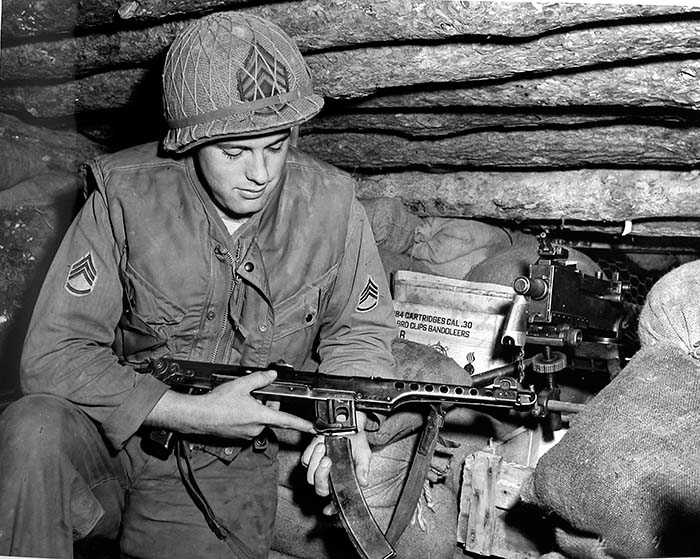
A U.S. Army sergeant examines a captured PPS-43 submachine gun during the Korean War. (NARA photograph)

The PPSh 41 was an effective weapon well suited to the Soviet’s massed infantry assault tactics, but the submachine gun was heavy and although relatively simple in construction a new weapon was needed that could be produced faster and cheaper. The PPSh 41 was deemed satisfactory for the infantry, but a more compact design was needed for tank crewmen and troops whose function was to support the infantry. However, the primary consideration was for a weapon that required less raw materials and labor hours to manufacture. In 1942, as the German invasion troops were advancing across Russia, Soviet weapon designers were faced with developing a submachine gun that was lighter, had a slower cyclic rate than the PPSh 41, and was fabricated primarily from pressed sheet metal.

Circa 1944 Soviet troops pose for a photo. The man visible on the left is holding a PPS-43 submachine gun. Partially visible to his left is a soldier with a PPSh 41. (NARA)
Very crude hand etched markings on a Soviet PPS-43 receiver. The C is a Cyrillic character representing the letter S, the symbol of the Scetmach factory. The rear sight leaves were marked 10 for 100 meters and 20 for 200 meter ranges. (Courtesy of the National Museum of the Marine Corps)

As early as February of 1942, several prototype submachine guns were submitted by Valsiliy Degtyarev, Georgiy Shpagin, Aleksey Sudaev, Sergey Korovin and Nikolay Rukavishnikov. Georgiy Shpagin, the designer of the PPSh 41, submitted an updated version of that weapon designated as the PPSh 42. Shpagin’s new weapon was a simplified version of his PPSh 41. A rectangular-shaped receiver was fabricated from pressed steel. Like Sudaev’s PPS-43 design, the recoil spring guide was used to eject spent cartridge cases. The PPSh 42 had a wooden or metal folding buttstock that was detachable and a rear pistol grip. A short sheet metal ventilated shroud covered a portion of the barrel to serve as a foregrip. The barrel was fitted with a protected front sight and muzzle compensator. Sling attachment points were spot-welded to the left side of the barrel shroud and receiver. The PPSh 42 submachine gun was fed from a 35 round box magazine and only capable of full-automatic fire with a cyclic rate of approximately 600 rounds per minute. During testing, the PPSh 42 was found to have many flaws: the method of attaching the stock was fragile, it had excessive weight, and the weapon had poor accuracy.


None of the designs submitted were acceptable. Work resumed and a second trial was scheduled for April. Of all the weapons tested, the Sudaev entry proved superior, although some improvements were necessary before the weapon could be considered for production. Another trial was scheduled for July 1942. Sudaev’s weapon successfully passed the testing and was ordered to be placed in series production immediately. On 28 July, Sudaev’s submachine gun was adopted as the PPS-42. The manufacture of the weapon required 13.7 pounds of steel and only 2.7 machine hours, less than half of that required for fabrication of the PPSh 41 submachine gun. Production was initially assigned to the Voskov Instrument Factory in Sestroretsk, using a double-diamond logo with a letter B in the center. As the German army was advancing, the plant was relocated to Leningrad. The situation was chaotic, Leningrad was under siege as the factory was being reorganized, and at the same time new tooling and gages were being designed and fabricated so production could begin. The Kulakov factory in Leningrad was another company that produced a large number of PPS-43 submachine guns. The Kulakov factory symbol was an upward pointing arrow with a horizontal line at the bottom, inside of a triangle. A third manufacturer was Scetmach in Moscow, marking their weapons with a letter C. Other factories contributing to production of the PPS-43 included: the Tbilisi Instrument Factory, the Tbilisi Train Factory, and Artel Primus, Leningrad. One known magazine manufacturer was the Leningrad Metal Factory. After an extraordinary effort working around the clock, the first PPS weapons were delivered in early 1943.
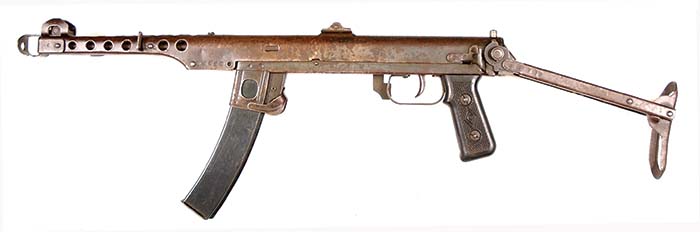
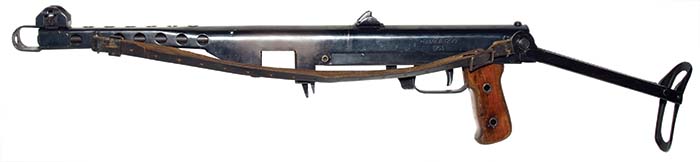
Soviet made PPS-43. Note the letter C inside the diamond pattern on the pistol grip. (Courtesy of the National Museum of the Marine Corps)

While often overshadowed by its predecessor, the iconic PPSh 41 submachine gun, the PPS-43 was considered a superior weapon by the Soviets. Primarily as a result of the rush into production, many problems were encountered with the manufacturing methods resulting in the PPS-42 weapon being less than reliable in the field. Sudaev went to work to further improve his original design, which was adopted and designated as the PPS-43 model. The PPS-43 was lighter and shorter in length.

After the adoption of the PPS-43, the PPSh 41 remained in production. Rather than waste time and resources to retool the factories for the PPS 43, the Soviets realized that more submachine guns could be produced if both weapons were produced simultaneously.

Polish copy of the PPS-43. The plastic grip panels are checkered without any type of icon on them. (Private collection)

The Soviet PPS-43 is a 7.62x25mm, full-automatic only weapon that fires from an open bolt. The cyclic rate is approximately 600 rounds per minute, nearly half of that of its predecessor the PPSh 41. The safety lever was located inside the trigger guard on early models and could lock the bolt in a forward or rear position. On later production the safety lever was moved to the right side of the trigger guard. The bolt handle is a simple tab that is on the right side of the receiver. The recoil spring guide rod also serves as a spent case ejector. The 10-inch, 4-groove chromium lined barrel is pressed and pinned into the receiver. The barrel is enclosed in a shroud that is an integral part of the receiver. A muzzle compensator is riveted onto the end of the shroud. The metal stock is unlocked by depressing a button on top of the receiver. The buttplate is also hinged and is folded when the stock is positioned on top of the receiver. A pistol grip is fitted, which aids in controlling the weapon. The rear sight has two-leaves graduated for 100 and 200 meters; the sight is well protected from damage by side ears. The front sight is a protected post that can be adjusted for elevation and drifted left or right to adjust windage. The magazine release is at the rear of the magazine well, and is protected by a shroud to prevent accidental release of the magazine. Two sling attachment points are located on the left side. Many of the features of the PPS-43 were borrowed from the earlier submachine gun designs of I.K. Bezruchko-Vysotsky. Using many innovative features from other designs has always been a practice of weapon designers. One of the keys to designing a successful weapon is to study previous designs and learn what worked and what did not. The double stack, double feed 35-round magazine is an improvement over the single-feed PPSh design. The PPS magazine is much easier to load and more reliable. The PPS-43 was not designed for a drum magazine.

A Polish 43/52 variant with a fixed wooden buttstock produced at the Hipolit Cegielski plant. (Photo courtesy of Michael Heidler)

Although a number of Communist nations used the PPS-43, only the Soviet Union, China and Poland are known to have manufactured the weapon. There were very few deviations from the original Soviet pattern other than receiver markings and the pattern of the pistol grips. The Soviet made PPS-43 weapons generally can be identified by a Cyrillic letter C (representing a letter S) molded on the grips. Chinese plastic grips will have a diamond or letter K on their grip panels. Polish plastic grips have no markings. All of the plastic grip panels had a checkered surface to provide a slip-free surface.

Poland was licensed to manufacture the Soviet PPS-43 design in 1950 as the Pistolet Maszynowy wz.43. The submachine gun was a very close copy of the PPS-43, with the original Soviet pattern folding metal buttstock. Factory markings were on top of the receiver consisting of a number inside of an oval. Known manufacturers of the weapons were: HCP Hipolit Cegielski, in the city of Poznan; a few prototypes were marked with the HCP logo but switched over to an encircled number 6 logo during production. The HCP plant was briefly renamed as the Joseph Stalin Metal Works from 1953-56, before reverting back to its original name. Other manufacturers included the Zaklady Metalowe im. gen. Waltera, Radom, using an encircled number 11, and Huta Baildon, Katowice marked with an encircled number 12. PPS-43 submachine guns were also made at the Polish magazine factory Zaklady Metalowe Wifama in Lódz, marked with the encircled 53 factory code. In 1952, a new model, designated as the 43/52, was fitted with a fixed wooden buttstock. The 43/52 variation was only manufactured at the HCP plant.

Top view of a Polish Pistolet Maszynowy wz.43. Copies of the PPS-43 made in communist nations varied little from the original Soviet pattern.

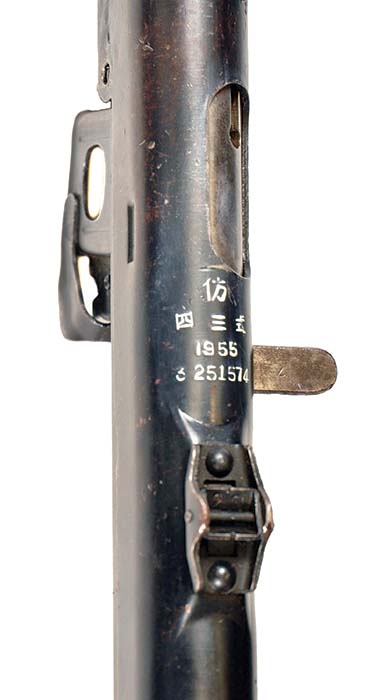
The People’s Republic of China manufactured a copy of the PPS-43 from 1953 to 1956 designated as the Type 54. The Type 54 was manufactured in several Chinese arsenals. The receivers were marked “replica 43 model” in Chinese characters, date of manufacture and serial number.

Though production was limited, Hungary made a variant of the PPS-43 called the 53M.

The Soviet PPS-43 and copies manufactured in Communist countries were chambered for the 7.62x25mm Tokarev cartridge, which was originally developed in 1929 for the Tokarev pistol. The cartridge case is a bottleneck design with a bullet weight of approximately 85.8 grains. The lightweight bullet has a muzzle velocity of approximately 1,492 feet per second. Early Soviet production used brass cases, however because of brass being a critical material in wartime; around 1942 the case material was changed to steel with a painted or copper washed finish to protect the cases from corrosion. To conserve material the bullet was later redesigned with a mild steel core surrounded by a lead envelope, the bullet jackets were steel, clad with gilding metal.

Korean Conflict 9 January 1952. PFC Henry Sarpy of Alexandria, LA (left) and SFC Chick Loveless of Olympia, WA, instructors of Headquarters Company, 19th Regiment, 24th Infantry Division, explain the nomenclature of Communist weapons to troops of the Division. (NARA photograph)

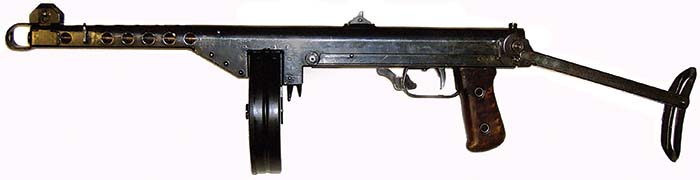
Finland designed and adopted their M/44 submachine gun, which was a Sudaev PPS-43 copy chambered in 9mm, and able to accept the Finnish Suomi drum magazine, the 35-round box magazine and the 50-round duplex “coffin” magazine.

Another lesser known copy was the DUX 53 (Latin for leader) submachine gun manufactured in Spain. The DUX 53 was chambered for the 9mm Parabellum cartridge. The DUX 53 was an almost identical copy of the Finnish M/44, and used the same box and drum magazines. In 1954, the weapon was adopted by the West German Border Guards- the Bundesgrenzschutz BGS. The DUX 53 was followed by the DUX 59 model that was developed by Anschütz in Germany. The DUX 59 had a few changes and upgrades, most of which were copied from other designs. The recoil spring was changed to an enclosed telescoping configuration like that used in the German World War II MP40. The trigger frame of the DUX 59 was reinforced on the sides of the magazine well, preventing the use of the drum or duplex magazine. A sliding safety lever was relocated above the pistol grip on the left side, and the folding metal buttstock was reinforced. A new curved magazine was developed for improved feeding. The DUX 59 was under development for many years, but basically it was a World War II design. The weapon was evaluated, but not adopted by the German military.

Two UN soldiers dressed as enemy troops with Type 54 submachine guns as part of a new troop orientation exercise in Korea circa 1952. (NARA photograph)

PPS-43

Folding stock
Overall length: 32.25/24.25
Barrel length: 10-inches
4-groove barrel
Loaded weight: 8.65 pounds
Magazine capacity: 35 rounds
Cyclic rate: 600 rounds per minute
Full automatic only
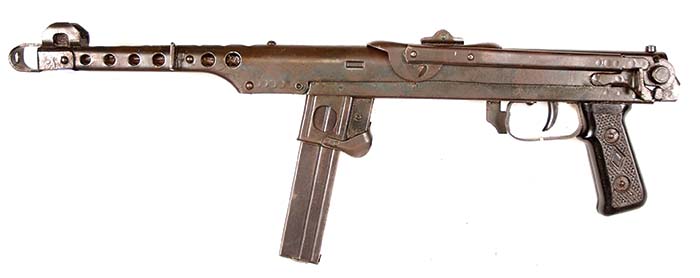
Chinese Type 54 copy of the Soviet PPS-43 with the stock in a folded position. The plastic pistol grip panels have a diamond shape pattern in the center. In the weapon is a 25-round magazine. (Courtesy of the National Museum of the Marine Corps)
The M/44 submachine gun, a copy of the Soviet PPS-43 chambered in 9mm. The weapon can use the Suomi drum magazine, 35-round box magazine or the 50-round duplex magazine. (Photo courtesy of Michael Heidler)
A 1953 dated DUX 53 Spanish submachine gun, chambered for the 9mm Parabellum cartridge. The weapon is a copy of the Finnish M/44, which in turn was copied from the Soviet PPS-43. (Photo courtesy of Michael Heidler)
Chinese receiver markings on a Type 54 submachine gun. The markings translate to ìreplica, 43 Type, 1955.î (Courtesy of the National Museum of the Marine Corps)
Polish manufactured wz.43 submachine guns from the left: A 1950 dated wz.43 from the Huta Baildon plant (Michael Heidler), a 1951 dated wz.43 from the Zaklady Metalowe Wifama factory and a wz.43 manufactured at the Hipolit Cegielski, factory. (Michael Heidler)
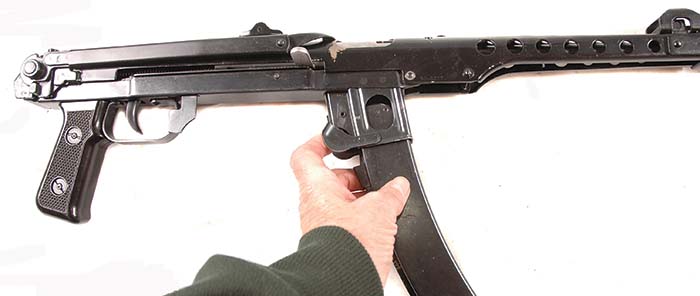
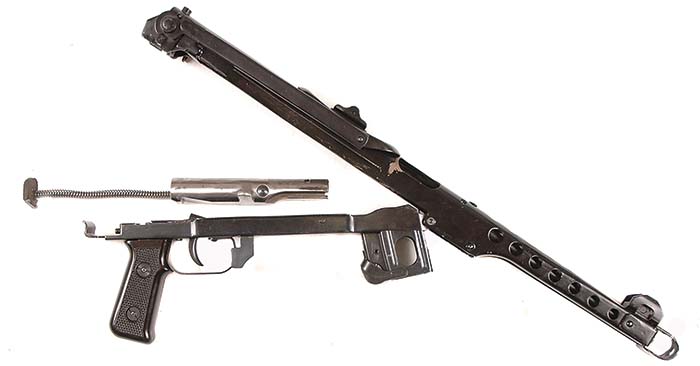
Remove magazine and visually inspect the chamber to ensure the weapon is clear.
Depress the spring-loaded catch at the rear of the receiver.
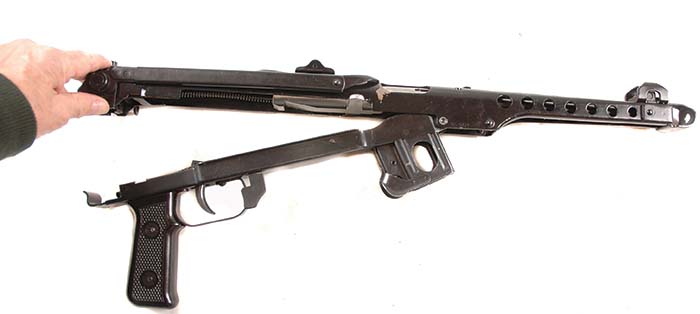
Lift the receiver to separate it from the trigger frame.
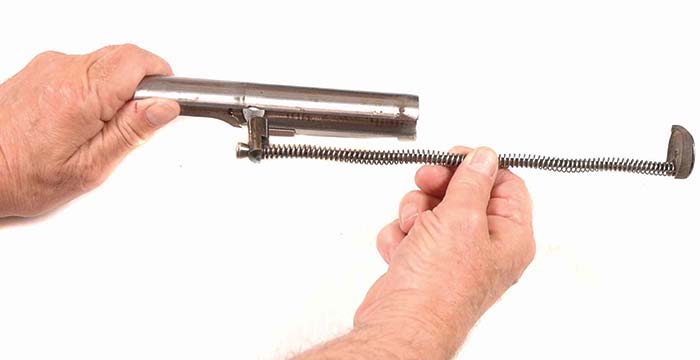
Pull the bolt assembly to the rear to remove it from the receiver.
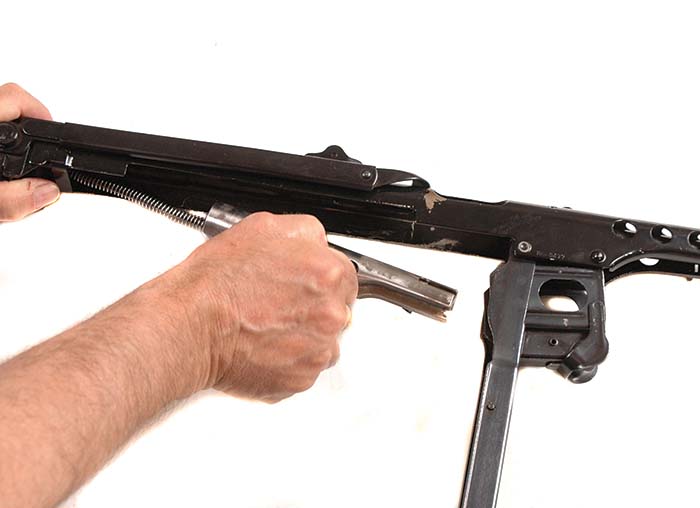
Remove the recoil spring assembly from the side of the bolt.
Field stripped PPS-43 submachine gun. The weapon is effective, simple and reliable.
This article first appeared in Small Arms Review V18N1 (February 2014)
Tags: 2014FEBRUARY 2014Frank IannamicoThe Soviet PPS-43 Submachine GunV18N1
Previous Post

MYSTERIOUS YUGOSLAV PISTOL – SYSTEM YOVANOVITCH

Next Post

SITREP: SAR V18N2

Next Post
SITREP: V19N1

SITREP: SAR V18N2

TRENDING STORIES

  • The Alofs Reloading Magazine for Shotguns

    The Alofs Reloading Magazine for Shotguns

    0 shares
    Share 0 Tweet 0
  • The New Light and Handy Ruger American Generation II Ranch Rifle

    0 shares
    Share 0 Tweet 0
  • The Complete Guide To Colt M-16 Models: Part I

    0 shares
    Share 0 Tweet 0
  • True to Form: The Tisas 1911A1 ASF

    0 shares
    Share 0 Tweet 0
  • VALKYRIE ARMAMENT BELT-FED CONVERSION

    0 shares
    Share 0 Tweet 0

RECENT POSTS

SIG Sauer’s Full-Size Compact P365 “Fuse”

SIG Sauer’s Full-Size Compact P365 “Fuse”

June 27, 2024
The Importance of Offhand Shooting

The Importance of Offhand Shooting

June 25, 2024
BOOK REVIEW – The Collector’s Guide to the SKS

BOOK REVIEW – The Collector’s Guide to the SKS

June 20, 2024
True to Form: The Tisas 1911A1 ASF

True to Form: The Tisas 1911A1 ASF

June 18, 2024
Setting the Record Straight on the Fedorov Avtomat

Setting the Record Straight on the Fedorov Avtomat

June 6, 2024

QUICK LINKS

  • About Chipotle Publishing
  • About Small Arms Review
  • Advertise with Us
  • Write for Us

CONTACT DETAILS

  • Phone: +1 (702) 565-0746
  • E-mail: office@smallarmsreview.com
  • Web: www.chipotlepublishing.com
  • Chipotle Publishing, LLC 631 N. Stephanie St., No. 282, Henderson, NV 89014
Small Arms Review

FOLLOW US

  • Privacy Policy
  • Disclaimer

© 2022 Chipotle Publishing | All Rights Reserved

Welcome Back!

Login to your account below

Forgotten Password?

Retrieve your password

Please enter your username or email address to reset your password.

Log In

Add New Playlist

No Result
View All Result
  • Home
  • Articles
    • Guns & Parts
    • Suppressors
    • Optics & Thermals
    • Ammunition
    • Gear
    • News & Opinion
    • Columns
    • Museums & Factory Tours
    • ID Guides
    • Interviews
    • Event Coverage
    • Articles by Issue
      • Volume 1
      • Volume 2
      • Volume 3
      • Volume 4
      • Volume 5
      • Volume 6
      • Volume 7
      • Volume 8
      • Volume 9
      • Volume 10
      • Volume 11
      • Volume 12
      • Volume 13
      • Volume 14
      • Volume 15
      • Volume 16
      • Volume 17
      • Volume 18
      • Volume 19
      • Volume 20
      • Volume 21
      • Volume 22
      • Volume 23
      • Volume 24
  • The Archive
    • Search The Archive
  • Store
    • Books
    • Back Issues
    • Merchandise
  • Events
  • About
    • About Small Arms Review
    • About Chipotle Publishing
    • Contact Us
    • Other Publications
      • Small Arms Defense Journal

© 2022 Chipotle Publishing | All Rights Reserved

This website uses cookies. By continuing to use this website you are giving consent to cookies being used. Visit our Privacy and Cookie Policy.

Redirecting to External Website

You are leaving the Small Arms Review website and will be redirected to an external link in a 5 Seconds.
VISIT NOW!