

By Julio A. Montes
Dominican Republic, April–June 1965
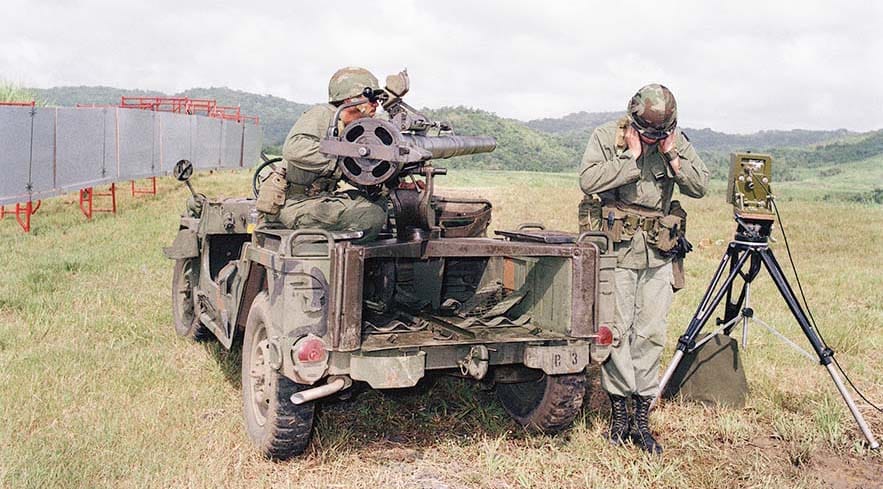
On June 6, 1965, Col. Francisco Alberto Caamaño Deñó’s rebel forces suspended negotiations and moved to break free from the noose around their strongholds within Ciudad Nueva. Nine days later, at 0750 hours, they launched the most violent attack against U.S. and the Inter-American Force’s positions. “By 0915hrs they were directing continuous fire at American positions, and at noon they assaulted Brazilian positions with a coordinated use of mortars, bazookas, and tanks.”1 Spearheading the offensive was a handful of captured armored vehicles, which faced Brazilian and U.S. jeep-mounted 106mm recoilless rifles (RRs). U.S. paratroopers used a 106mm RR to knock out an L60 light tank, stalling the attack. It was the bloodiest battle of the intervention, with the rebels suffering a sound defeat and the lost 56 square blocks of territory. By the time it was over, there were between 500 regulars and 325 police officers killed on the Loyalists’ side, and 600 regulars, hundreds of armed civilians and five light tanks destroyed on the Constitutionalists’ side. For its part, the U.S. was to suffer 10 Marines and 13 paratroopers killed and 283 wounded, most of them casualties of sniper fire.
As it happened, in early 1965 the Dominican Republic sank in a civil war between Loyalists and Constitutionalists, so the U.S. intervened to prevent another Cuba. The U.S. stability operation, later code-named “Powerpack,” took place in three phases between April 30 and May 3, 1965. The plan consisted of landing at San Isidro Airfield (about 10 miles east of Santo Domingo) then advancing 8 miles west to the Ozama River and finally establishing a line of communications to link the airfield with the International Security Zone (INSZ) around the U.S. Embassy thereby separating the two factions. The U.S. acted unilaterally and was nominally neutral, but it backed the Loyalists; however, the intervention took an international turn when the Organization of American States (OAS) authorized the formation of the Fuerza Interamericana de Paz (FIP / IAPF) on May 23, 1965. The FIP was under the command of Brazilian General Hugo Penasco Alvim, heading an 1,130-strong Brazilian Battalion and a Fraternity Battalion with a Brazilian Marine Company, and three other infantry companies from Honduras (250), Paraguay (178) and Nicaragua (164), plus a 25-strong police squad from Costa Rica. However, the U.S. continued to provide the bulk of the FIP, with elements from the 1st Brigade/82nd Airborne Division, 16th Support Group, 7th Special Forces Group and assorted U.S. Air Force personnel.2
The FIP started deployment on May 24, but before that, the Marines had come ashore in late April with all their tools of the trade, including the M50 Ontos, an ugly light tank-destroyer equipped with six M40 RRs. In addition, each Marine company had a section of 106mm RRs to bolster their firepower. Facing them were the Constitutionalists, led by Caamaño Deñó, with 1,500 soldiers with five light tanks and one gunboat, plus another 5,000 armed civilians. The Loyalists, on the other hand, had the CEFA, the Armed Forces Training Center, under general Elías Wessin y Wessin, at San Isidro barracks, collocated with the 19th of November air base. This meant some 4,000 soldiers and the General de Brigada Felipe Ciprian Armored Battalion, consisting of four armored companies, one with AMX-13 light tanks, another with the Scania L60 truck, one with Lynx armored cars and one more with mechanized infantry with halftracks. Soon after the U.S. Marines landed, the Constitutionalists’ armored forces clashed with an armored column, resulting in a Marine M50 quickly destroying an L60 light tank but also losing an M50 in the fire exchange. Another M50 is credited with blowing the turret off a rebel AMX-13, while another light tank was destroyed by an M48 Patton tank. It is not clear if the AMX-13 with the turret blown off was later recovered, but Captain Manuel Antonio Cuervo Gómez and mechanical engineer Lazaro Rosado developed the MAC-LR, which matched one AMX-13 chassis with an HS630 triple 20mm gun. The MAC-LR was also reported destroyed in those early clashes of April 1965.
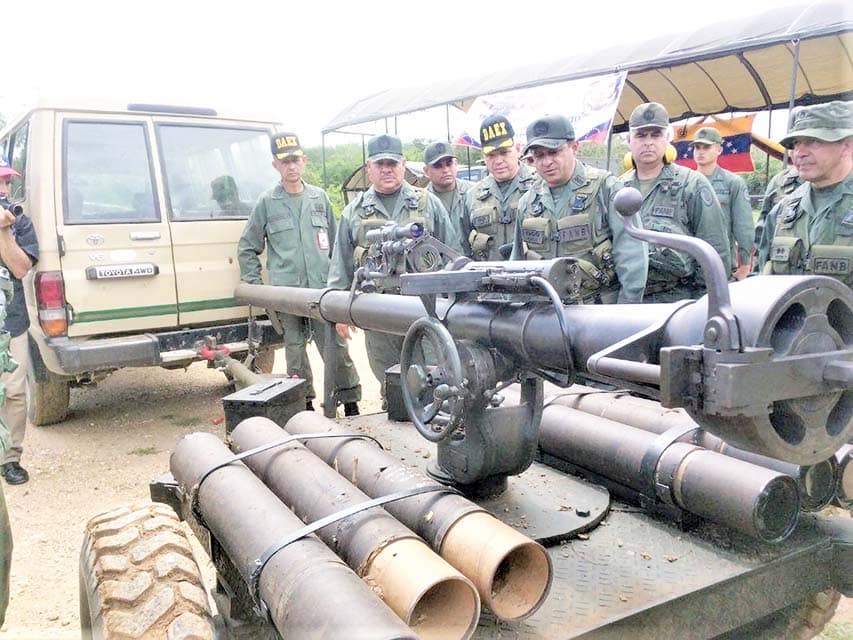
In August 2019, the Venezuelan automobile industry (ENSOVEN) developed a rolling platform for the M40A1. In September, the CAVIM completed the refurbishment of all 175 M40A1s, equipping some of them with new sights.
After these skirmishes, fighting was largely restricted to dealing with the occasional sniper fire, to which U.S. troops discovered that their 106-RRs were excellent anti-sniper weapons. They also used a single 106mm round to sink a boat that shelled their position with mortar fire. The U.S. retired its M40A1 recoilless rifles in favor of guided missiles starting in 1970, but 54 years after the skirmishes in the Dominican Republic, the 106mm-RR continues to be the main anti-tank and fire support weapon used by the Mexican and many Central and South American militaries. Those manufactured in Spain received the denomination “CSR-106” or “CSR CETME” 105mm while those built in Israel were called “M70s.”
Latin America’s M40A1 RR
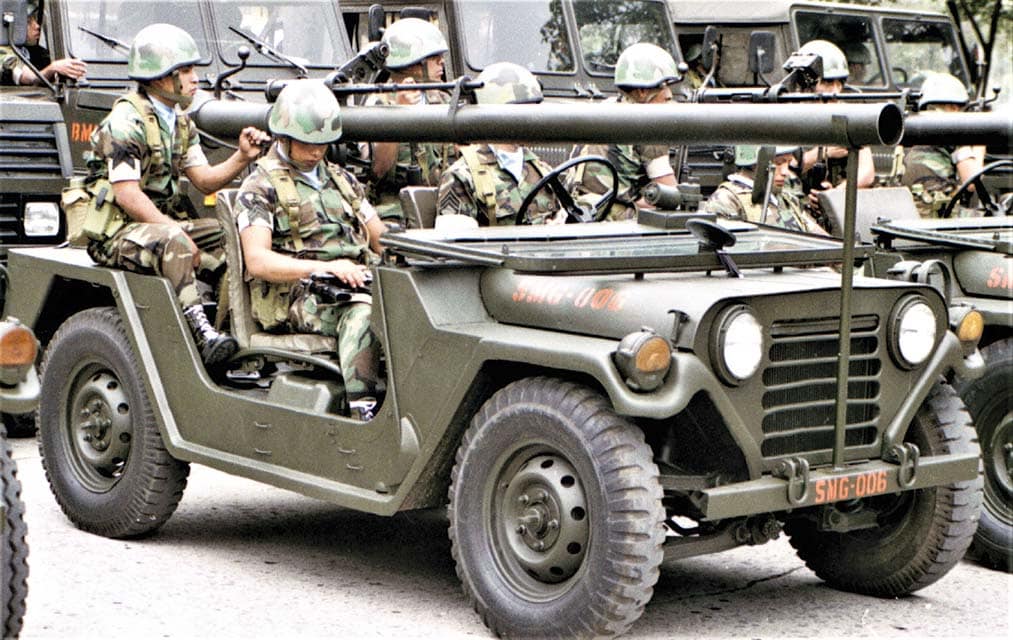
Mexico has about 102 CSR-106s still in use, distributed among Recoilless Rifle Groups, comprising the First at San Juan Teotihuacan, the Second at Queretaro, the Third at Puebla, the Fourth at Sarabia, the Fifth and Sixth at 1-A Military Camp, Mexico D.F., the Seventh at San Miguel de los Jagüeyes and the Eighth at Chicoasen. The first M40A1 examples arrived in the early 1970s from Watervliet Arsenal (NY), followed by Spain’s Santa Barbara models in the 1980s, and then again from the U.S. in excess in the 1990s. The Mexican Army mounted its M40 RRs on Willys M38A1C, or its local equivalent the VAM J-3M, while the Navy mounted some of them on Jeep CJ-7s. Mexico received hundreds of M151s and M825s (together with numbers of M40A1s) in the early 1990s from excess stocks and U.S. pre-positioned warehouses. By 1994 Mexico had also incorporated thousands of Humvees, and eventually the M825 MUTTs (Military Utility Tactical Trucks) were replaced with M1038A1 troop carrier models. These RRs’ carriers were slightly modified with short pedestals to raise the M79 tripod high enough for the M40A1 tube to clear over the soft-top cabin, so the windshield could remain raised for travel and shooting. In 2014, Mexico purchased another 3,335 Humvee M1100 series vehicles, to include M1152 variants. This is an improved cargo/troop transport version with an integrated armor protection;3 modified as TTP (troop transport protected), and with modifications similar to the M1038A1 RR, an M1152A1 TTP-RR would have made for an expedient and more efficient armored support vehicle.
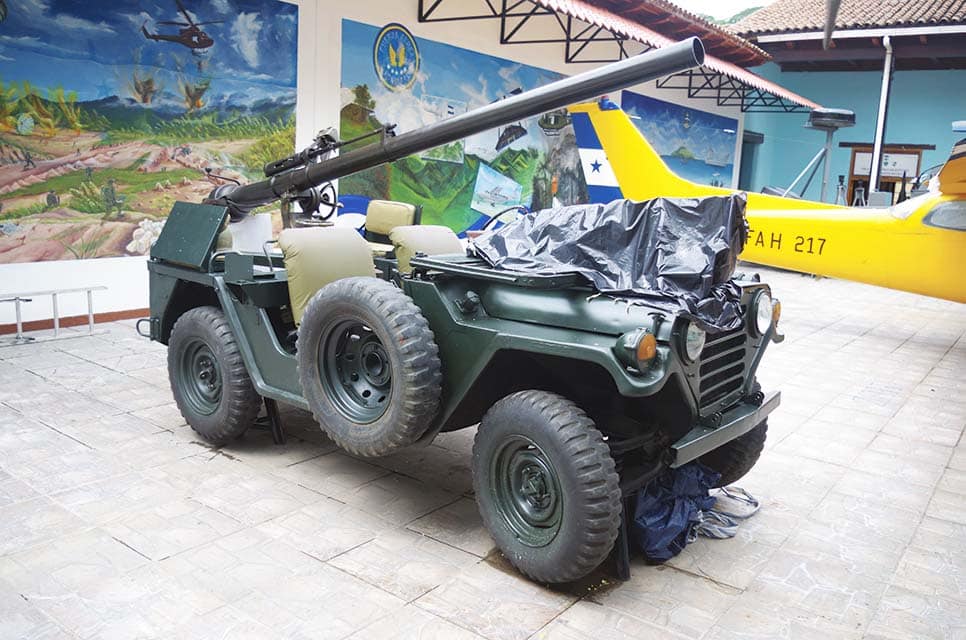
Honduran M825 at the San Francisco Fort, Tegucigalpa. It has been noted that inexplicably, Honduran forces have shifted from the M998 Humvee as an M40A1 carrier back to the M825.
In Central America, Guatemala received a few U.S. examples, but ended up acquiring more than 56 M40A1 CSR-106s from Spain along with ECia 120mm mortars. In 1998, El Salvador organized the “AT Battalion” within the Cavalry Regiment, equipped with 18 AIL M-240 Recce Storm Jeeps and 18 M-240 Anti-Tank models. By 2019, only 12 operational CSR-106s were available, all mounted on repowered M-240 AIL jeeps. In 1977, Honduras obtained 16 160mm M66 mortars together with the first nine 106mm M70 RRs4 from Israel, and eventually amassed some 80 M40A1s to include U.S. and Spanish models. There were eight M70s on RBY-MK1 light armored vehicles, while others were mounted on M606A2 Jeeps, and Israeli Matmar Industries’ Jeep CJ-5 or CJ-6 Tolar versions.5 Honduras also adopted the Israeli practice of providing an anti-tank squad to each infantry battalion, and each brigade received an anti-tank company. Some 50 remain, mainly mounted on M825 or M998 vehicles.
In 1994, the Colombian Army restored 40 M3A1 Scout Cars, replacing the gas engines for diesels and mounting the M40A1 in the open bed. Within a decade, the Scout Cars RRs had been retired and replaced with M462 Abir Portee light trucks. The Portee was a dedicated weapon platform developed by AIL and fitted with ammunition racks, an additional fire extinguisher, equipment for the recoilless rifle and a rack at the rear for additional jerry cans, while the Colombians added some armor. Although local sources indicate that there are 75 M40A1s still operational, officially there are 63 of them.6 As a side note, Colombia has been the recipient of hundreds of Humvees, mostly M998s and M1097s, and the maintenance battalion (BAMAN) has reconstructed at least three of them to Buffalo VLBB standards. These are upgraded HMMWVs with an armored capsule that brings MRAP Level 1 protection for the crew. One of the capsule’s designs fits the two-cabin M1097 cargo variant, which, with further modifications as an RR carrier, would be an ideal fire support platform and an ideal replacement for the Abir Portee.
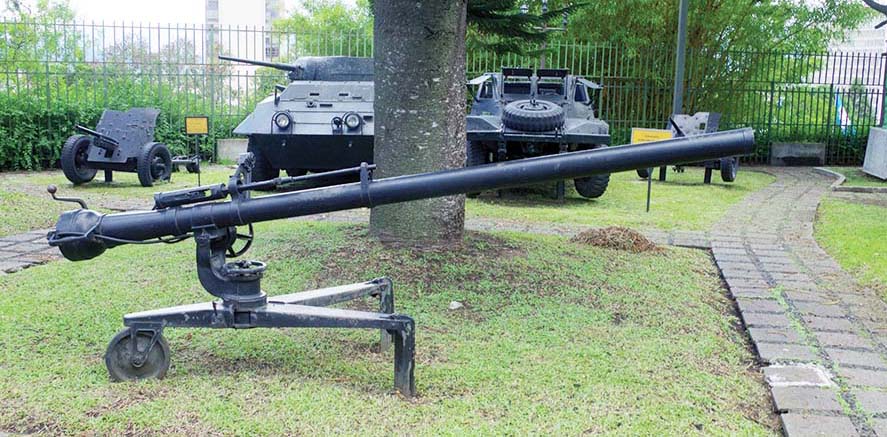
Guatemalan M40A1 at the San Jose Fort, Guatemala City. The Guatemalan Army complemented its M40A1 with Argentinean 105mm RRs.
The ground version of the M40 is mounted on an M79 “wheelbarrow” tripod, with a single front wheel and two solid legs while the M40A4 uses a conventional 3-leg M27 tripod. Either way, the weapon is not easily emplaced by hand. As result, Norway mounted its M40 on a two-wheel carriage and called it the Rekylfri Kanon 106mm M40. Austria built its own trailer and named it 10.6 cm rPAK (also rPak-66), and in its original form, the M40 was mounted on a simple two-wheel carriage towed 106mm RR M79 trailer. In August 2019, the Venezuelan automobile industry (ENSOVEN) developed a rolling platform for the weapon. It is similar in shape to the U.S. Marine M274, but unlike the Mule, the platform has two wheels and is not self-propelled. A number of Venezuelan RRs have been mounted on the Tiuna 106, a shortened version of the UR-53AR50 light truck, similar in design to the South Korean KM424 106mm recoilless rifle carrier, and developed by CENARECA (military auto industry). The Venezuelan Naval Weapons and Electronics Directorate (DAE) recovered four M40A1s in June 2016 for the 22nd Mariscal Antonio Jose de Sucre Marine Battalion, and by September 2019, the Military Industry complex (CAVIM) had refurbished the remaining 171 M40A1s. The weapons then were tested by the 12th Caribes Brigade before redistribution.
Brazil has been a large user of the M40A1, retaining some 160 pieces that are operational today. The M40A1 is used by Bolivia, and there are some 24 with Ecuador. Uruguay has 69 M40A1s in use, some of them mounted on OT-64C/OT-93 APCs, and has deployed them with their forces serving with MONUC. In 2013, it was reported that Peru had deployed 36 M40A1s along the southern border with Chile.7 At one-point, Chile deployed some 500 M40A1/ CSR-106s. In 1978, when Chile’s Beagle Conflict with Argentina became acute, the No. 14 “Caupolicán” Infantry Regiment was the southernmost military unit of the Chilean Army facing Argentinean forces. It was the sole unit permanently based in Tierra del Fuego, so reinforcements came from the No. 10 “Pudeto” Infantry Regiment and from the “Cochrane” Marine Corps detachment. The M40A1 was the most important Chilean anti-tank weapon against the Argentineans, so these were supplied in quantities. The No. 145 regiment became the Reinforced Regiment No. 11 “Caupolican” on January 13, 2003, having as its headquarters El Porvenir. Currently, these regiments have become known as motorized detachments (DM), and the No. 11 DM still comprises one RR anti-tank company, together with the No. 11 “Caupolicán” Infantry Battalion, and the No. 13 “Tierra del Fuego” Artillery Group. Today, Chile has some 213 M40A1 RCLs in inventory, but only a handful are in service with the mentioned anti-tank company and the 106mm “Karut” Anti-tank Company, a unit subordinated to the No. 14 “Aysén” Reinforced Regiment based in the city of Coyhaique, under the IV Army Division. Some of the Chilean models have been upgraded with Simrad LP101 locators, computerized laser sights (CLASS) and MVS-800 night-vision systems, which allow accurate shots between 1200m and more than 2000m. The M40A1s are mounted on Jeep M-240 Storms, a multi-mission vehicle based on the Jeep Wrangler YJ and the CJ-6/CJ-8 wheelbase, built by the Israeli AIL. The M40 is used by conscribed soldiers, and familiarization is provided at “Las Bandurrias” training camp. The troops practice tactical use and combat doctrine.
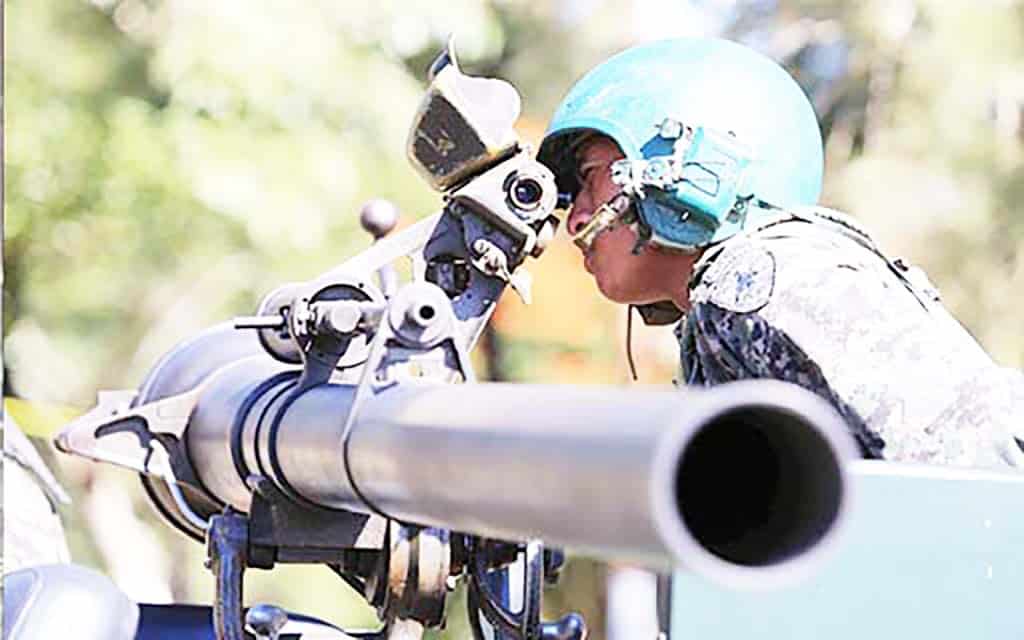
Honduran and Chilean M40A1 close-ups. Combining the 3A-HEAT round and the LP101 Optronic viewfinder, which includes a laser rangefinder and a fire-shot calculator, allows engagements beyond the 2,000m. The combination of these items increased the possibility of accurate shooting by 200% to 300% against targets between 100m and 1,000m away and by 300% to 400% at distances between 1,000m and 1,500m.
Paradise Was Hell,8 1980-1993
The offensive started with some 3,000 FMLN (Frente Farabundo Marti de Liberación Nacional) guerrillas descending from the mountains to San Salvador, occupying the neighborhoods of Mejicanos, Ciudad Delgado, Soyapango and San Jacinto, and then taking positions in the upper-class neighborhoods of San Benito, Maquilishuat, Lomas Verdes and Escalón. They also attacked the eastern cities of Zacatecoluca, San Miguel and Usulután. In their wake they overran the 1st Infantry Brigade’s positions, pushing the troops inside the Capital.9 Soon after the initial firefights, there were skirmishes in the north, east, and to a lesser extent, west of the Capital, and within 48 hours, San Salvador was a battlefield. Meanwhile, at El Paraíso Camp, in Chalatenango,10 everything was quiet—too quiet … .
El Paraiso Army Camp was one of the most besieged military garrisons in the country. The camp came into intensive fire in January 1981, when elements of the “Modesto Ramírez” guerrilla front, part of the FMLN, assaulted it and besieged the zone. In the early hours of December 30, 1983, 25 elements of the Selected Special Forces (FES), led by Dimas Rodríguez, had cleared a path through the trenches and mine fields of El Paraiso Camp with Bangalore torpedoes. Another 150 fighters of the X-21 battalion of the Popular Liberation Forces (FPL), who were hidden along the outer fence, charged through the openings, occupying and destroying the base. The attack had been executed perfectly, with the FPL’s K-93 battalion deployed west, occupying positions in the area of the Troncal del Norte highway, and attacked units at nearby El Refugio, El Barrancon in La Reina and the Colima bridge to block relief forces. The FPL’s SA-7 battalion besieged an infantry company stationed at the town of El Paraiso, setting up containments along the road to Santa Rita while the SS-20 battalion set siege to Military Detachment 1 in the city of Chalatenango. The guerrillas occupied the base for 2 days, ironically surrounded by companies from the Atlacatl and the Paratrooper battalions. As they threatened to kill the survivors, a compromise allowed them to leave on a convoy of 17 trucks and buses.
On March 31, 1987, guerrillas penetrated the perimeter once again,11 killing 64 Salvadoran soldiers and wounding 79. Their attack also killed SFC Gregory A. Fronius, an element of the 3rd Battalion, 7th SFG (A). El Paraiso was subjected to another attack in March 1988, and on September 13, 1988, another attack to the base was repelled by Army troops and U.S. advisors, Major James Parker, SSG Michael Roth, Captain Gilberto Aguiar, SFC Mario Orozco Torres and 1st Lt. Byron Castleman.12 In one of those assaults, the rebels decimated the crew of an M40A1 recoilless rifle (RR), seizing it but then failing to find the trigger to fire it against Army positions, allowing the soldiers to retake the piece. Another attack had taken place in September 1989, so upon the news of the offensive in San Salvador in November of that year, the garrison commander, Colonel Ciro López Roque cancelled all leave, while Colonel Gilbert Cáceres, S3 Officer, ordered a defensive posture.
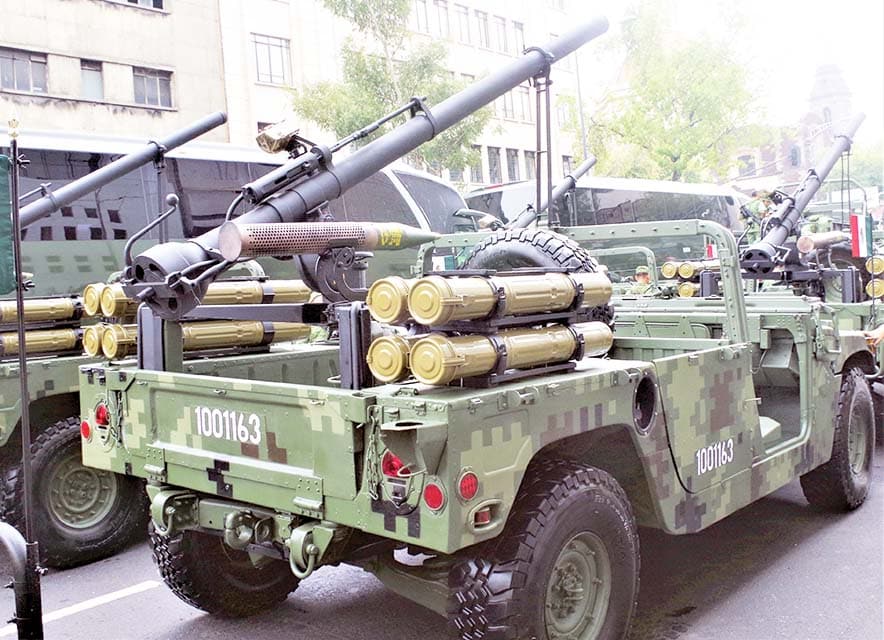
Mexican M1038A1 modified as weapon platform. The M40A1 locks into a pedestal that raises the tube over the soft cab cover. The additional space provides for 10 to 16 rounds to be carried. A bet-ter platform could be the M1152, equipped with side panels for additional protection.
El Salvador, November 12, 198913
In the darkness of the early morning of November 12, 1989, on one of the defensive hills, Lieutenant Geovanni Hidalgo, Battalion Azmitía/2nd Company commander, kept watch along with a renewed crew of that same 106mm recoilless rifle momentarily lost to the enemy in a previous fight. Lt. Hidalgo watched the top of the mountain in front of him; he was aware that there was a bunker manned by local Special Forces at the crest and that previous attacks originated from that mountain just outside the base perimeter. Expecting any movement to come from the same place, Hidalgo decided to test fields of fire and calculated a point midway up the hill. After calling and checking with the nearby patrols, and lacking 12.7mm ammunition to use in the recoilless rifle’s aiming device, he, along with the gunner, simply measured the distance by sight. Hidalgo then ordered the crew to open fire. With orders to be silent, the gunner hesitated, but Hidalgo repeated, “I am telling you to shoot.” The gunner responded immediately and fired. The quick gunner’s reaction and the backblast cached the lieutenant by surprise, blinding him. While he wiped his eyes trying to recover, the radio came alive. Initially, it was feared that the round hit a nearby patrol but then they realized that the officer on the other side was asking for additional fire since the patrol had detected movement at the site of impact. Hidalgo then ordered another shot as he was recovering from his blindness; the gun crew was ahead of the order and fired, catching Hidalgo off-guard again and blinding him one more time.14 The crew and officer had forgotten that the 105mm projectile follows a curved trajectory, and instead of the side, the rounds were smashing at the foot of the mountain. The first round landed on top of the guerrilla concentration. To everyone’s surprise, as the second round landed, the base of the hill lit up. The round had smashed right on top of the guerrillas’ ammo and explosives, causing a catastrophic reaction at the point of impact. The survivors attempted suppressive fire against the recoilless gun position, but that ended quickly. At day light, the troops found the disabled mortars, traces of blood and signs of casualties.15
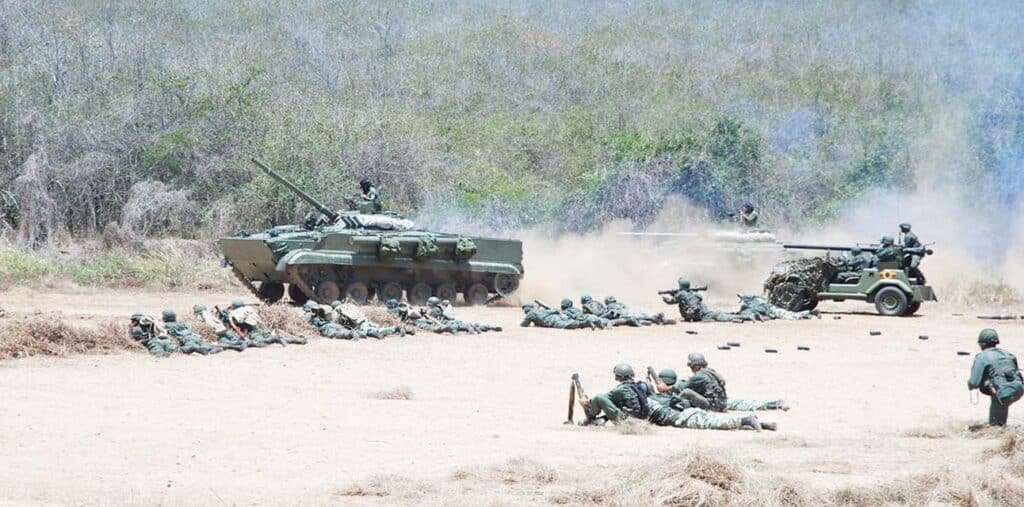
Venezuelan armored formation in exercises in 2015. A Tiuna-106 is seen on the left.
From that point-on, all continued to be really quiet at the 4th Brigade while hell rained on San Salvador, where the fight was house to house. As elements of the 1st and 4th Paratrooper Squadrons broke the siege around Ilopango Air Base, they were joined by elements of the Arce Reaction Battalion pushing against a Soyapango suburb, where they engaged some 1,500 rebels of the PRTC and RN factions. As the troops advanced on rebel strongholds, the fight centered around the neighborhoods of Santos-I, Las Brisas and Reparto Guadalupe. The guerrillas finally relinquished their dug-in positions on the 16th, and were in full retreat on the 17th, with the paratroopers on their heels. The troops dragged an M40A1 RR with them to the edge of Venecia and Prusia areas, where some rebels were trapped, shelling their positions and decimating their strongholds until the fight finally ended. The battle continued elsewhere in the Capital for another 2 weeks. The CSR-106 had proven its worth, disrupting the fight in El Paraíso and helping to subdue enemy positions in Soyapango.
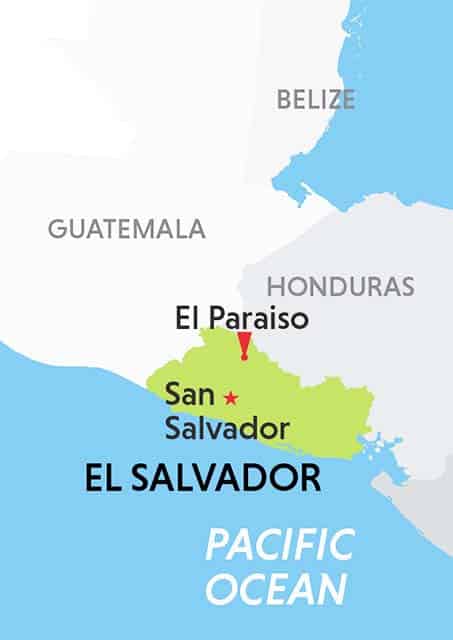
A Place Called “Paradise”
It is important to dispel claims that El Paraiso base in El Salvador was devised by American advisers. “Paradise” Camp, located 64km from San Salvador and 24km from the departmental capital, Chalatenango, actually took shape in 1968-1969 as an advanced Salvadoran Army depot and as a blocking strongpoint against any Honduran incursion. It gained importance after the July 1969 war between the two countries. In the mid-1970s, the Salvadoran Army reorganized and consolidated its maneuvering units, with the 1st Infantry Brigade at San Carlos Camp (cuartel/barracks) in San Salvador, comprising the 1st Regiment, the Engineer Battalion (detachment) from Zacatecoluca, and the 4th Infantry Regiment from Chalatenango. It deployed troops along the border detachments housed at El Paraíso, Chalatenango, El Refugio, Arcatao and El Guayabo Dam.
El Paraíso Camp was located on an esplanade not very strategically located in the municipality of El Paraíso, Chalatenango. The base covered a square kilometer of flat land while its installations occupied a hollow between Loma (“hill”) El Espinal to the north and Loma Lisa to the south in Columbia. The small town of El Paraíso is approximately 1.5km (by road) to the northeast while the Guayabo is less than 2km northwest. A main entrance to the Cerrón Grande Dam is approximately 1km southeast. The development of the Camp continued until November 4, 1980, when it was established as headquarters for the 4th Infantry Brigade, and with U.S. assistance, the defensive perimeter was established with barbed wire, fortifications and night lighting, in addition to the usual mobile patrols, fixed posts and a prevention guard. The base was neither impressive nor impregnable.
Documents captured in 1990 indicated that the guerrillas’ attacks in November 1989 pretended to overrun the Ilopango Air Base, the 1st, 2nd, 3rd and 6th Infantry Brigade bases, the Engineer Detachment and the Arce and Atonal Battalion camps. Therefore, the failed attack on the 4th Brigade was diversionary in nature and was prepared by “only” about 100 rebels. Two well-placed—and lucky—105mm shots from the M40A1 were sufficient to thwart their intentions in 1989.
- history.army.mil/html/reference/army_flag/dominican.html.
- dsca.mil/major-arms-sales/mexico-m1152-high-mobility-multi-purpose-wheeled-vehicles-hmmwvs.
- United States Congress, House Committee on Foreign Affairs, 1979.
- pmulcahy.com/light_uv/israeli_luv.htm.
- Colombia: A Country Study. Edited by Rex A. Hudson, Library of Congress (U.S.), Federal Research Division.
- elmostrador.cl/noticias/pais/2013/07/15/los-desconocidos-preparativos-militares-en-chile-y-peru-previos-al-fallo-de-la-haya.
- soc.mil/ARSOF_History/articles/v3n1_paraiso_page_1.html.
- cambridge.org/core/books/the-salvador-option/guerrilla-second-final-offensive-november-1989/6562240F43C7C91E92901ABA8788AF36.
- contrapunto.com.sv/archivo2016/cultura/literatura/romper-un-candado-asalto-al-cuartel-el-paraiso-1983. cia.gov/library/readingroom/docs/CIA-RDP90- 00965R000200730001-2.pdf.
- cia.gov/library/readingroom/docs/CIA-RDP90-00965R000200730001-2.pdf.
- fas.org/irp/agency/dod/socom/2007history.pdf.
- From LA F.A.E.S. a Fierro y Machete: Recopilación de Detalles Históricos de las Fuerzas de Tierra de El Salvador, draft presented to the Salvadoran Ministry of Culture, July 2019.
- Testimony provided by Geovanni Hidalgo.
- From LAF.A.E.S.aFierroyMachete:RecopilacióndeDetallesHistóricosdelasFuerzasdeTierradeElSalvador, draft presented to the Salvadoran Ministry of Culture, July 2019.
| This article first appeared in Small Arms Review V24N4 (April 2020) |