


Small Arms Review
  • Home
  • Articles
    • Guns & Parts
    • Suppressors
    • Optics & Thermals
    • Ammunition
    • Gear
    • News & Opinion
    • Columns
    • Museums & Factory Tours
    • ID Guides
    • Interviews
    • Event Coverage
    • Articles by Issue
      • Volume 1
        • V1N1 (Oct 1997)
        • V1N2 (Nov 1997)
        • V1N3 (Dec 1997)
        • V1N4 (Jan 1998)
        • V1N5 (Feb 1998)
        • V1N6 (Mar 1998)
        • V1N7 (Apr 1998)
        • V1N8 (May 1998)
        • V1N9 (Jun 1998)
        • V1N10 (Jul 1998)
        • V1N11 (Aug 1998)
        • V1N12 (Sep 1998)
      • Volume 2
        • V2N1 (Oct 1998)
        • V2N2 (Nov 1998)
        • V2N3 (Dec 1998)
        • V2N4 (Jan 1999)
        • V2N5 (Feb 1999)
        • V2N6 (Mar 1999)
        • V2N7 (Apr 1999)
        • V2N8 (May 1999)
        • V2N9 (Jun 1999)
        • V2N10 (Jul 1999)
        • V2N11 (Aug 1999)
        • V2N12 (Sep 1999)
      • Volume 3
        • V3N1 (Oct 1999)
        • V3N2 (Nov 1999)
        • V3N3 (Dec 1999)
        • V3N4 (Jan 2000)
        • V3N5 (Feb 2000)
        • V3N6 (Mar 2000)
        • V3N7 (Apr 2000)
        • V3N8 (May 2000)
        • V3N9 (Jun 2000)
        • V3N10 (Jul 2000)
        • V3N11 (Aug 2000)
        • V3N12 (Sep 2000)
      • Volume 4
        • V4N1 (Oct 2000)
        • V4N2 (Nov 2000)
        • V4N3 (Dec 2000)
        • V4N4 (Jan 2001)
        • V4N5 (Feb 2001)
        • V4N6 (Mar 2001)
        • V4N7 (Apr 2001)
        • V4N8 (May 2001)
        • V4N9 (Jun 2001)
        • V4N10 (Jul 2001)
        • V4N11 (Aug 2001)
        • V4N12 (Sep 2001)
      • Volume 5
        • V5N1 (Oct 2001)
        • V5N2 (Nov 2001)
        • V5N3 (Dec 2001)
        • V5N4 (Jan 2002)
        • V5N5 (Feb 2002)
        • V5N6 (Mar 2002)
        • V5N7 (Apr 2002)
        • V5N8 (May 2002)
        • V5N9 (Jun 2002)
        • V5N10 (Jul 2002)
        • V5N11 (Aug 2002)
        • V5N12 (Sep 2002)
      • Volume 6
        • V6N1 (Oct 2002)
        • V6N2 (Nov 2002)
        • V6N3 (Dec 2002)
        • V6N4 (Jan 2003)
        • V6N5 (Feb 2003)
        • V6N6 (Mar 2003)
        • V6N7 (Apr 2003)
        • V6N8 (May 2003)
        • V6N9 (Jun 2003)
        • V6N10 (Jul 2003)
        • V6N11 (Aug 2003)
        • V6N12 (Sep 2003)
      • Volume 7
        • V7N1 (Oct 2003)
        • V7N2 (Nov 2003)
        • V7N3 (Dec 2003)
        • V7N4 (Jan 2004)
        • V7N5 (Feb 2004)
        • V7N6 (Mar 2004)
        • V7N7 (Apr 2004)
        • V7N8 (May 2004)
        • V7N9 (Jun 2004)
        • V7N10 (Jul 2004)
        • V7N11 (Aug 2004)
        • V7N12 (Sep 2004)
      • Volume 8
        • V8N1 (Oct 2004)
        • V8N2 (Nov 2004)
        • V8N3 (Dec 2004)
        • V8N4 (Jan 2005)
        • V8N5 (Feb 2005)
        • V8N6 (Mar 2005)
        • V8N7 (Apr 2005)
        • V8N8 (May 2005)
        • V8N9 (Jun 2005)
        • V8N10 (Jul 2005)
        • V8N11 (Aug 2005)
        • V8N12 (Sep 2005)
      • Volume 9
        • V9N1 (Oct 2005)
        • V9N2 (Nov 2005)
        • V9N3 (Dec 2005)
        • V9N4 (Jan 2006)
        • V9N5 (Feb 2006)
        • V9N6 (Mar 2006)
        • V9N7 (Apr 2006)
        • V9N8 (May 2006)
        • V9N9 (Jun 2006)
        • V9N10 (Jul 2006)
        • V9N11 (Aug 2006)
        • V9N12 (Sep 2006)
      • Volume 10
        • V10N1 (Oct 2006)
        • V10N2 (Nov 2006)
        • V10N3 (Dec 2006)
        • V10N4 (Jan 2007)
        • V10N5 (Feb 2007)
        • V10N6 (Mar 2007)
        • V10N7 (Apr 2007)
        • V10N8 (May 2007)
        • V10N9 (Jun 2007)
        • V10N10 (Jul 2007)
        • V10N11 (Aug 2007)
        • V10N12 (Sep 2007)
      • Volume 11
        • V11N1 (Oct 2007)
        • V11N2 (Nov 2007)
        • V11N3 (Dec 2007)
        • V11N4 (Jan 2008)
        • V11N5 (Feb 2008)
        • V11N6 (Mar 2008)
        • V11N7 (Apr 2008)
        • V11N8 (May 2008)
        • V11N9 (Jun 2008)
        • V11N10 (Jul 2008)
        • V11N11 (Aug 2008)
        • V11N12 (Sep 2008)
      • Volume 12
        • V12N1 (Oct 2008)
        • V12N2 (Nov 2008)
        • V12N3 (Dec 2008)
        • V12N4 (Jan 2009)
        • V12N5 (Feb 2009)
        • V12N6 (Mar 2009)
        • V12N7 (Apr 2009)
        • V12N8 (May 2009)
        • V12N9 (Jun 2009)
        • V12N10 (Jul 2009)
        • V12N11 (Aug 2009)
        • V12N12 (Sep 2009)
      • Volume 13
        • V13N1 (Oct 2009)
        • V13N2 (Nov 2009)
        • V13N3 (Dec 2009)
        • V13N4 (Jan 2010)
        • V13N5 (Feb 2010)
        • V13N6 (Mar 2010)
        • V13N7 (Apr 2010)
        • V13N8 (May 2010)
        • V13N9 (Jun 2010)
        • V13N10 (Jul 2010)
        • V13N11 (Aug 2010)
        • V13N12 (Sep 2010)
      • Volume 14
        • V14N1 (Oct 2010)
        • V14N2 (Nov 2010)
        • V14N3 (Dec 2010)
          • Ammunition
        • V14N4 (Jan 2011)
        • V14N5 (Feb 2011)
        • V14N6 (Mar 2011)
        • V14N7 (Apr 2011)
        • V14N8 (May 2011)
        • V14N9 (Jun 2011)
        • V14N10 (Jul 2011)
        • V14N11 (Aug 2011)
        • V14N12 (Sep 2011)
      • Volume 15
        • V15N1 (Oct 2011)
        • V15N2 (Nov 2011)
        • V15N4 (Jan 2012)
        • V15N5 (Feb 2012)
      • Volume 16
        • V16N1 (1st Quarter 2012)
        • V16N2 (2nd Quarter 2012)
        • V16N3 (3rd Quarter 2012)
        • V16N4 (4th Quarter 2012)
      • Volume 17
        • V17N1 (1st Quarter 2013)
        • V17N2 (2nd Quarter 2013)
        • V17N3 (3rd Quarter 2013)
        • V17N4 (4th Quarter 2013)
      • Volume 18
        • V18N1 (Jan Feb 2014)
        • V18N2 (Mar Apr 2014)
        • V18N3 (May Jun 2014)
        • V18N4 (Jul Aug 2014)
        • V18N5 (Sep Oct 2014)
        • V18N6 (Nov Dec 2014)
      • Volume 19
        • V19N1 (Jan 2015)
        • V19N2 (Feb Mar 2015)
        • V19N3 (Apr 2015)
        • V19N4 (May 2015)
        • V19N5 (Jun 2015)
        • V19N6 (Jul 2015)
        • V19N7 (Aug Sep 2015)
        • V19N8 (Oct 2015)
        • V19N9 (Nov 2015)
        • V19N10 (Dec 2015)
      • Volume 20
        • V20N1 (Jan 2016)
        • V20N2 (Feb Mar 2016)
        • V20N3 (Apr 2016)
        • V20N4 (May 2016)
        • V20N5 (Jun 2016)
        • V20N6 (Jul 2016)
        • V20N7 (Aug Sep 2016)
        • V20N8 (Oct 2016)
        • V20N9 (Nov 2016)
        • V20N10 (Dec 2016)
      • Volume 21
        • V21N1 (Jan 2017)
        • V21N2 (Feb Mar 2017)
        • V21N3 (Apr 2017)
        • V21N4 (May 2017)
        • V21N5 (Jun 2017)
        • V21N6 (Jul 2017)
        • V21N7 (Aug Sep 2017)
        • V21N8 (Oct 2017)
        • V21N9 (Nov 2017)
        • V21N10 (Dec 2017)
      • Volume 22
        • V22N1 (Jan 2018)
        • V22N2 (Feb 2018)
        • V22N3 (March 2018)
        • V22N4 (Apr 2018)
        • V22N5 (May 2018)
        • V22N6 (Jun Jul 2018)
        • V22N7 (Aug Sep 2018)
        • V22N8 (Oct 2018)
        • V22N9 (Nov 2018)
        • V22N10 (Dec 2018)
      • Volume 23
        • V23N1 (Jan 2019)
        • V23N2 (Feb 2019)
        • V23N3 (Mar 2019)
        • V23N4 (Apr 2019)
        • V23N5 (May 2019)
        • V23N6 (Jun Jul 2019)
        • V23N7 (Aug Sep 2019)
        • V23N8 (Oct 2019)
        • V23N9 (Nov 2019)
        • V23N10 (Dec 2019)
      • Volume 24
        • V24N1 (Jan 2020)
        • V24N2 (Feb 2020)
        • V24N3 (Mar 2020)
        • V24N4 (Apr 2020)
        • V24N5 (May 2020)
        • V24N6 (Jun Jul 2020)
        • V24N7 (Aug Sep 2020)
        • V24N8 (Oct 2020)
        • V24N9 (Nov 2020)
        • V24N10 (Dec 2020)
  • The Archive
    • Search The Archive
  • Store
    • Books
    • Back Issues
    • Merchandise
  • Events
  • About
    • About Small Arms Review
    • About Chipotle Publishing
    • Contact Us
    • Other Publications
      • Small Arms Defense Journal
  • Home
  • Articles
    • Guns & Parts
    • Suppressors
    • Optics & Thermals
    • Ammunition
    • Gear
    • News & Opinion
    • Columns
    • Museums & Factory Tours
    • ID Guides
    • Interviews
    • Event Coverage
    • Articles by Issue
      • Volume 1
        • V1N1 (Oct 1997)
        • V1N2 (Nov 1997)
        • V1N3 (Dec 1997)
        • V1N4 (Jan 1998)
        • V1N5 (Feb 1998)
        • V1N6 (Mar 1998)
        • V1N7 (Apr 1998)
        • V1N8 (May 1998)
        • V1N9 (Jun 1998)
        • V1N10 (Jul 1998)
        • V1N11 (Aug 1998)
        • V1N12 (Sep 1998)
      • Volume 2
        • V2N1 (Oct 1998)
        • V2N2 (Nov 1998)
        • V2N3 (Dec 1998)
        • V2N4 (Jan 1999)
        • V2N5 (Feb 1999)
        • V2N6 (Mar 1999)
        • V2N7 (Apr 1999)
        • V2N8 (May 1999)
        • V2N9 (Jun 1999)
        • V2N10 (Jul 1999)
        • V2N11 (Aug 1999)
        • V2N12 (Sep 1999)
      • Volume 3
        • V3N1 (Oct 1999)
        • V3N2 (Nov 1999)
        • V3N3 (Dec 1999)
        • V3N4 (Jan 2000)
        • V3N5 (Feb 2000)
        • V3N6 (Mar 2000)
        • V3N7 (Apr 2000)
        • V3N8 (May 2000)
        • V3N9 (Jun 2000)
        • V3N10 (Jul 2000)
        • V3N11 (Aug 2000)
        • V3N12 (Sep 2000)
      • Volume 4
        • V4N1 (Oct 2000)
        • V4N2 (Nov 2000)
        • V4N3 (Dec 2000)
        • V4N4 (Jan 2001)
        • V4N5 (Feb 2001)
        • V4N6 (Mar 2001)
        • V4N7 (Apr 2001)
        • V4N8 (May 2001)
        • V4N9 (Jun 2001)
        • V4N10 (Jul 2001)
        • V4N11 (Aug 2001)
        • V4N12 (Sep 2001)
      • Volume 5
        • V5N1 (Oct 2001)
        • V5N2 (Nov 2001)
        • V5N3 (Dec 2001)
        • V5N4 (Jan 2002)
        • V5N5 (Feb 2002)
        • V5N6 (Mar 2002)
        • V5N7 (Apr 2002)
        • V5N8 (May 2002)
        • V5N9 (Jun 2002)
        • V5N10 (Jul 2002)
        • V5N11 (Aug 2002)
        • V5N12 (Sep 2002)
      • Volume 6
        • V6N1 (Oct 2002)
        • V6N2 (Nov 2002)
        • V6N3 (Dec 2002)
        • V6N4 (Jan 2003)
        • V6N5 (Feb 2003)
        • V6N6 (Mar 2003)
        • V6N7 (Apr 2003)
        • V6N8 (May 2003)
        • V6N9 (Jun 2003)
        • V6N10 (Jul 2003)
        • V6N11 (Aug 2003)
        • V6N12 (Sep 2003)
      • Volume 7
        • V7N1 (Oct 2003)
        • V7N2 (Nov 2003)
        • V7N3 (Dec 2003)
        • V7N4 (Jan 2004)
        • V7N5 (Feb 2004)
        • V7N6 (Mar 2004)
        • V7N7 (Apr 2004)
        • V7N8 (May 2004)
        • V7N9 (Jun 2004)
        • V7N10 (Jul 2004)
        • V7N11 (Aug 2004)
        • V7N12 (Sep 2004)
      • Volume 8
        • V8N1 (Oct 2004)
        • V8N2 (Nov 2004)
        • V8N3 (Dec 2004)
        • V8N4 (Jan 2005)
        • V8N5 (Feb 2005)
        • V8N6 (Mar 2005)
        • V8N7 (Apr 2005)
        • V8N8 (May 2005)
        • V8N9 (Jun 2005)
        • V8N10 (Jul 2005)
        • V8N11 (Aug 2005)
        • V8N12 (Sep 2005)
      • Volume 9
        • V9N1 (Oct 2005)
        • V9N2 (Nov 2005)
        • V9N3 (Dec 2005)
        • V9N4 (Jan 2006)
        • V9N5 (Feb 2006)
        • V9N6 (Mar 2006)
        • V9N7 (Apr 2006)
        • V9N8 (May 2006)
        • V9N9 (Jun 2006)
        • V9N10 (Jul 2006)
        • V9N11 (Aug 2006)
        • V9N12 (Sep 2006)
      • Volume 10
        • V10N1 (Oct 2006)
        • V10N2 (Nov 2006)
        • V10N3 (Dec 2006)
        • V10N4 (Jan 2007)
        • V10N5 (Feb 2007)
        • V10N6 (Mar 2007)
        • V10N7 (Apr 2007)
        • V10N8 (May 2007)
        • V10N9 (Jun 2007)
        • V10N10 (Jul 2007)
        • V10N11 (Aug 2007)
        • V10N12 (Sep 2007)
      • Volume 11
        • V11N1 (Oct 2007)
        • V11N2 (Nov 2007)
        • V11N3 (Dec 2007)
        • V11N4 (Jan 2008)
        • V11N5 (Feb 2008)
        • V11N6 (Mar 2008)
        • V11N7 (Apr 2008)
        • V11N8 (May 2008)
        • V11N9 (Jun 2008)
        • V11N10 (Jul 2008)
        • V11N11 (Aug 2008)
        • V11N12 (Sep 2008)
      • Volume 12
        • V12N1 (Oct 2008)
        • V12N2 (Nov 2008)
        • V12N3 (Dec 2008)
        • V12N4 (Jan 2009)
        • V12N5 (Feb 2009)
        • V12N6 (Mar 2009)
        • V12N7 (Apr 2009)
        • V12N8 (May 2009)
        • V12N9 (Jun 2009)
        • V12N10 (Jul 2009)
        • V12N11 (Aug 2009)
        • V12N12 (Sep 2009)
      • Volume 13
        • V13N1 (Oct 2009)
        • V13N2 (Nov 2009)
        • V13N3 (Dec 2009)
        • V13N4 (Jan 2010)
        • V13N5 (Feb 2010)
        • V13N6 (Mar 2010)
        • V13N7 (Apr 2010)
        • V13N8 (May 2010)
        • V13N9 (Jun 2010)
        • V13N10 (Jul 2010)
        • V13N11 (Aug 2010)
        • V13N12 (Sep 2010)
      • Volume 14
        • V14N1 (Oct 2010)
        • V14N2 (Nov 2010)
        • V14N3 (Dec 2010)
          • Ammunition
        • V14N4 (Jan 2011)
        • V14N5 (Feb 2011)
        • V14N6 (Mar 2011)
        • V14N7 (Apr 2011)
        • V14N8 (May 2011)
        • V14N9 (Jun 2011)
        • V14N10 (Jul 2011)
        • V14N11 (Aug 2011)
        • V14N12 (Sep 2011)
      • Volume 15
        • V15N1 (Oct 2011)
        • V15N2 (Nov 2011)
        • V15N4 (Jan 2012)
        • V15N5 (Feb 2012)
      • Volume 16
        • V16N1 (1st Quarter 2012)
        • V16N2 (2nd Quarter 2012)
        • V16N3 (3rd Quarter 2012)
        • V16N4 (4th Quarter 2012)
      • Volume 17
        • V17N1 (1st Quarter 2013)
        • V17N2 (2nd Quarter 2013)
        • V17N3 (3rd Quarter 2013)
        • V17N4 (4th Quarter 2013)
      • Volume 18
        • V18N1 (Jan Feb 2014)
        • V18N2 (Mar Apr 2014)
        • V18N3 (May Jun 2014)
        • V18N4 (Jul Aug 2014)
        • V18N5 (Sep Oct 2014)
        • V18N6 (Nov Dec 2014)
      • Volume 19
        • V19N1 (Jan 2015)
        • V19N2 (Feb Mar 2015)
        • V19N3 (Apr 2015)
        • V19N4 (May 2015)
        • V19N5 (Jun 2015)
        • V19N6 (Jul 2015)
        • V19N7 (Aug Sep 2015)
        • V19N8 (Oct 2015)
        • V19N9 (Nov 2015)
        • V19N10 (Dec 2015)
      • Volume 20
        • V20N1 (Jan 2016)
        • V20N2 (Feb Mar 2016)
        • V20N3 (Apr 2016)
        • V20N4 (May 2016)
        • V20N5 (Jun 2016)
        • V20N6 (Jul 2016)
        • V20N7 (Aug Sep 2016)
        • V20N8 (Oct 2016)
        • V20N9 (Nov 2016)
        • V20N10 (Dec 2016)
      • Volume 21
        • V21N1 (Jan 2017)
        • V21N2 (Feb Mar 2017)
        • V21N3 (Apr 2017)
        • V21N4 (May 2017)
        • V21N5 (Jun 2017)
        • V21N6 (Jul 2017)
        • V21N7 (Aug Sep 2017)
        • V21N8 (Oct 2017)
        • V21N9 (Nov 2017)
        • V21N10 (Dec 2017)
      • Volume 22
        • V22N1 (Jan 2018)
        • V22N2 (Feb 2018)
        • V22N3 (March 2018)
        • V22N4 (Apr 2018)
        • V22N5 (May 2018)
        • V22N6 (Jun Jul 2018)
        • V22N7 (Aug Sep 2018)
        • V22N8 (Oct 2018)
        • V22N9 (Nov 2018)
        • V22N10 (Dec 2018)
      • Volume 23
        • V23N1 (Jan 2019)
        • V23N2 (Feb 2019)
        • V23N3 (Mar 2019)
        • V23N4 (Apr 2019)
        • V23N5 (May 2019)
        • V23N6 (Jun Jul 2019)
        • V23N7 (Aug Sep 2019)
        • V23N8 (Oct 2019)
        • V23N9 (Nov 2019)
        • V23N10 (Dec 2019)
      • Volume 24
        • V24N1 (Jan 2020)
        • V24N2 (Feb 2020)
        • V24N3 (Mar 2020)
        • V24N4 (Apr 2020)
        • V24N5 (May 2020)
        • V24N6 (Jun Jul 2020)
        • V24N7 (Aug Sep 2020)
        • V24N8 (Oct 2020)
        • V24N9 (Nov 2020)
        • V24N10 (Dec 2020)
  • The Archive
    • Search The Archive
  • Store
    • Books
    • Back Issues
    • Merchandise
  • Events
  • About
    • About Small Arms Review
    • About Chipotle Publishing
    • Contact Us
    • Other Publications
      • Small Arms Defense Journal
No Result
View All Result
Small Arms Review
No Result
View All Result
Home Reloading

The Venerable .22 Rimfire: Flobert’s Metallic Cartridge and How One Company Continues Its Story

by Paul Evancoe
March 11, 2024
in Reloading, Ammunition, Articles, Articles by Issue, Gear, V23N7 (Aug Sep 2019), Volume 23
The Venerable .22 Rimfire: Flobert’s Metallic Cartridge and How One Company Continues Its Story
Share on FacebookShare on Twitter

Many of us began our shooting experience with a .22 rifle. That’s because the .22 rimfire cartridge is the most prolific round with the most varied chamber-ings of any cartridge ever fielded. The .22 rim-fire cartridge has a rich history beginning in 1845 when Frenchman, Louis-Nicolas Flobert invented the first rimfire metallic cartridge named the 6mm Flobert cartridge (aka the .22 BB Cap). The .22 BB (bBulleted breech) Cap was little more than a breech-style rimfire percussion cap with a case outside diameter measuring 6mm and a 5.6mm (.22 caliber), 16-grain lead ball inserted into the top opening. While the invention of the first modern percussion ignition cap is credited to Scottish Presbyterian clergyman, Alexander Forsyth in 1807, Flobert turned it into a metallic cartridge.

The cap bodies were simply small, thimble-shaped cups with a base rim flange that were die-formed out of thin iron, pewter or copper sheet (today’s center fire primer caps are formed out of aluminum). A small amount of pressure-sensitive chemical explosive, called an initiator, was cast inside the cap base. Typical initiators used during that era were mercury fulminate or potassium chlorate, in combination with oxidizers. As a group, these initiating compounds were called fulminating powders or simply, fulminate. Today it is known as the “primer.”
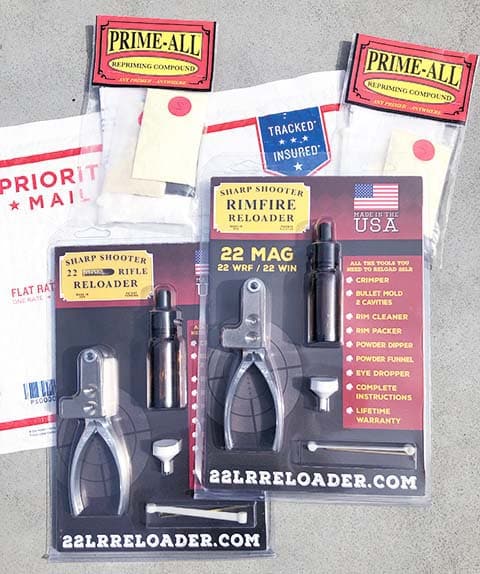
Sharp Shooter Ammunition LLC, offers two .22 rimfire reloading kits: 22LR and 22WMR; affordable and work as advertised.

Using this fulminated-base cap design as a crude cartridge meant the firing pin could strike the cap’s bottom outside face at any location to fire the cartridge. Since the cap’s base rim (flange) diameter was already small (6.9mm), with very thin metal across its center, Flobert designed a firing pin strike point to impact along the cap’s base rim where the metal was folded to create the flange. Striking this thicker rim area all but eliminated the likelihood of puncture that could vent combustion gas rearward towards the shooter. Thus, the rimfire cartridge was born. So now you know—it’s called “rimfire ammunition” because the gun’s firing pin strikes and crushes a small notch into the cartridge base’s rim to ignite the primer (fulminate), and that fires the cartridge.

These first Flobert .22 BB cartridges did not contain any propellant powder. The only propellant was the fulminate cast into the internal base of the BB cap. Although crude by today’s ammunition designs, the Flobert cartridge led to the elimination of muzzle loading and cap and ball firearms by combining a percussion cap (that later included a pre-mea-sured powder charge) and a bullet in a single, self-contained, easily loaded, weather-resis-tant cartridge.
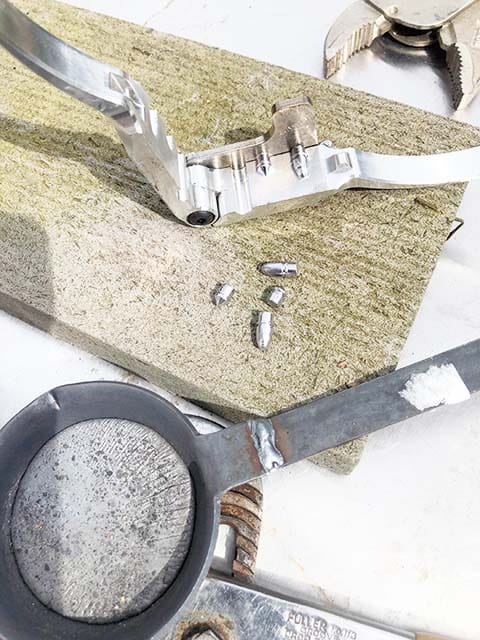
Sharp Shooter’s two-cavity mold is a precision mold requiring no mold release. Each pour produces a 25-grain solid point and a 38-grain, round nose bullet ready for loading.

Parlor Guns

Flobert made use of his new metallic cartridge ammunition in what he called “parlor guns.” These heavy barreled rifles and pistols, many with ornately engraved metal work and relief carved furniture (stocks and grips), were designed for in-home target shooting. In the mid-19th century it was fashionable for wealthy Europeans to have a dedicated shooting parlor or shooting gallery inside their homes. Flobert’s new ammunition fired by his parlor guns answered that market.

Prior to the 6mm Flobert cartridge, a typical “cartridge” consisted of a premeasured quantity of black powder wrapped together with a ball in a tightly rolled paper cylinder or small cylindrically shaped cloth bag, which also acted as wadding (gas check). This fragile cartridge was either breech-loaded or muzzle-loaded (depending on the firearm’s design) and ignited by a percussion cap that was separately attached to a cap nipple (touch hole). While far faster than muzzle loading individual components (powder, wad, ball), this delicate paper or cloth cartridge was neither weather-resistant, nor utilitarian.

In 1888, the .22 BB Cap that Flobert introduced in 1845 was improved and became the .22 CB (conical bullet) Cap. The .22 CB Cap was loaded with a lead-cast .22 caliber conical bullet instead of a ball. It also became slightly more powerful than its predecessor when a few grains of black powder were added inside the percussion cap cavity to boost bullet velocity from the BB’s 400ft/sec to CB’s 700ft/sec. Even so, both the BB and CB cartridges (still available today) are called 6mm Flobert and for all practical purposes are considered the same cartridge.

Unique to that point in history, Flobert designed a distinctive bullet shape for his cartridge using what is known as a “heeled” bullet design. This was necessary because the bullet and the cartridge case outside diameter are the same. Therefore, Flobert narrowed the bullet’s base to form a “heel” or “shoe-like” shape so it could be inserted into the cartridge case.

The Short and Long of It

Thus, rimfire ammunition got its start and continued to evolve. In 1857, Smith & Wesson developed the 22 Short for specific chambering in their newest revolver. The 22 Short used a lengthened CB rimfire cartridge case loaded with 4 grains of black powder that propelled a 29-grain, lead cast conical “heeled” bullet. This success in popularity and performance led to the 1871 debut of the 22 Long.

The 22 Long used the same 29-grain bullet as the 22 Short, but it employed a longer cartridge case that provided the needed space for 5 grains of black powder, which increased bullet velocity to near sonic speed. This was followed by the 22 Extra Long in 1880, which was designed primarily for use in bolt-action rifles. With a case longer than the 22 Long and a heavier 40-grain outside lubricated conical lead bullet, the Extra Long was loaded with 6 grains of black powder.

Building upon these many successes, the 22 Rimfire continued to morph. In 1887, U.S. arms manufacturer, J. Stevens Arms & Tool Company introduced today’s favorite 22 Long Rifle cartridge (22LR). Stevens brilliantly combined the casing of the 22 Long with the 40-grain bullet of the 22 Extra Long and loaded it with smokeless powder. This component marriage gave the 22LR a longer overall length, a higher muzzle velocity and superior performance for small game hunting, plinking and competition shooting. These enhancements also improved 22LR performance and popularity to the point its success doomed both the 22 Long and 22 Extra Long cartridges to obscurity.
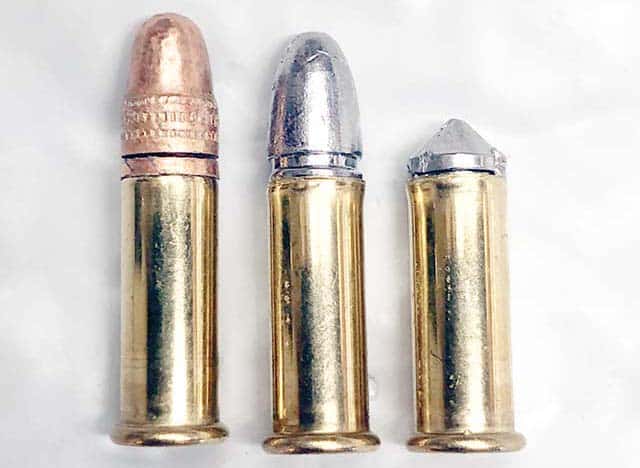
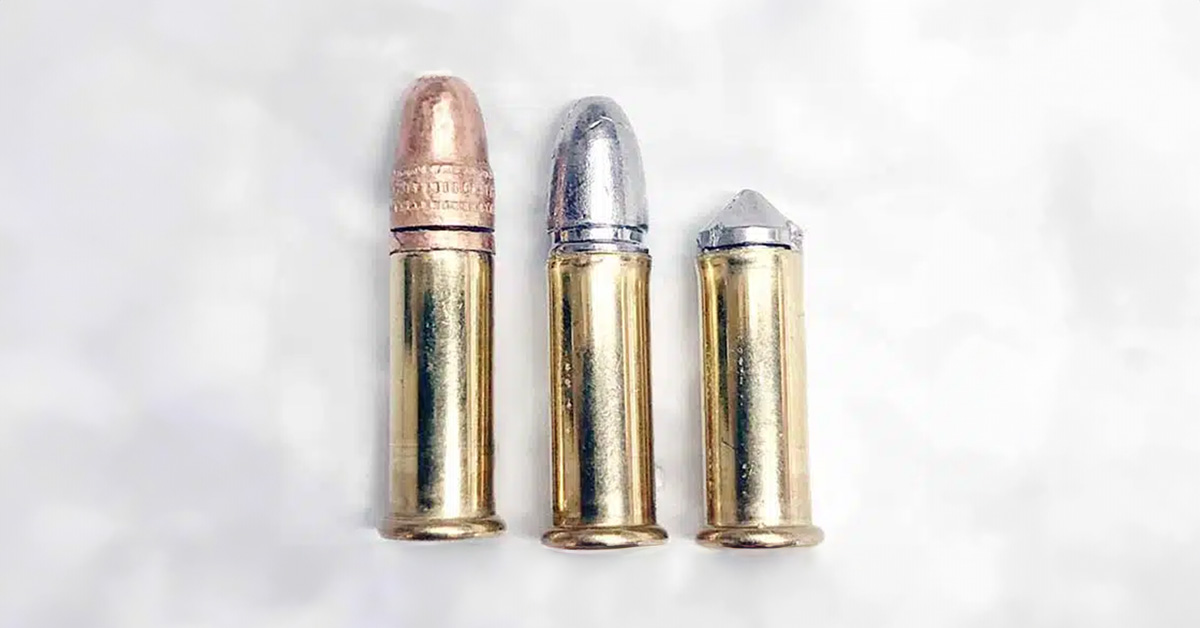
Left to right: Copper-plated 40-grain factory LR load, 38- grain LR reload, 25-grain LR reload.

22WRF Ammunition

In 1890, Winchester introduced its M1890 slide rifle (pump action) that fired Win-chester’s latest .22 rimfire ammunition improvement: the .22 Winchester Rimfire or 22WRF. This ammunition employed a slightly larger diameter cartridge case than the 22LR and a flat-base, flat-nose bullet, making it ideal for use in pump rifles with tubular magazines. The 22 WRF bullet also differed from its .22 rimfire predecessors’ outside-lubricated grooved bullets (used in the 22 Short, Long, LR and Extra Long) by using inside-lubricated bullets which protected the lubrication from dirt contamination. While demonstrably less accurate than the 22LR, it possessed a notable improvement in killing power.

But the 22 WRF met with obsolescence just prior to WWII as smokeless rifle propel-lants improved so significantly they replaced black powder and nitro-cellulose propellants. By loading this new, high-velocity, smokeless propellant in the 22 LR cartridge, its bullet velocity soared into the 1,300 to 1,500ft/sec range, trumping the 22WRF with increased power at a far cheaper cost per round.

From 22WRF to 22WMR

Winchester debuted the next major improvement in .22 rimfire ammunition in 1959 with their 22 Winchester Magnum Rifle ammunition or 22WMR. The WMR cartridge case is essentially a lengthened version of the older WRF cartridge case with a jacketed bullet. The WMR is offered in a range of 30- to 40-grain unlubricated jacketed (or plated) bullets. While comparable in bullet weight to the 22 Long Rifle, the WMR rounds fly faster, flatter and farther and carry far superior kinetic energy at all ranges. For example, WMR bullet velocities using a 30-grain bullet can easily exceed 2,300ft/sec and 1,875ft/sec using a heavier 40-grain bullet when fired from a rifle.

Because of the WMR’s larger case diameter and greater length, a 22WMR round will not chamber in a firearm chambered for any other .22 cartridge. However, the reverse is possible, and if fired, the resulting hot high-pressure gas venting around the smaller .22 cartridge case can be very dangerous to the shooter’s face and eyes.

Remarkably, in terms of ammunition quantity sold over the last 150 years, 22 Long Rifle far exceeds the popularity of any other commonly used ammunition on planet Earth. Some of the reasons are its low recoil, low cost (per round) and the large variety of rifles and handguns chambered to fire it. However, 22 LR ammunition has experienced sporadic availability issues over the past, resulting from the government’s tightening of firearms purchase and ownership regulations.
Those who experienced the threatening on again/off again times of firearms regulation—especially leading up to the 2006 through 2016 House, Senate and Presidential elections—may recall those times when store ammunition shelves were sold out, and ammunition hoarding became the norm. Today, .22 rim-fire ammunition is abundantly available, but that availability will again become threatened depending upon which political party is in power. Therefore, we should anticipate future ammunition shortages, at which time the political power changes hands. During such times, dating back to the early 1900s, reloading centerfire ammunition has always been a fallback to traverse ever-restrictive firearms and ammunition regulations. But today, reloading .22 rimfire brass has mostly been discounted as the impossible dream.
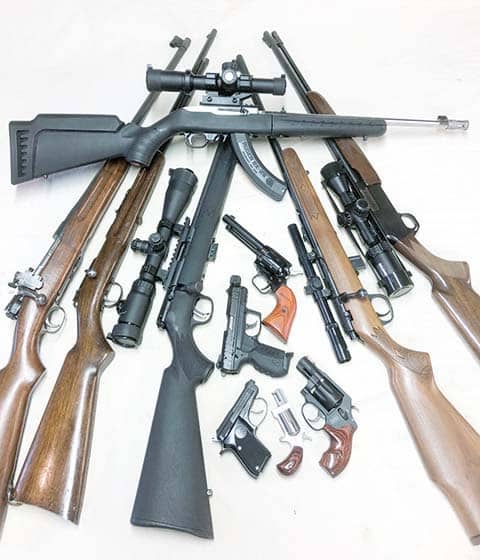
A few examples. .22 rimfire is the most widely chambered round in firearms history, and it far exceeds the popularity of any other commonly used ammunition in terms of sustained sales volume.

Sharp Shooter Ammunition LLC

Thanks to Brian Nixon, founder of Sharp Shooter Ammunition LLC, the .22 rimfire reloading story continues; and there is light at the end of the .22 rimfire reloading tunnel (and it’s not the approaching train). Not only is reloading .22 rimfire brass possible (including .22 WMR brass), it’s an easy process if you have the right stuff. Even better, the reloading equipment and components necessary are readily available and affordable should you desire to have the capability available when needed.

Everything needed to get started is available in kit form on the web at 22lrreloader.com/store. Sharp Shooter Ammunition LLC offers two .22 reloading kits, one for 22LR and one for 22WMR. Since LR and WMR use different outside diameter and length cartridge cases, you’ll need to buy the appropriate reloading kit depending upon what you intend to reload.

Sharp Shooter’s reloading kit provides the basic tools necessary to cast your own bullets and reload your spent .22 rimfire brass. Above all, Sharp Shooter has included a detailed instruction pamphlet. Written in plain English and laid out with descriptive close-up photos showing detailed cutaway views, this pamphlet contains everything you need to know to reload .22 rimfire ammunition using the Sharp Shooter kit.

A small, wire dual-purpose scraper/tamper tool is provided as part of the kit. This ingenuous tool serves as a scraper to remove the burnt priming compound residue from the case’s internal rim. The tamper end is designed to help work fresh (moistened) priming compound (fulminate) back into the cleaned cartridge case rim. The priming compound is moistened to make it insensitive to pressure and friction (more on that in a moment).

Manufacturers of .22 rimfire ammunition stuff a small quantity of priming compound into this petite space inside the cartridge case rim. It is this primer material that explodes and ignites the powder charge when the gun’s firing pin strikes the very edge of the case rim. The shot consumes all of the priming compound, and the firing pin strike leaves a characteristic compression dent in the base of the cartridge case rim.

Sharp Shooter additionally offers prim-ing compound ingredients consisting of four small bags of powders identified as, “L,” “L2” and two bags marked “S.” These powders are proportionally mixed per the guidance provided in the instruction manual using the kit’s measuring scoop. Once mixed, the light-gray-colored priming compound becomes pressure sensitive and must be respected in its handling. As a matter of safety, the primer compound should be desensitized by moistening before attempting to work it into the case’s internal rim. Desensitizing can be easily accomplished by using the kit-provided eyedropper to add a drop of acetone, denatured alcohol (even vodka will work) to the primer once it’s loaded into the case. Working moistened primer into the empty rim area is far safer and easier than using dry pressure sensitive primer. The down side of moistening the primer is that it must be completely dried out (at least overnight) before continuing the loading process. That said, the added margin of safety is worth the wait.

Using Sharp Shooter’s priming compound is both easy and reliable, but other priming compound, like Prime-All, is available from commercial sources. There are some priming compound homemade alternatives that can be realized by harvesting the powder contained in commonly available things, like strike anywhere match heads or the contents of party poppers you throw on the floor and pop when stepped on. Even powder contained in toy gun cup-type roll caps can be gently scraped off and collected for use as a primer. In all cases the primer should be moistened for loading safety.

As a side note, the question always seems to arise as to whether a reloaded rimfire round will reliably fire if the firing pin hits the same indent left from a previous firing. The answer is somewhat dubious. First, the firing pin dent can be knocked back out by using a small pin punch or flat blade screwdriver, but the casing can also be damaged in the process. Second, the odds that the firing pin will strike exactly the same location again are very long. Third, assuming one uses the same gun he used to fire the ammunition the first time with identical firing pin geometry, and should the firing pin precisely strike the exact same indent it left from the first firing, the odds are the round will still fire. That’s an acceptable gamble in most all scenarios except self-defense.

A small base funnel and a powder dipper are also provided in the kit. The small base funnel is used to charge the cases with primer and powder. The powder dipper has a small cup on either end that provides a precise powder measure with each dip. Weighing the powder charge is unnecessary if you use the powder dipper and follow the instruction book.

A pliers-like tool serves double duty as a two-cavity bullet mold and crimping tool. Two bullets can be made per cast; one is a 25-grain solid point, and the other is a 38-grain round nose. Sharp Shooter’s plier mold has a steel spur cutter engineered into the mold that flat cuts the bullet’s base. The bullets, themselves, have a lube groove cast into them for proper down-bore bullet lubrication. Bullet lubrication compound is commercially available, but alternatives like beeswax will work. Unlubed bullets are safe to use, but they will result in lead accumulation in the bore, necessitating frequent cleaning.

Resizing expended brass casing before reloading is a good idea but not necessary if the reloads are fired in the same gun. If the intention is to use the reloaded ammunition in several different guns, resizing is necessary. Sold separately, Sharp Shooter offers an inexpensive resizing die that fits any sin-gle-stage reloading press.

Casting your own bullets does not require using a casting furnace or buying lead. Almost any old iron pan or pot will work, and it can be heated using a propane blowtorch or other gas-type burner. Lead is available from numerous sources. Wheel weights, recovered lead shot or bullets can all be melted for bullet casting. Slag can be skimmed off using an old spoon. Preheating the mold prior to lead casting is important to flawless bullet casting. Be sure to extend the bullet mold’s handle length with a vice-grip or suitable locking pliers and wear gloves and eye protection. It’s also wise to do all lead melting and casting outdoors. Wearing a breathing mask is also a good idea.

Follow Directions

Make no mistake, reloading rimfire cartridges is a time-consuming process. Follow the provided instructions carefully. The most important step (before priming) is meticulously scraping the burned primer residue out of the inside rim of each cartridge case. That narrow little rim space must be clean so new primer can be worked into the rim.

Once the cartridge cases are primed and dried and bullets are cast, the next step is charging them with powder. Sharp Shooter’s instruction book provides suggested charge guidelines for several commonly available smokeless gunpowder brands, e.g., IMR, Hodgdon, Alliant Unique and Pyrodex P. Additionally, black powder can be effectively used.

The small powder funnel provided in the kit is used to charge each casing. The .22 bullets are inserted manually but need to be crimped using the bullet mold crimp-ing tool. The crimping notch is located forward of the two bullet cavities. At the conclusion of the described preceding process, the reloads are now complete and ready to shoot.

Is reloading .22 rimfire worth it? You be the judge. If history repeats itself, there will be future ammunition shortages. Having this inexpensive reloading capability in your hip pocket is insurance from tyranny. Sharp Shooter’s products work as advertised.

Author

  • Paul Evancoe
    Paul Evancoe

    View all posts
Tags: 2019AUGUST/SEPTEMBER 2019Paul EvancoeThe Venerable .22 Rimfire: Flobert’s Metallic Cartridge and How One Company Continues Its StoryV23N7
Previous Post

Fix It Sticks Introduces the Most Extensive AR Toolkit Available

Next Post

A Visit to Argentina’s Museo de Armas de la Nación

Next Post
A Visit to Argentina’s Museo de Armas de la Nación

A Visit to Argentina’s Museo de Armas de la Nación

TRENDING STORIES

  • The Alofs Reloading Magazine for Shotguns

    The Alofs Reloading Magazine for Shotguns

    0 shares
    Share 0 Tweet 0
  • The New Light and Handy Ruger American Generation II Ranch Rifle

    0 shares
    Share 0 Tweet 0
  • The Complete Guide To Colt M-16 Models: Part I

    0 shares
    Share 0 Tweet 0
  • True to Form: The Tisas 1911A1 ASF

    0 shares
    Share 0 Tweet 0
  • VALKYRIE ARMAMENT BELT-FED CONVERSION

    0 shares
    Share 0 Tweet 0

RECENT POSTS

SIG Sauer’s Full-Size Compact P365 “Fuse”

SIG Sauer’s Full-Size Compact P365 “Fuse”

June 27, 2024
The Importance of Offhand Shooting

The Importance of Offhand Shooting

June 25, 2024
BOOK REVIEW – The Collector’s Guide to the SKS

BOOK REVIEW – The Collector’s Guide to the SKS

June 20, 2024
True to Form: The Tisas 1911A1 ASF

True to Form: The Tisas 1911A1 ASF

June 18, 2024
Setting the Record Straight on the Fedorov Avtomat

Setting the Record Straight on the Fedorov Avtomat

June 6, 2024

QUICK LINKS

  • About Chipotle Publishing
  • About Small Arms Review
  • Advertise with Us
  • Write for Us

CONTACT DETAILS

  • Phone: +1 (702) 565-0746
  • E-mail: office@smallarmsreview.com
  • Web: www.chipotlepublishing.com
  • Chipotle Publishing, LLC 631 N. Stephanie St., No. 282, Henderson, NV 89014
Small Arms Review

FOLLOW US

  • Privacy Policy
  • Disclaimer

© 2022 Chipotle Publishing | All Rights Reserved

Welcome Back!

Login to your account below

Forgotten Password?

Retrieve your password

Please enter your username or email address to reset your password.

Log In

Add New Playlist

No Result
View All Result
  • Home
  • Articles
    • Guns & Parts
    • Suppressors
    • Optics & Thermals
    • Ammunition
    • Gear
    • News & Opinion
    • Columns
    • Museums & Factory Tours
    • ID Guides
    • Interviews
    • Event Coverage
    • Articles by Issue
      • Volume 1
      • Volume 2
      • Volume 3
      • Volume 4
      • Volume 5
      • Volume 6
      • Volume 7
      • Volume 8
      • Volume 9
      • Volume 10
      • Volume 11
      • Volume 12
      • Volume 13
      • Volume 14
      • Volume 15
      • Volume 16
      • Volume 17
      • Volume 18
      • Volume 19
      • Volume 20
      • Volume 21
      • Volume 22
      • Volume 23
      • Volume 24
  • The Archive
    • Search The Archive
  • Store
    • Books
    • Back Issues
    • Merchandise
  • Events
  • About
    • About Small Arms Review
    • About Chipotle Publishing
    • Contact Us
    • Other Publications
      • Small Arms Defense Journal

© 2022 Chipotle Publishing | All Rights Reserved

This website uses cookies. By continuing to use this website you are giving consent to cookies being used. Visit our Privacy and Cookie Policy.

Redirecting to External Website

You are leaving the Small Arms Review website and will be redirected to an external link in a 5 Seconds.
VISIT NOW!